
Academic Voices for a Sustainable Earth: The Second-Semester English Language Teaching Department Students Embark on Multisensory Learning Journey at Pasir Batang Forum
Kuningan, May 2, 2026 — The second installment of the Academic Voices for a Sustainable Earth seminar series unfolded at Pasir Batang, Kuningan, with profound resonance among participants (the second semester students) from UIN Siber Syekh Nurjati Cirebon’s English Language Teaching Department program, Faculty of Education, and International Office. Unlike conventional workshops, this forum was designed as a living curriculum, students engaged not through lectures alone, but through multisensory immersion in sacred geography, ritual memory, and oral epistemology. Lala Bumela Sudimantara, Ph.D., opened the day by reiterating that Pasir Batang is not merely a location but a “living text” where ecological ethics, linguistic structure, and cosmological order converge.
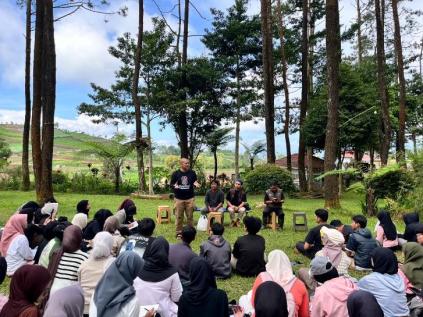
He emphasized that the forum directly extends the Sagarahiang Gathering of April 25, transforming field-based experience into academic praxis grounded in Reading for Emotion & Aesthetics and Multisensory CALL. Students, supported by fellow student staffs from the International Office, documented dialogues and mapped toponymic connections. This curricular continuity from Sagarahiang to Pasir Batang, exemplifies UIN SSC’s commitment to place-based ELT enhancement, where language learning becomes an act of cultural re-membering. The forum thus fulfilled its core mission which is to embed English literacy within the ethical and ecological grammar of Sundanese ancestral wisdom.
Central to the forum’s intellectual depth were two indigenous knowledge holders: Didin Mishbahuddin, S.Hum., archaeologist and cultural interpreter, and Mr. Sukad, Spiritual Elder and Guardian of Sagarahiang. Didin Mishbahuddin, S.Hum. unpacked Carita Pantun not as folklore but as a multilayered knowledge system, a dynamic architecture encoding agriculture (ngahuma), hydrology, social governance, and spiritual cosmology. He demonstrated how localized variants of Lutung Kasarung across Kuningan, Cirebon, and Ciamis reflect intentional adaptation, same narrative core, different toponyms and ecological contexts, all serving to root moral instruction in lived terrain.
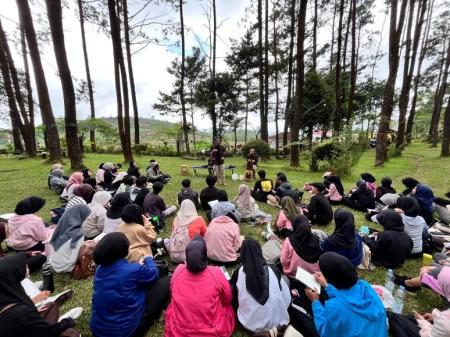
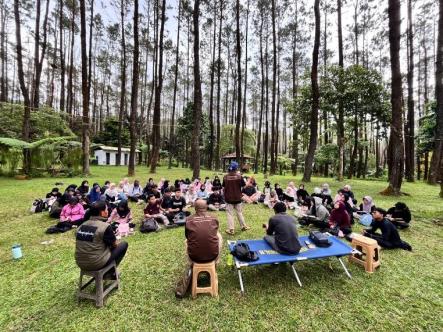
Mr. Sukad, meanwhile, translated abstract principles into actionable conservation logic, detailing the tripartite zoning (larangan, tutupan, baladahan) and its precise geomantic calculation, dividing mountain slopes by seven and multiplying by nine, a method still scientifically viable today. Both speakers rejected the notion of “preservation” in favor of activation, knowledge must be lived, performed, and recontextualized to remain vital. Their presence affirmed that curriculum development at UINSSC is no longer top-down, but co-designed with local epistemic authorities, a radical shift toward epistemic justice in higher education. Crucially, their insights were not presented as relics, but as living frameworks ready for integration into ELT syllabi, environmental policy modules, and community-engaged research.
The forum’s pedagogical core lay in embodied, multisensory activities that bridged theory and practice. Students participated in walking dialogues along forest trails, discussing ecological ethics while feeling the moss-covered stones and listening to the rhythm of flowing water, transforming grammar acquisition into relational intelligence. In sensory story circles, they handled natural and co-constructed micro-narratives in English, linking tactile sensation to lexical creativity and affective resonance. These exercises directly operationalized Lala Bumela Sudimantara, Ph.D. Regenerative ELT Materials, which fuse linguistic input, emotional response, and environmental stimulus to internalize knowledge beyond rote memorization. By grounding language in place, ritual, and sensory memory, the forum proved that decolonized ELT is not theoretical but something that is walkable, speakable, and deeply felt.
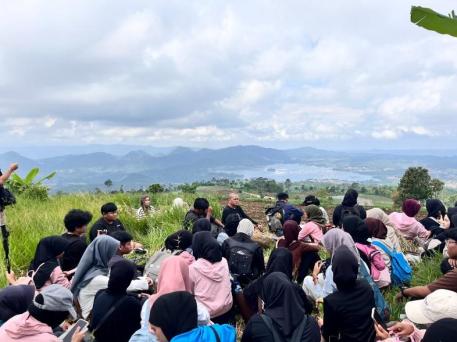
In closing, the gathering at Pasir Batang was not an end, but rather the beginning of a collective commitment to reviving a holistic way of learning. one that integrates mind, emotion, body, and space. Through the dialogue between Lala Bumela Sudimantara, Ph.D., Didin Mishbahuddin and Mr. Sukad, students were invited into the realm of rasa, experiencing how language, ecology, and spirituality intertwine within the living landscape of Sundanese society.
This experience serves as the foundation for developing an ELT (English Language Teaching) curriculum that is no longer severed from its cultural roots and ecological responsibilities. In doing so, UIN Siber Syekh Nurjati Cirebon does more than just teach English, it nurtures a generation of learners capable of speaking to the world without losing their identity, learners who realize that every word spoken must also resonate with the very earth beneath our feet.
Author: Resa Diah Gayatri