Advancing Indonesian Language and Cultural Diplomacy in Japan
Cirebon, August 07, 2026 – The session of the Seminar of the Education and Cultural Attachés and the Deputy Permanent Delegate of the Republic of Indonesia to UNESCO provided a focused examination of the development of Indonesian language learning and cultural activities in Japan, particularly in response to the growing presence of Indonesians and the expanding social, economic, and academic connections between the two countries. The session featured Amzul Rifin, the Education and Cultural Attaché of the Embassy of the Republic of Indonesia in Tokyo, who presented an overview of the landscape of Indonesian language education, the institutions supporting its development, and the various communities contributing to the promotion of Indonesian culture in Japan. According to the presentation, the number of Indonesian citizens residing in Japan reached 266,069 people as of December 2025, encompassing workers, trainees, and students distributed across different regions of the country. This growing Indonesian population has coincided with increasing Japanese interest in learning Bahasa Indonesia, while Japanese companies expanding their operations into Indonesia have increasingly equipped their employees with Indonesian language skills. Academic interest has also contributed to this development, with numerous Japanese researchers conducting studies in Indonesia. As the presentation states, “Dengan semakin banyaknya WNI di Jepang, ketertarikan masyarakat Jepang untuk belajar Bahasa Indonesia semakin meningkat pula”—a development that demonstrates how demographic mobility, economic expansion, and academic exchange can simultaneously create new spaces for Indonesian language diplomacy.

Despite these favourable conditions, the development of Indonesian language learning in Japan takes place within a diverse and decentralized educational landscape in which learning opportunities are distributed across different types of institutions. Bahasa Indonesia is offered through the Japan Indonesia Association (Japinda), universities, language institutions, and private learning arrangements, indicating that Indonesian language education does not depend on a single institutional structure. One particularly established initiative is the Kursus Orientasi Indonesia (KOI), offered by Japinda, an association of Japanese businesspeople conducting activities in Indonesia. Established in 1975, KOI provides Indonesian language courses ranging from beginner to advanced levels, reflecting the long-standing practical demand for Indonesian among Japanese professionals with connections to Indonesia. Within higher education, Indonesian language provision is likewise represented through several universities, including Kanda University of International Studies (KUIS), Tokyo University of Foreign Studies (TUFS), and Osaka University, while institutions such as Keio University and Sophia University also provide Indonesian language learning programs. The diversity of these pathways illustrates both the strength and complexity of Indonesia’s linguistic presence in Japan: Indonesian is learned not only for cultural interest, but also for professional, academic, and practical purposes.
The educational landscape is further strengthened by professional associations and scholarly communities that create spaces for sustained intellectual and pedagogical interaction. Among them is the Afiliasi Pengajar dan Pegiat Bahasa Indonesia bagi Penutur Asing (APPBIPA) Japan, established on 23 September 2017, which provides an organizational foundation for teachers and practitioners involved in Indonesian as a foreign language. Another important network is the Himpunan Peneliti Indonesia Seluruh Jepang (HPISJ), established in December 1969, which organizes annual academic seminars addressing diverse areas related to Indonesian language, culture, literature, history, humanities, and other fields. The presentation also highlights the contribution of Indonesianists, referring to foreign researchers and scholars who investigate, write about, or demonstrate strong intellectual interest in Indonesian culture, language, and history. Their contribution is particularly significant within university environments, where scholarly engagement can introduce Indonesian studies to new generations of Japanese students and researchers. The presentation explicitly notes that “Para Indonesianis ini berperan besar dalam pengenalan Bahasa Indonesia terutama di lingkungan kampus.” Their role therefore extends beyond individual research interests, as their academic activities contribute to sustaining institutional knowledge about Indonesia and creating an intellectual foundation for continued Indonesian language and cultural engagement in Japan.
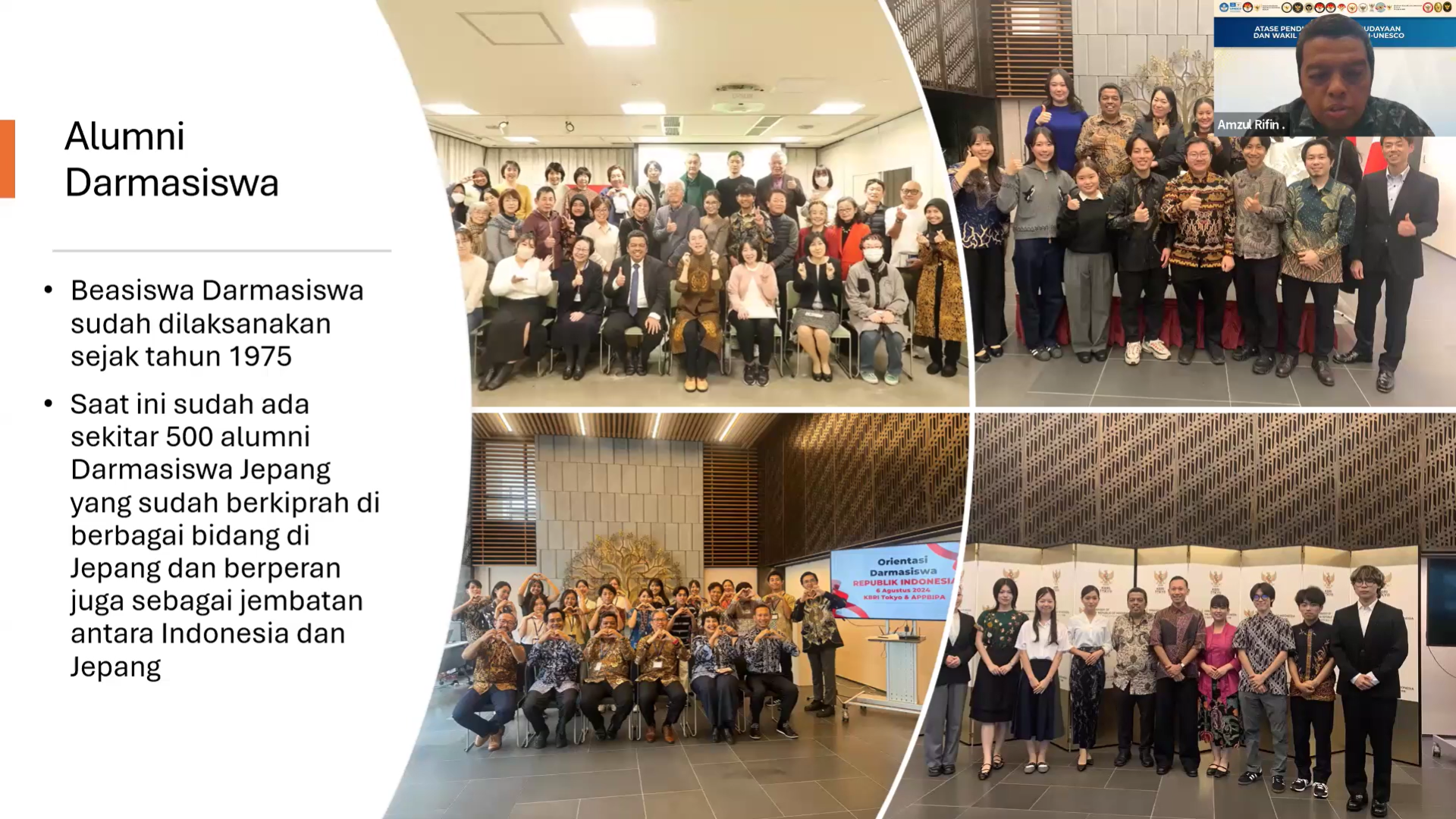
Beyond formal educational institutions and scholarly networks, Indonesian language and cultural diplomacy in Japan has developed through individuals whose experiences connect the two societies over extended periods. One important example is the Darmasiswa scholarship alumni network. The Darmasiswa scholarship has been implemented since 1975, and the presentation records approximately 500 Japanese alumni who have subsequently pursued professional activities across various fields in Japan. Their significance lies not merely in their status as former scholarship recipients, but in their potential to function as enduring cultural intermediaries between Indonesia and Japan. Having experienced Indonesian language, culture, and educational environments directly, these alumni possess forms of intercultural familiarity that can continue to influence their professional and social engagement after completing their studies. The presentation consequently identifies them as individuals who “berperan juga sebagai jembatan antara Indonesia dan Jepang.” This role demonstrates how the long-term impact of educational diplomacy may extend well beyond the duration of a formal program: scholarship recipients can become part of an enduring transnational network through which knowledge, cultural familiarity, professional relationships, and personal connections continue to circulate between the two countries.
These interconnected initiatives provide a broader framework for sustaining Indonesian cultural diplomacy through active participation from both institutional and community-based actors. Cultural activities in Japan are organized through several complementary channels, including programs conducted by KBRI Tokyo, Japanese communities, and Indonesian communities, including PPI. This distribution of responsibility demonstrates that cultural diplomacy does not operate exclusively through diplomatic missions; it is also sustained by communities that voluntarily create spaces for cultural exchange and public engagement. The Indonesia Festival, highlighted in the presentation, represents one manifestation of this broader cultural presence, providing a platform through which Indonesian culture can be introduced to Japanese audiences. Such activities complement language education by giving learners and wider communities opportunities to encounter Indonesia through cultural experiences rather than through linguistic instruction alone. In this sense, language and culture operate reciprocally: language learning can stimulate interest in Indonesian society, while cultural activities can provide the contextual experiences that make language learning more meaningful. The development of these interconnected networks consequently offers a practical foundation for strengthening Indonesia’s visibility and engagement within Japanese society.
The presentation delivered through the Seminar of the Education and Cultural Attachés and the Deputy Permanent Delegate of the Republic of Indonesia to UNESCO demonstrates that Indonesia’s educational and cultural diplomacy in Japan is sustained through a complex network of institutions, educators, researchers, businesses, scholarship alumni, Indonesian communities, and Japanese citizens with an interest in Indonesia. The experience of Japan illustrates that effective cultural diplomacy does not depend solely upon formal diplomatic initiatives, but develops through relationships that continue across classrooms, universities, professional environments, research communities, scholarship networks, and cultural gatherings. The growing Indonesian population, the demand for Indonesian language skills among Japanese companies, the activities of universities and language institutions, the contributions of Indonesianists and scholarly associations, and the continuing role of Darmasiswa alumni collectively demonstrate how people themselves become essential agents of international connection. Within the broader context of the seminar, the presentation by Amzul Rifin therefore reinforces the responsibility of Education and Cultural Attachés and the Deputy Permanent Delegate to UNESCO to facilitate environments in which Indonesian education, language, and culture can generate lasting international relationships. More fundamentally, the Japanese experience suggests that cultural diplomacy reaches its greatest significance when it ceases to be merely the presentation of a national identity and becomes an ongoing process of mutual learning, participation, and human connection between Indonesia and the wider world.