
ASEAN Siblinghood and Shared Linguistic Roots: Evaluating the Efficacy of Grassroots Educational Outreach and University Partnerships in Advancing Indonesian Soft Power Diplomacy in Thailand.
Cirebon, August 05, 2026 – The Wednesday session of the Seminar of the Education and Cultural Attachés and the Deputy Permanent Delegate of the Republic of Indonesia to UNESCO provided a comprehensive analysis of Indonesian cultural diplomacy in Thailand. This extensive virtual event, centered on the development of Indonesian language and culture abroad, featured Dr. Cyti Daniela Aruan, the Education and Cultural Attaché of the Indonesian Embassy in Bangkok. She framed Thailand not merely as a neighboring state but as a sibling nation and a fellow founder of ASEAN, highlighting seventy-six years of uninterrupted diplomatic harmony. The recent state visit by the Thai Prime Minister to Indonesia, the first in fifteen years, further underscores the revitalization of this strategic bilateral relationship. The session ultimately revealed how deep-rooted cultural affinities can be systematically translated into concrete educational collaborations between Indonesian and Thai institutions.
The diplomatic closeness between the two nations is deeply anchored in shared linguistic and cultural heritage derived from ancient Sanskrit roots. Everyday terms such as language, teacher, and human possess striking phonetic similarities in both Indonesian and Thai, facilitating a natural cognitive bridge for language learners. Folkloric narratives like the Ramayana and the Panji tales traverse both borders, while royal exchanges have historically enriched mutual artistic traditions through batik and musical instruments.
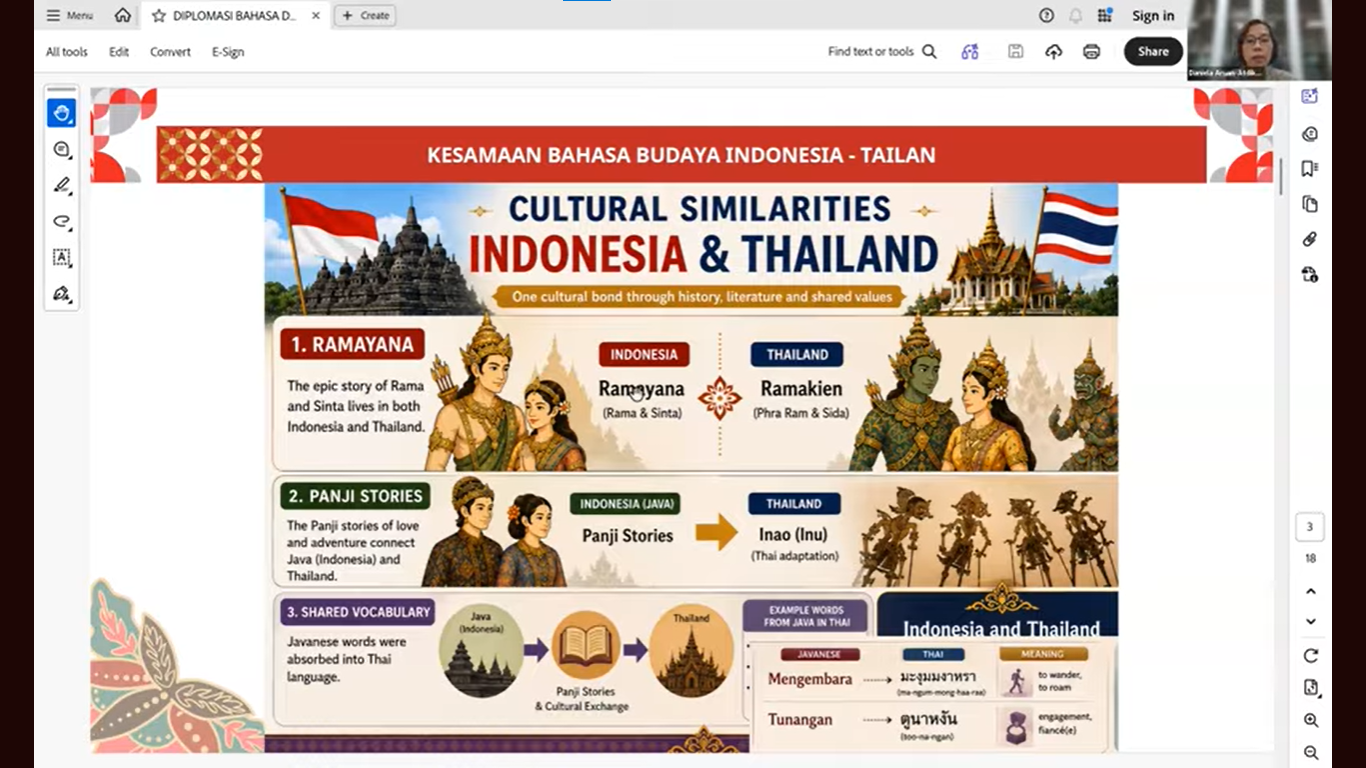
In Thai academic circles, the Indonesian angklung is affectionately known as angkalung, and several universities actively maintain gamelan ensembles in collaboration with Indonesian art institutes. Furthermore, the southern region of Thailand shares a linguistic proximity with Indonesia due to the widespread use of Malay, creating an organic corridor for educational outreach. These shared historical and linguistic markers significantly lower the affective filter for Thai students approaching the Indonesian language.
Capitalizing on these cultural affinities, the Indonesian language program in Thailand has experienced exponential growth, earning recognition as one of the top ten most enthusiastic learning nations globally. The transition to hybrid learning models has significantly expanded access, allowing a single virtual class to accommodate approximately one hundred participants simultaneously. Beyond the embassy, Indonesian language subjects are now formally integrated into the curricula of ten prominent Thai universities, spanning from Fatoni University in the south to Chiang Mai University in the north
The attaché office is currently exploring strategic partnerships with Indonesian universities to supply specialized instructors who possess a foundational understanding of the Thai language. This pedagogical adjustment ensures that linguistic nuances are effectively communicated, thereby accelerating the proficiency and confidence of Thai learners in professional contexts. For instance, local professionals in the garment industry have reported that mastering Indonesian directly facilitates smoother negotiations and stronger business ties with Indonesian counterparts.
To cultivate early academic interest, the attaché office executes a monthly Bahasa Indonesia Goes to School program in coordination with the Thai Ministry of Education. These interactive sessions combine basic language instruction with traditional music and culinary tasting, frequently exceeding initial participation targets due to immense student enthusiasm. At the tertiary level, Indonesian Day celebrations at institutions like Thammasat University and Mae Fah Luang University transform campuses into vibrant hubs of bilateral cultural exchange.

Large-scale diplomatic events, such as the Indonesian Cultural Night, deliberately feature Thai artistic performances alongside Indonesian arts to emphasize a philosophy of mutual respect rather than unilateral promotion. Collaborative projects in fine arts and fashion, including the integration of Indonesian batik with Thai silk by vocational students in Roi Et, further demonstrate the practical economic potential of this cultural diplomacy. Such grassroots and institutional initiatives collectively ensure that Indonesian culture is perceived as an accessible and valuable asset within Thai society.
Despite the strong bilateral relations, executing joint programs in Thailand requires strict adherence to local administrative rhythms and long-term strategic planning. Thai educational institutions generally resist expedited timelines, necessitating a deliberate and patient approach from Indonesian partners to ensure successful implementation. Addressing this operational reality, Ms. Daniela stated directly, "We need to prepare the planning at least three or four months in advance, because when they collaborate they do it with total commitment."
Additionally, a significant tourism imbalance persists, as hundreds of thousands of Indonesians visit Thailand annually while Thai arrivals to Indonesia remain comparatively low. Overcoming these logistical and promotional asymmetries demands that Indonesian campuses offer highly structured, mutually beneficial proposals rather than ad-hoc cultural demonstrations. A shortage of BIPA instructors who are fluent in Thai also presents a structural bottleneck that requires systematic intervention from Indonesian teacher-training universities.
For Indonesian higher education institutions, Thailand presents a highly structured landscape for internationalization, student mobility, and joint research initiatives. The annual Afiliasi BIPA conference, scheduled for December at Walailak University, offers an excellent academic forum for lecturers to disseminate research and build institutional networks. Furthermore, the upcoming education expo in Songkhla provides a strategic entry point for recruiting students from the linguistically compatible southern provinces. Indonesian universities can also position themselves as premier host institutions for the KNB scholarship, attracting Thai students interested in religious and regional studies.