
AsiaCALL 2025 Pre-Conference Opens the Gate to “Alternative Intelligence”: Where Machines Learn from Humanity, and Humanity Learns Through the Art of Theory and Emotion
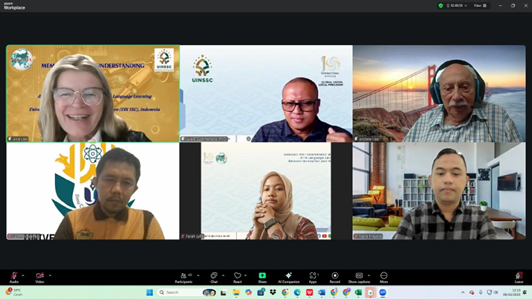
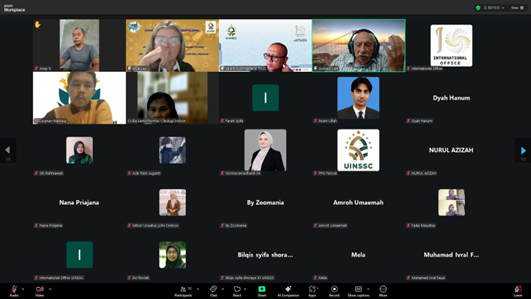
Cirebon, October, 9th 2025 — The AsiaCALL 2025 Pre-Conference, hosted by the International Office and Partnership of UIN Siber Syekh Nurjati Cirebon, successfully unfolded in an online format with broad international participation. The event, titled “AI in Language Education: Between Innovation and Integrity,” brought together leading scholars, educators, and students from across continents in an inspiring academic exchange. Lala Bumela, Ph.D., Director of the International Office, extended invitations to students, teachers, and English language lecturers to join this workshop featuring Prof. Andrew Lian, Ph.D. (President of AsiaCALL 2025) and Dr. Ania Lian, Ph.D. (Vice President of AsiaCALL 2025). The session attracted 55 participants from countries including Indonesia, China, Vietnam, Nigeria, Thailand, and Australia, marking a new milestone in global engagement for UIN SSC. Among the participants was Luqman Baehaqi, Ph.D. from IAIN Palangkaraya, who also shared educational insights from his institution. The event’s success was further supported by the Global Engagement Team (GET) — consisting of students and young professionals from the International Office who coordinated technical, academic, and digital operations. The workshop featured an in-depth discussion on theoretical and ethical dimensions of Artificial Intelligence in education. “We are witnessing a historical shift,” Lala Bumela remarked, “where machines learn from human values, and humans rediscover their intellectual depth through the language of theory, emotion, and responsibility.”
In an era where Artificial Intelligence rapidly expands into all dimensions of life, concerns about its potential to replace human intellect have become widespread. Prof. Andrew Lian opened his session by drawing a striking historical analogy. He compared the current panic surrounding AI to the fear that accompanied the birth of the automobile in the late 19th century. Back then, cars were viewed as deadly inventions, so much so that a person had to walk in front of each vehicle waving a red flag as a safety measure. “What we are experiencing today,” Andrew Lian explained, “is not fear of machines, but fear of the unknown — the same fear humanity felt every time innovation outpaced regulation.” He elaborated that AI is often misunderstood as a destructive force, when in fact it holds the potential to amplify human creativity and redefine how we understand learning itself. The unease surrounding AI, he argued, reflects not the threat of technology but the inertia of outdated educational systems reluctant to evolve.
Building upon this perspective, Andrew Lian proposed a conceptual shift: reframing Artificial Intelligence as Alternative Intelligence. In his view, education must move beyond viewing machines as replacements and instead embrace them as partners in human thought. “AI should not be seen as a rival mind,” he noted, “but as a collaborator — one that challenges us to think better, deeper, and with more awareness of our emotional dimensions.” He encouraged universities to abandon the notion that knowledge must reside solely in human memory. For centuries, humans have relied on external memory — books, scribes, archives, and now digital databases. AI, he said, is simply the next iteration of that tradition. In a groundbreaking moment, Lian even asked ChatGPT to critique his own theoretical model, Lian-Constructivism. The AI responded by revealing an emotional dimension within the framework that Lian himself had not recognized. From that discovery, he concluded that education should move away from rote memorization toward valuing original thought and human-machine collaboration. His insight sparked active engagement among participants, who reflected on how this redefinition could reshape curriculum design in English language education.
The discussion evolved into a deeper exploration of how AI transforms research and pedagogy. Andrew Lian emphasized that AI has begun to dissolve the boundary between quantitative and qualitative research. Previously, close reading could only be performed on small data sets, while statistics dominated large-scale analysis. Now, AI can process and interpret thousands of interviews or student essays in minutes, producing what Lian called “precision interventions.” These are adaptive teaching models that continuously adjust based on data feedback, enabling real-time pedagogical improvement without waiting for the next academic term. Dr. Ania Lian expanded on this concept by stressing that AI, no matter how advanced, cannot create innovation without a strong theoretical foundation. She illustrated this through her postgraduate course on dyslexia, where students must first build a multidisciplinary conceptual framework — integrating linguistics, neuroscience, semiotics, and educational policy — before using AI tools to analyze or refine their work. “AI without theory,” Dr. Ania Lian cautioned, “is just a heap of raw data — it speaks, but it does not understand.” She then introduced her Reading-for-Emotion model, inspired by Bakhtin’s dialogism and Ramachandran & Hirstein’s neuroaesthetics, explaining that every text follows an emotional arc of six stages: Focus, Disturbance, Dialogue, Development, Resolution, and Moral. By understanding this emotional structure, students learn to read and write with greater depth and empathy. As she demonstrated through a reinterpretation of Van Gogh’s “Café Terrace at Night” as a short story, Ania urged teachers to teach AI how to think through theory, rather than what to think through content.
Both professors converged on a profound conclusion: cognition and emotion are inseparable. Human memory, they argued, is bound by feeling — much like Proust’s recollection of his childhood triggered by the scent of a madeleine cake. Education that divorces emotion from cognition, Lian warned, risks becoming a form of epistemic violence — a system that erases the learner’s humanity. In this light, AI should not be seen as an emotional vacuum, but as a mirror that reflects the depth of human creativity. When AI assists teachers in moderating tone, improving politeness strategies, or supporting students with dyslexia, it is not replacing emotion but expanding the teacher’s capacity to nurture it. This marks a paradigm shift in which technology becomes a humanizing instrument, not a mechanizing one. AsiaCALL’s pre-conference successfully illustrated how alternative intelligence can guide language education toward empathy, precision, and inclusivity.
During the Q&A session, participants raised a pressing concern: Could AI ultimately dehumanize learning? Andrew Lian responded thoughtfully, clarifying that the true value of AI lies not in whether it “has emotions,” but in whether it “enables humans to think and learn more profoundly.” AI, he said, carries no epistemology of its own — its purpose depends entirely on the learning theory guiding its use. “If our learning theory values dialogue and meaning,” he asserted, “then AI must be used to open dialogues, not to close them.” The session concluded with three key takeaways: (1) Build a strong conceptual framework before using AI; (2) Design assessments that evaluate originality and oral reasoning; and (3) Anchor every learning task in emotional engagement. These principles, according to Lala Bumela, encapsulate UIN SSC’s educational vision: “We believe that alternative intelligence will not replace human wisdom — it will extend it. Through theory, emotion, and awareness, we are building not just smart learners, but conscious thinkers.” His closing words reflected the moral core of the event — that the dialogue between machines and humanity is not a competition, but a collaboration shaping the next chapter of education itself.

Author: Muhammad Azkiya Bahtsulkhoir