
AsiaCALL 2025 Symposium Honours Dr. Ania Lian, Ph.D.’s Visionary Framework, Recasting AI as a Tool for Cultivating Human Discernment and Insight in the Spirit of King Solomon’s Wisdom
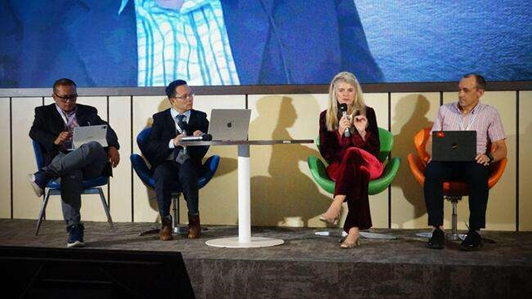
Cirebon, November, 16th 2025 — UIN Siber Syekh Nurjati Cirebon shone as an academic lighthouse when the AsiaCALL International Conference 2025 hosted the highly anticipated symposium “AI in Language Education: Opportunities, Challenges, and Future Directions.” The event drew a vibrant international audience—researchers, practitioners, and emerging scholars—filling the auditorium with intellectual energy and global perspectives. Distinguished academic figures enriched the atmosphere, among them Prof. Andrew Lian, Ph.D. (Suranaree University of Technology, Thailand & The University of Canberra, Australia / President of AsiaCALL 2025), Assoc. Prof. Dr. Pham Vu Phi Ho, Ph.D. (Industrial University of Ho Chi Minh City, Vietnam), Ania Lian, Ph.D. (Charles Darwin University, Australia), Prof. Jeremy White, Ph.D. (Ritsumeikan University, Japan), and Lala Bumela Sudimantara, Ph.D. (UIN Siber Syekh Nurjati Cirebon). Yet among the constellation of voices, Dr. Ania Lian captured the intellectual spotlight, offering a transformative and deeply philosophical perspective that reshaped the flow of discussion. Rather than positioning AI as merely a tool for automation or efficiency, she encouraged participants to reimagine AI as a partner in strengthening human discernment—redirecting the audience toward a richer conversation centered on wisdom, ethical awareness, and the evolution of human-centered learning within language education.
Dr. Lian acknowledged that despite rapid technological innovation, contemporary language education remains heavily centered on rigid forms—grammar structures, standardized genres, and uniform outputs—which often limit learners’ ability to think critically and creatively. She argued that such conventional approaches risk producing students who can replicate answers but cannot meaningfully interpret the world around them. This tension between traditional teaching frameworks and the dynamic complexity of AI-driven environments presents a critical challenge for educators who must now rethink what learning is truly intended to achieve.
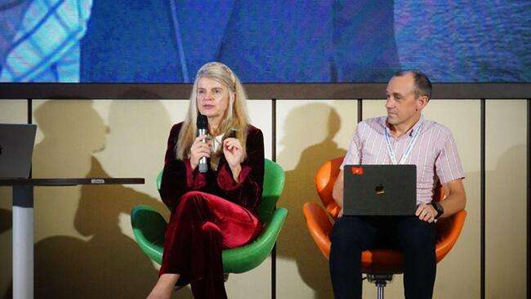
In expressing this paradigm shift, Dr. Lian referred to the biblical parable of King Solomon, who asked not for wealth or power but for the wisdom to discern. She emphasized that discernment—the ability to notice complexity, evaluate perspectives, and create powerful solutions—is increasingly the most valuable competence in modern society. “Learning is about developing the capacity to discern,” she stated, underscoring that AI’s greatest contribution lies not in producing answers, but in supporting students as they refine their insight and judgment. This philosophical approach enriched the dialogue with a deeper reflection on the purpose of education beyond technical efficiency.
Dr. Lian explained that AI can serve as a powerful augmentation to human cognition when integrated responsibly. Rather than replacing human expertise, AI should be designed to enhance interactive systems where students are guided, challenged, and empowered to articulate ideas with increasing clarity and sophistication. She described AI as a catalyst for evolving intellectual power through iterative engagement, enabling learners to explore diverse dimensions of knowledge rather than simply practicing mechanical correctness.
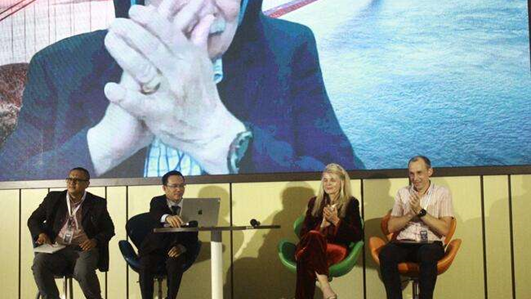
Reflecting on her own academic journey, Dr. Lian acknowledged that her understanding of learning evolved through years of listening, collaborating, and being shaped by academic leaders such as Prof. Andrew Lian. She emphasized that meaningful growth emerges from humility, openness, and willingness to transcend rigid boundaries. This personal testimony amplified her message that education must evolve alongside technology—not through replication, but through transformation rooted in human depth and ethical purpose.
The dialogue closed with a compelling reminder that AI in education must be a partnership grounded in wisdom. Dr. Lian asserted that the future belongs not to institutions that adopt technology fastest, but to those that build systems enabling students to develop discernment as a lifelong competence. Her perspective reinforced a powerful moral lesson: innovation without insight is empty, but when aligned with wisdom, AI becomes a tool for shaping a more thoughtful, just, and creative global society.
Author: Muhammad Azkiya Bahtsulkhoir