
AsiaCALL International Conference 2025 Confronts the Silence Behind the Screen: Assoc. Prof. Dr. Pham Vu Phi Ho Reclaims Academic Writing as an Act of Moral Courage in the Age of Artificial Authorship
Cirebon, November 16, 2025 –— The AsiaCALL International Conference 2025 at UIN Siber Syekh Nurjati Cirebon featured a critical intervention by Assoc. Prof. Dr. Pham Vu Phi Ho, Ph.D., Vice President for Administrative Affairs and Publication of AsiaCALL and scholar at Industrial University of Ho Chi Minh City, Vietnam, addressing “Between Innovation and Integrity: Postgraduate Students' Use of AI Tools in Academic Writing.” The The Auditorium of Cyber Building convened Ania Lian, Ph.D. (Vice President of AsiaCALL/Charles Darwin University, Australia), Prof. Dr. Jeremy White (Vice President for International Relations, AsiaCALL/Ritsumeikan University, Japan), Lala Bumela Sudimantara, Ph.D. (Director of International Office and Conference President, UIN SSC), Wulan Rahmatunnisa, M.Pd. (Universitas Kuningan), Wakhid Nashruddin, Ph.D., Listiani Ekawati, M.Hum (UINSSC), and Hakim Ventura International delegates Aries Endri Susanto, S.T., M.E., Eka Destarada Sesunan, S.E., and Nur’aeni, S.E., M.E., with Prof. Dr. Andrew Lian, Ph.D. (President of AsiaCALL/Suranaree University of Technology, Thailand) and Luqman Baehaqi, Ph.D. (UIN Palangka Raya) participating online via coordination by International Office team: Ivo Dinasta Yanuar, S.S., M.Appling., Ghina Amaliyah Sholihah, S.Sos., and Global Engagement Team (IO’s Student Staff). Prof. Ho opened with a provocative challenge to global academia: “If your thesis is written entirely by AI, should the degree be awarded to you or to the AI?” His session confronted the erosion of scholarly trust caused by unverified AI outputs, positioning UIN SSC as the ethical compass for AI integration in higher education. He documented how EFL postgraduates increasingly default to ChatGPT for critical writing tasks while institutional safeguards lag dangerously behind. This tension between technological convenience and intellectual authenticity defines academia’s most urgent crisis. The presentation established that writing transcends private expression, it is a covenant of truth between scholars and society.
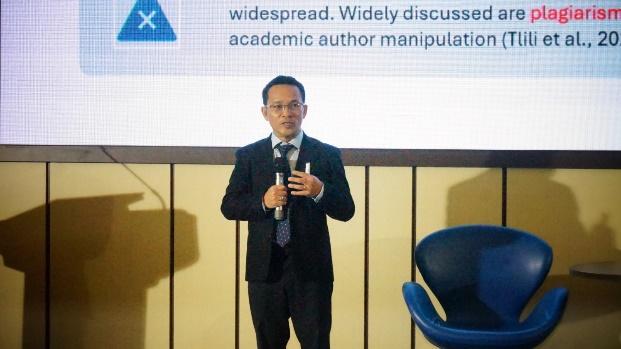
Prof. Ho methodically dismantled the misconception that writing serves only personal expression, emphasizing its fundamental role as communal communication demanding honesty and accountability. He revealed alarming trends where academic works are increasingly presumed AI-generated, corroding trust in student scholarship across Southeast Asian institutions. His research showed students who uncritically accept AI outputs produce shallow analyses devoid of authentic voice, mistaking syntactic fluency for intellectual depth. Crucially, he stressed that responsibility requires validating every fact, reference, and argument, transforming writing from transactional output into ethical practice. Educators worldwide echoed his observation that supervisors lack time to verify every citation, placing the burden squarely on students’ shoulders. This framework positions academic integrity not as bureaucratic compliance but as moral obligation to readers who depend on scholarly truth. His arguments resonated deeply with Indonesian faculty confronting similar classroom challenges in faith-based education contexts.
The session’s most sobering segment exposed AI’s capacity for fabrication through a documented case study. Prof. Ho recounted grading a seemingly exemplary student paper that later revealed twelve fabricated references, non-existent articles, incorrect authors, invalid DOIs, forcing journal rejection despite flawless structure. He emphasized that such errors damage not only students’ credibility but supervisors’ professional reputations, creating systemic risks for academic ecosystems. This phenomenon, he noted, stems from AI’s hallucination tendencies when generating citations without human verification, particularly under deadline pressure. Prof. Ho condemned institutional policies that fail to teach source validation as core research methodology, arguing that technology without critical literacy produces dangerous scholarship.
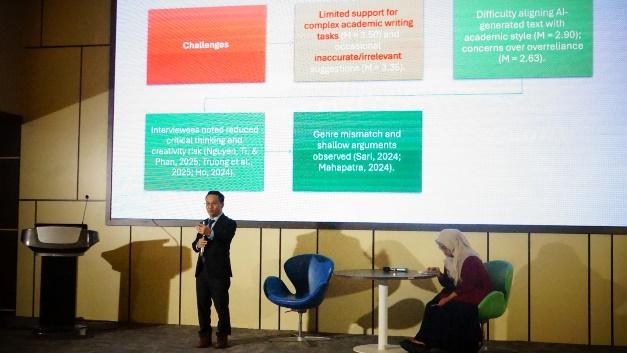
Prof. Ho reframed AI as a scaffold for learning rather than a replacement for intellectual labor, demonstrating how tools like Grammarly can ethically enhance vocabulary development and syntactic clarity when used as drafting aids. He cautioned against outsourcing core scholarly functions, literature synthesis, argument construction, and critical analysis, to algorithms lacking human judgment. His framework requires students to master subject matter first, then deploy AI for refinement under faculty guidance, ensuring technology amplifies rather than erodes expertise. For EFL learners, he advocated structured workflows where AI assists with language mechanics only after conceptual frameworks are human-developed. This approach builds digital literacy while preserving academic voice, transforming dependency into deliberate tool selection. Indonesian educators documented his phased adoption model for immediate curriculum integration, recognizing its alignment with UINSSC’s humanistic values. The session affirmed that true innovation lies in balancing technological efficiency with irreplaceable human cognition.
Addressing institutional responsibility, Prof. Ho proposed mandatory AI literacy modules integrated into research methodology courses across disciplines. His framework includes discipline-specific usage thresholds, permitting AI for grammar checks in literature reviews but prohibiting it for theoretical frameworks, and transparent disclosure requirements for AI-assisted work. Crucially, he advocated co-creating policies with students to ensure practical relevance, moving beyond top-down restrictions that ignore classroom realities. Prof. Ho ’s model positions universities not as enforcers but as mentors guiding students through nuanced decision-making, where every citation verified and every argument human-crafted becomes an act of scholarly citizenship. This vision transforms policy from constraint into cultivation of academic virtue.
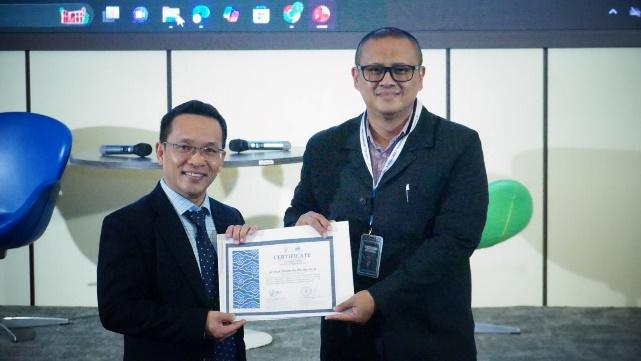
Concluding the session, Prof. Ho positioned ethical AI integration as higher education’s defining challenge of the decade, urging institutions to protect scholarly integrity while embracing technology’s democratizing potential. UIN Siber Syekh Nurjati Cirebon had not merely hosted a lecture, it had ignited a global movement to preserve humanity in the machine age. Tomorrow’s closing ceremony would formalize partnerships, but today’s ethical blueprint had already reshaped academia’s future, proving Cirebon’s wisdom is not just local heritage but global necessity.
Authors: Resa Diah Gayatri, Salsabilla, and Lily