
AsiaCALL International Conference 2025 Gathered the World’s Conscience: UIN Siber Syekh Nurjati Cirebon Hosted the Symposium that Changed the World’s Understanding of Language, AI, and the Human Soul
Cirebon, November 16, 2025 – UIN Siber Syekh Nurjati Cirebon resonated with scholarly intensity during the AsiaCALL International Conference 2025 symposium “AI in Language Education: Opportunities, Challenges, and Future Directions.” The session convened global thought leaders: Assoc. Prof. Dr. Pham Vu Phi Ho, Ph.D. (Chair/Vice President for Administrative Affairs and Publication, AsiaCALL/Industrial University of Ho Chi Minh City, Vietnam), Professor Dr. Andrew Lian, Ph.D. (President of AsiaCALL/Suranaree University of Technology, Thailand and University of Canberra, Australia), Ania Lian, Ph.D. (Vice President of AsiaCALL/Charles Darwin University, Australia), Prof. Dr. Jeremy White (Vice President for International Relations, AsiaCALL/Ritsumeikan University, Japan), and Lala Bumela Sudimantara, Ph.D. (Director of International Office and Conference President, UIN SSC). Assoc. Prof. Dr. Pham Vu Phi Ho opened by framing AI’s transformative potential alongside urgent questions about pedagogy, ethics, and equity. Attendees from fourteen nations filled the auditorium, reflecting AsiaCALL’s growing influence under Indonesian stewardship. This gathering positioned UINSSC as a global convener of human-centered technological discourse. The symposium’s timing underscored Cirebon’s emergence as a crucible for reimagining language education’s future through indigenous wisdom and technological innovation.
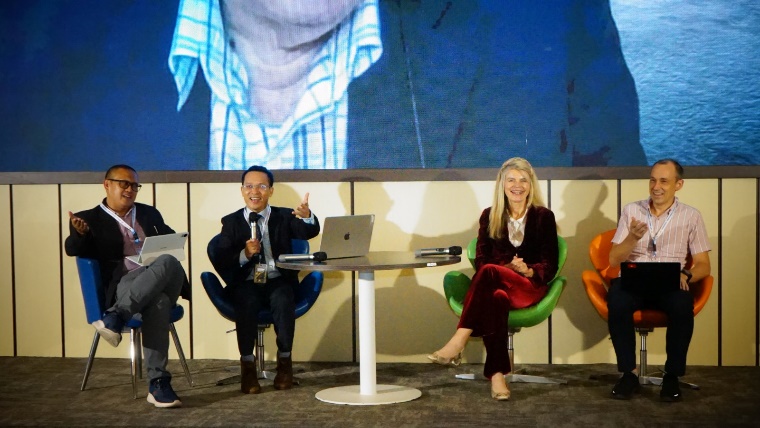
Assoc. Prof. Dr. Pham Vu Phi Ho initiated the dialogue with his first question to Professor Dr. Andrew Lian: “You have worked with technology in language education for many years. How do you see today’s AI developments in relation to earlier forms of CALL? What is genuinely new and what is a continuation of older ideas?” Prof. Andrew Lian distinguished between recycled methodologies and genuine innovation, noting AI chatbots now fulfill decades-old aspirations for conversational language partners. He emphasized functional comprehension, AI’s ability to process language for practical communication, as a breakthrough surpassing rigid feedback systems of earlier CALL eras. Prof. Andrew Lian critiqued academia’s fixation on academic writing, recalling medieval traditions where such texts were often disposable exercises. He warned that current Learning Management Systems will transform as they fail to harness AI’s adaptive potential. Crucially, he stressed that meaningful integration requires careful connection between learners and systems, not unsupervised chatbot interactions. His historical perspective grounded innovation in scholarly continuity rather than disruption, positioning AI as an extension of human capacity when guided by pedagogical vision. Indonesian faculty members documented his insights for immediate curriculum applications.
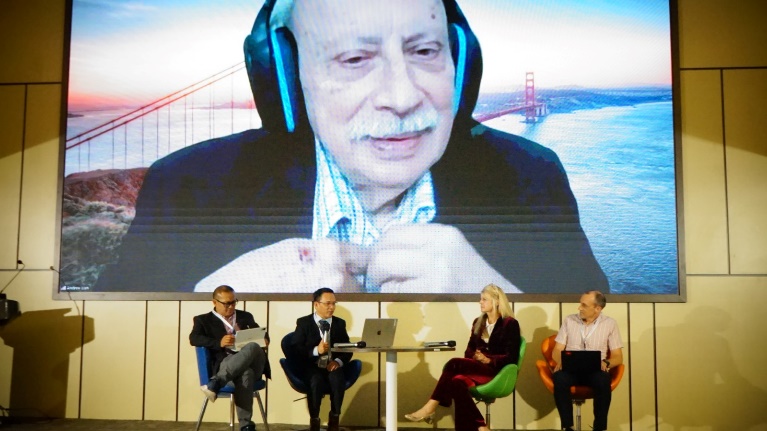
Prof. Ho’s second question directed to Ania Lian, Ph.D. explored transformative opportunities: “As AI increasingly becomes embedded in educational settings, what do you see as the most transformative opportunities it brings to language learning today?” Ania Lian,Ph.D. centered her response on discernment as the core competency, drawing from King Solomon’s wisdom to argue that teaching grammatical forms alone is insufficient without cultivating critical evaluation skills. She positioned AI-human interaction as a catalyst for developing precise discernment in complex linguistic landscapes. Her framework reframed technology as a scaffold for elevating human judgment rather than replacing it, transforming AI from a transactional tool into a partner for deepening intellectual and emotional intelligence. Ania Lian, Ph.D. emphasized that true innovation lies not in automating tasks but in designing experiences that expand learners’ perceptual capacities. This approach aligned with UINSSC’s Multisensory CALL philosophy, where technology amplifies embodied cognition without diminishing human agency. Her vision offered a counterpoint to purely efficiency-driven AI adoption models prevalent in global education.
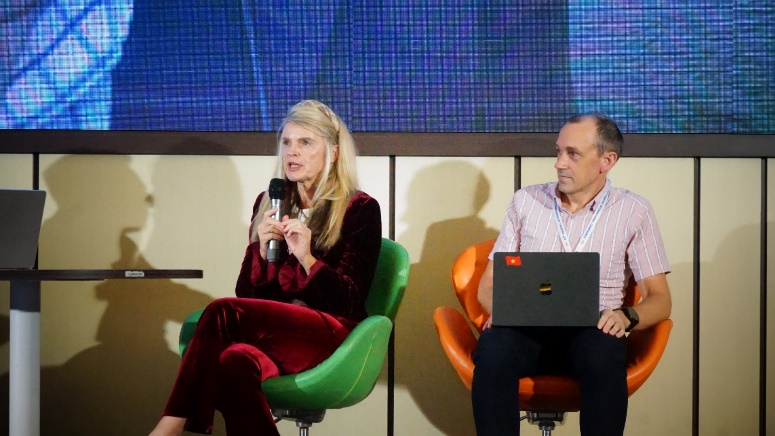
Prof. Ho then examined assessment transformation with his third question to Prof. Jeremy White: “AI tools are now being used to support feedback, grading, and even high-stakes assessment. Do you think AI will change the way we design and understand language assessment?” White advocated shifting from product-focused exams to process-based evaluations tracking longitudinal progress through drafts and revisions. He demonstrated how AI systems can automate data collection, freeing educators to focus on individual growth trajectories. When Prof. Ho followed up with his fourth question, “Many teachers worry about the accuracy and fairness of AI-based feedback and scoring. What can institutions do to ensure these systems are valid and transparent?” Prof. Jeremy White revealed most institutions lack formal oversight, leaving decisions to individual instructors. He proposed calibrating AI outputs with human expert raters using transparent rubrics and training teachers to interpret feedback critically. White cited cases where detection tools falsely accused students of misconduct due to algorithmic bias, insisting AI should never make high-stakes decisions alone. His pragmatic approach balanced technological potential with irreplaceable human judgment.
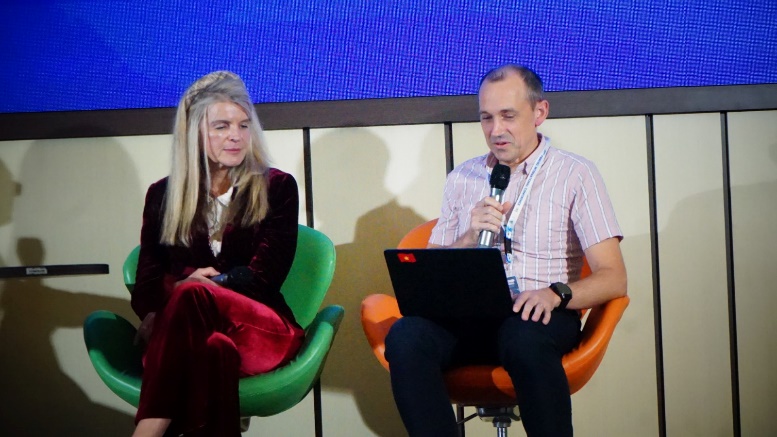
Prof. Ho’s fifth question addressed linguistic equity with Lala Bumela Sudimantara, Ph.D.: “Teachers in multilingual and multicultural environments often face unique challenges when integrating AI tools. Based on your research, what are the most common barriers they encounter?” Lala Bumela Sudimantara, Ph.D. exposed how monocultural AI tools erase identities by prioritizing dominant languages over local ones like Sundanese, reinforcing linguistic hierarchies that discourage usage. He argued these platforms emphasize memorization over imagination, neglecting sensory-rich engagement essential to learning. When Prof. Ho asked his sixth question “What kinds of institutional or policy-level support systems are needed to ensure AI enhances, not widens, educational equity?”, Lala Bumela Sudimantara, Ph.D. warned AI risks deepening the digital divide disguised as innovation. He championed open infrastructure over proprietary systems, enabling teachers to localize content in home languages that become bridges rather than barriers. Lala Bumela Sudimantara, Ph.D. called for Asia-Pacific consortia to develop shared multilingual datasets and ethical guidelines, positioning the Global South as creators rather than consumers of AI solutions. His decolonial perspective redefined innovation as contextual relevance through teacher co-design, directly addressing Cirebon’s commitment to inclusive technological integration.
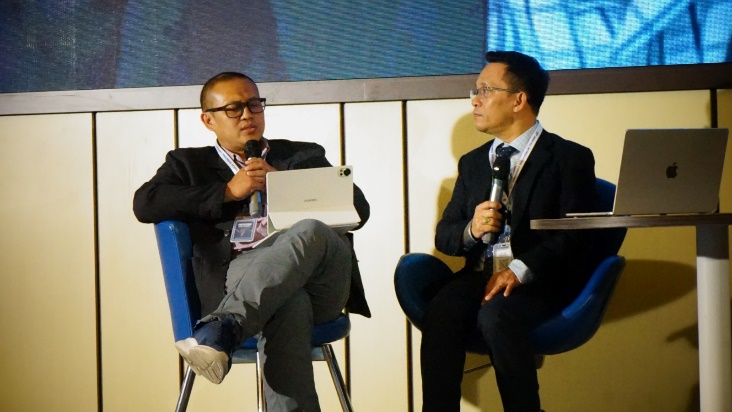
Assoc. Prof. Dr. Pham Vu Phi Ho synthesized the symposium’s themes, affirming AI’s capacity to personalize learning while underscoring non-negotiable humanistic foundations. He emphasized that transparency, accuracy, and evolving educator roles must anchor all implementations, with institutions creating policies for ethical adoption. Prof. Ho highlighted the urgent need for regional collaboration on open AI repositories and multilingual datasets to prevent knowledge monopolies. The discussion crystallized that technology must serve people rather than dictate pedagogy, with AI acting as collaborator not replacement. He positioned the symposium as a blueprint for transforming Cirebon’s convening power into actionable frameworks across universities. Quality assurance leaders noted immediate applications for curriculum reform and teacher training programs. This collective vision affirmed language education’s future as comprehensive, inclusive, and fair through deliberate human-AI partnership. The International Office documented concrete commitments for post-conference implementation.
The symposium reached its intellectual apex with Assoc. Prof. Dr. Pham Vu Phi Ho facilitating cross-pollination of ideas among speakers. Prof. Dr. Andrew Lian connected Lala Bumela Sudimantara, Ph.D.’s equity concerns to his critique of academic writing fixation, suggesting AI could redirect energy from polished outputs to meaningful community engagement. Ania Lian, Ph.D. linked discernment development to Prof. Jeremy White’s assessment models, proposing that longitudinal tracking should measure growth in critical evaluation skills. Prof. Jeremy White acknowledged Lala Bumela Sudimantara, Ph.D.’s warnings about linguistic hierarchies, committing to incorporate multilingual calibration in his AI assessment frameworks. These dialogues revealed emergent consensus: humanistic AI requires co-creation with educators, contextual adaptation beyond Northern templates, and institutional courage to prioritize learning over efficiency. The audience’s sustained engagement, evident in handwritten notes and whispered consultations, signaled a paradigm shift in how global scholars approach educational technology. UINSSC’s Cyber Building became more than a venue; it transformed into a living laboratory for decolonial innovation.
The symposium concluded with Assoc. Prof. Dr. Pham Vu Phi Ho extending gratitude to speakers and participants for their intellectual generosity. Reflecting on the day’s significance, Lala Bumela Sudimantara, Ph.D., Director of the International Office and Conference President, stated: “AI must be designed with teachers in multilingual contexts, honoring their linguistic repertoires, cultural references, and pedagogical imagination.” His words captured UINSSC’s leadership in shaping AI discourse beyond efficiency metrics toward educational dignity.
The event proved Cirebon’s role as both host and architect of language education’s inclusive future. UIN Siber Syekh Nurjati Cirebon had not merely convened a discussion but ignited a movement to ensure technology amplifies human wisdom. The International Office affirmed its commitment to translating these principles into tangible impact across Indonesia’s higher education landscape, cementing UINSSC’s position as a beacon of ethical innovation in the digital age.
Author: Resa Diah Gayatri