
Assoc. Prof. Hassan Khosravi Delivers a Groundbreaking and Visionary Keynote on the Transformative Power of AI, Illuminating How Humans-With-AI Can Boldly Navigate the Future of Work and Education, Driving Innovation, Ethical Leadership, and Global Equity
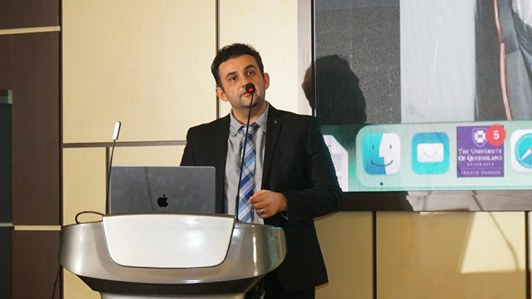
Cirebon, November, 15th 2025 — At the spectacular 22nd AsiaCALL International Conference 2025 hosted by UIN Siber Syekh Nurjati Cirebon, under the leadership of Lala Bumela, Ph.D., Director of the International Office and President of AsiaCALL 2025, Assoc. Prof. Hassan Khosravi, Ph.D., Vice President for Administrative Affairs of AsiaCALL from The University of Queensland, Australia, delivered a groundbreaking keynote entitled The AI Disruption: What It Means for Work and Education. The session, moderated by Ivo Dinasta Yanuar, S.S., M.Appling (Secretary of the International Office, UIN SSC), was attended by Prof. Dr. Andrew Lian (President of AsiaCALL, online), Prof. Dr. Hj. Ria Yulia Gloria, M.Pd. (Head of the Quality Assurance Institute, representing the Rector of UIN SSC), Ania Lian, Ph.D. (Vice President of AsiaCALL, Charles Darwin University, Australia), Prof. Dr. Jeremy White (Vice President for International Relations of AsiaCALL, Ritsumeikan University, Japan), Prof. Shameem Rafik-Galea, Ph.D. (SEGi University, Malaysia), Assoc. Prof. Dr. Pham Vu Phi Ho, Ph.D. (Vice President for Administrative Affairs and Publication of AsiaCALL, Industrial University of Ho Chi Minh City, Vietnam), Made Hery Santosa, Ph.D. (Universitas Pendidikan Ganesha, Indonesia), Luqman Baehaqi, Ph.D. (UIN Palangka Raya, Indonesia), Sirniawati, M.A. (Universitas Muhammadiyah Cirebon), Wulan Rahmatunnisa, M.Pd. (Universitas Kuningan), Aries Endri Susanto, S.T., M.E., Eka Destarada Sesunan, S.E., and Nur’aeni, S.E., M.E. (Hakim Ventura International), alongside Listiani Ekawati, M.Hum. (UIN SSC), Mariyah Ulfah, M.E.Sy. (Head of the Halal Inspection Institute), Ghina Amaliyah Sholihah, S.Sos., and Ivo Dinasta Yanuar, S.S., M.Appling. from the International Office. The audience was further enriched by international presenters from Japan, Saudi Arabia, Malaysia, Vietnam, the Netherlands, the Philippines, and other countries, as well as esteemed English Education lecturers from UIN SSC—Dra. Amroh Umaemah, M.Pd., Hendi Hidayat, M.Pd., and Wakhid Nashruddin, Ph.D.—and hundreds of English Education students, whose energy and engagement amplified the session’s impact. Prof. Khosravi’s keynote explored the transformative power of AI in both the workplace and education, advocating a “humans-with-AI” approach to ensure innovation, ethical leadership, and equitable access, highlighting the urgent need for curricula that foster critical thinking, complex problem solving, and ethical AI integration, positioning both students and educators to navigate the future responsibly and boldly.
The rapid emergence of artificial intelligence across industries and education has introduced both unprecedented opportunities and profound challenges. While AI promises to streamline workflows, enhance productivity, and revolutionize knowledge creation, it simultaneously raises critical questions: How can humans ethically and intelligently collaborate with AI? How should education systems evolve to equip learners for a future where AI is a pervasive presence? These tensions highlight the urgency for educators, policymakers, and thought leaders to critically examine the role of AI in shaping work, learning, and society. It is within this complex landscape of technological disruption that Assoc. Prof. Hassan Khosravi delivered his keynote, framing AI not as a distant possibility, but as an immediate force transforming professional and educational environments alike.
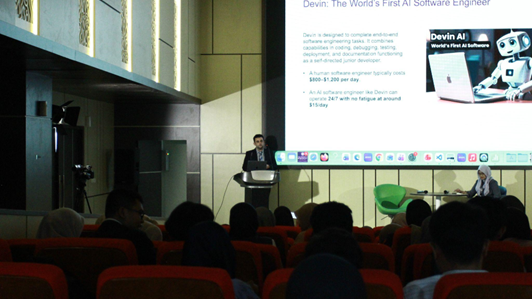
Khosravi began by confronting the conventional perception of AI as a replacement for human labor or intellect. He stated, “AI is not here to replace humans; it is here to partner with us. Understanding how to collaborate with AI—ethically, critically, and creatively—is the central challenge of our time.” He emphasized that success in the AI era requires individuals to shift their mindset from competition with machines to collaboration with them. Central to this dialogue is the distinction between AI’s role in industry, where efficiency and automation are prioritized, and in education, where the cultivation of judgment, creativity, and problem-solving is paramount.
Drawing on historical context, Khosravi traced the evolution of AI from early specialized systems like IBM’s Deep Blue to the current generation of generative AI, which can produce text, code, and other outputs at scale. He explained how these developments have fundamentally reshaped expectations in both professional and learning environments. In workplaces, AI optimizes processes, augments productivity, and handles routine tasks, allowing humans to focus on higher-order thinking and strategic decision-making. In education, however, AI must be harnessed to teach learners not only to use tools but to reason critically, make ethical judgments, and solve complex problems. Khosravi argued that traditional pedagogical models, focused on memorization or content delivery, are insufficient in an AI-driven world. Instead, curricula should integrate AI as a collaborator, encouraging learners to question, reflect, and innovate rather than passively consume AI-generated outputs.
Khosravi also addressed the ethical and societal dimensions of AI integration. He highlighted potential risks of inequality if access to AI-enhanced learning is uneven and stressed the importance of designing systems that promote inclusivity and fairness. He proposed proactive strategies, including embedding ethical reasoning, responsible AI use, and reflective practices into educational frameworks to ensure that AI amplifies human potential rather than reinforcing existing disparities.
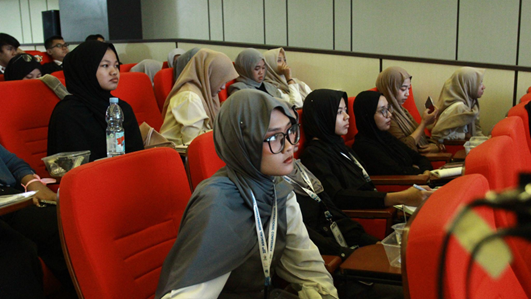
By the end of the keynote, Khosravi framed a clear vision: the future belongs to “humans-with-AI”—individuals who can harness AI as a collaborative partner while retaining human creativity, ethical awareness, and critical thinking. Education systems must transform to prioritize these capacities, preparing learners for a world in which AI is ubiquitous and integral. He concluded that the ethical and intelligent use of AI is not optional; it is essential for cultivating leaders, innovators, and problem-solvers capable of thriving in a rapidly evolving global landscape.
The overarching message of Khosravi’s keynote is that AI should be understood as a tool for empowerment rather than a threat. Ethical collaboration with AI, cultivation of critical thinking, and preparation for complex, unpredictable futures are the pillars of meaningful education in the AI era. Khosravi’s vision underscores that societies and institutions must embrace AI thoughtfully, ensuring that technology enhances human judgment, creativity, and equity, ultimately shaping a future where humans and AI advance together responsibly and innovatively.
Author: Muhammad Azkiya Bahtsulkhoir