
Between Words and Wisdom: Indra Maulana Arfan Ajiz’s Vision of AI as a Student Assessment Partner in English Language Learning — Presented at the Pre-Conference AsiaCALL 2025
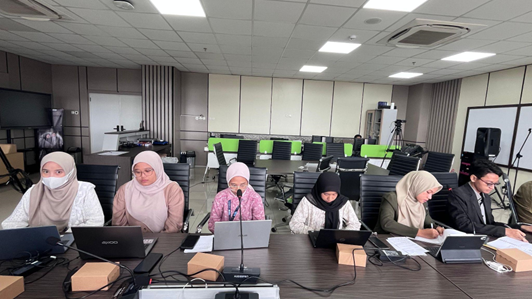
Cirebon, October, 11th 2025 — Under the coordination of the International Office and Partnership of UIN Siber Syekh Nurjati Cirebon, led by Lala Bumela, Ph.D., the Pre-Conference AsiaCALL 2025 Capacity Building Workshop emerged as an arena of intellectual awakening and international collaboration. The program aimed to equip students with research presentation skills and global academic confidence before their participation in the upcoming AsiaCALL 2025 international conference. With the academic guidance of Emma L. Schuberg from Charles Darwin University, Australia, seven members of the Global Engagement Team presented their studies that reflected diverse intersections of AI, culture, and education. Among them, Indra Maulana Arfan Ajiz captivated the audience through his thought-provoking paper titled “Between Words and Wisdom: AI as a Student Assessment Partner in English Language Learning.” As emphasized by Lala Bumela, “This initiative is not merely an academic exercise—it is a transformative process where our students learn to connect technology, empathy, and intellect in the pursuit of meaningful education.”
Indra’s motivation stemmed from a critical observation of how assessment practices in Indonesia often reduce learning into numbers, ignoring the emotional and cognitive journey behind each student’s effort. “We tend to value results more than reflection,” Indra remarked. “But real learning happens in the feedback loop—in those moments when students discover what they didn’t know they could do.” This realization led him to explore how AI could assist teachers in providing more formative, personalized feedback that goes beyond the static nature of final exams. Instead of replacing teachers, Indra envisioned AI as a collaborator that helps humanize assessment through immediacy, adaptability, and insight.
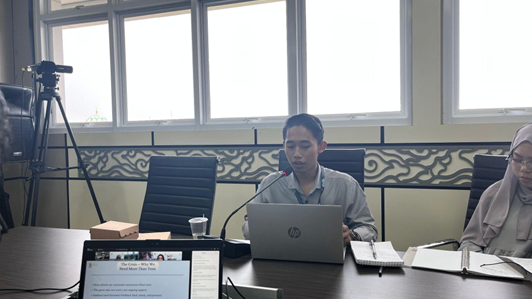
In response to Indra’s presentation, Lala Bumela reflected on the significance of integrating technology into pedagogy with ethical mindfulness. “Indra’s research shows us that AI must remain a servant of humanity, not its master,” he noted. His comment resonated deeply with the ethos of the Pre-Conference AsiaCALL 2025, which emphasized not just technological literacy but also moral intelligence. Under his mentorship, the students were encouraged to embrace AI critically—to see it as a bridge between data and dialogue, not as an endpoint of understanding. Indra’s work became a case in point for how reflective education could merge the precision of machines with the sensitivity of human thought.
In his presentation, Indra proposed a practical framework for AI-assisted formative assessment in English language learning. The model utilizes AI tools such as ChatGPT to generate instant, context-sensitive feedback on students’ writing, grammar, and cohesion, enabling teachers to focus more on interpretive and affective dimensions of learning. Yet, he reminded the audience that AI cannot perceive intention, emotion, or perseverance—it processes words, not wisdom. The role of the teacher, therefore, remains irreplaceable: to provide empathy, moral direction, and contextual understanding. Indra’s framework repositions educators as interpreters of intelligence rather than mere dispensers of evaluation, emphasizing the collaborative dance between human insight and technological assistance.
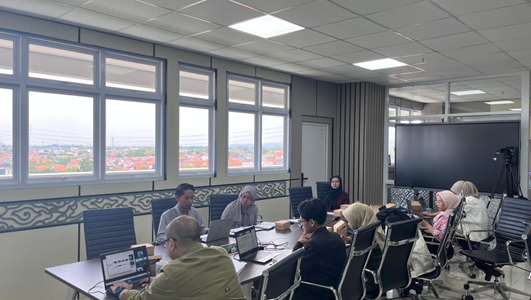
Indra concluded that the ultimate goal of integrating AI in education is not efficiency but empathy. Through his AI-based assessment model, he illustrated how technology can help students receive feedback that is timely and constructive, fostering motivation and autonomy in their learning process. “AI,” he said, “should not replace the teacher’s voice—it should help it reach more learners, more personally.” The audience responded with enthusiasm, recognizing that such an approach could transform classrooms into ecosystems of continuous growth where feedback becomes dialogue, not judgment. His study thus reframed the purpose of AI—not as a mechanical evaluator, but as a reflective partner in the art of learning.
As the session drew to a close, Lala Bumela highlighted the philosophical undertone of Indra’s work. “In the age of artificial intelligence, Indra reminds us of something profoundly human: that wisdom is born not from data, but from dialogue,” he concluded. The Pre-Conference AsiaCALL 2025 reflected the university’s growing spirit of innovation and reflection—where students like Indra redefine what it means to learn, teach, and think. Through his vision, UIN Siber Syekh Nurjati Cirebon reaffirmed its commitment to education that is both technological and humane—where words may come from machines, but wisdom always comes from the human heart.
Author: Muhammad Azkiya Bahtsulkhoir