
Beyond Folklore and Cultural Performance: Didin Misbahuddin, S.Hum. Highlights Carita Pantun as a Living Repository of Sundanese Wisdom and Ancestral Knowledge
Kuningan, May 23, 2026 — During the Focus Group Discussion (FGD) titled From Erasure to Emplacement: Reclaiming Sundanese Ecotheology in Digital English Language Teaching held in Pasir Batang, Kuningan, Didin Misbahuddin, S.Hum., an archaeologist and researcher at Niskala Institute, as the second speaker, delivered a thought-provoking presentation on the significance of Carita Pantun within Sundanese culture. His session invited participants to look beyond folklore as mere entertainment and to understand it as a sophisticated system of ancestral knowledge. Throughout the discussion, Didin emphasized that traditional narratives often preserve ecological, ethical, and historical insights that remain relevant today. By revisiting these oral traditions, participants were encouraged to reconsider the value of local knowledge in contemporary education. The presentation created a sense of curiosity as many attendees encountered unfamiliar dimensions of Sundanese heritage. It also reinforced the broader theme of the FGD, which sought to reconnect education with local wisdom and ecological consciousness.
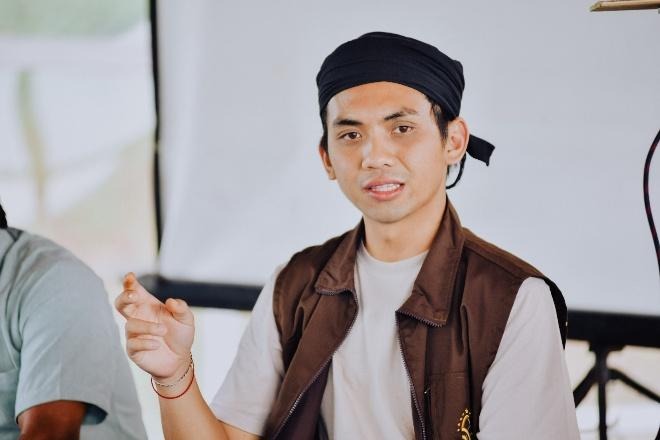
Didin began by explaining that Carita Pantun is a traditional oral storytelling performance accompanied by the kecapi, a Sundanese string instrument. Often described as a form of narrative poetry or oral theatre, these stories commonly recount the journeys of princes from the ancient Sunda Kingdom who seek either a worthy spouse or the conquest of another kingdom as a prerequisite for becoming a ruler. The performances are delivered by specialists known as juru pantun, whose role extends far beyond simply narrating stories. According to Didin, many people compare a juru pantun to a puppeteer in wayang performances, yet the two possess distinct performance traditions, particularly in their use of tone, rhythm, and vocal delivery. The role requires not only storytelling skills but also a deep understanding of culture, context, and ancestral messages. This explanation helped participants appreciate the complexity behind what is often perceived as a simple folk tradition.
A particularly engaging moment emerged when Didin discussed the social status of the juru pantun in ancient Sundanese society. He explained that the juru pantun was regarded as one of the most important figures in the community because they served as a bridge between ancestral wisdom and society. As he stated, “A juru pantun cannot be replaced by just anyone because their role is to transmit the messages of the ancestors while adapting them to the context of place and time.” He further noted that this position was traditionally inherited across generations and required extensive cultural knowledge. Unfortunately, the number of remaining juru pantun today is extremely limited. Didin highlighted Ki Rastani bin Suad from Gumulung Village, Cirebon, as one of the few surviving practitioners who continues to preserve this tradition.

Moving deeper into the discussion, Didin explored how knowledge was transmitted in ancient Sundanese civilization. He explained that there were generally two educational pathways: kamandalaan or mandala, which functioned similarly to centers of higher learning, and oral transmission through everyday practice and storytelling. Despite these differences, he emphasized that Sundanese education was fundamentally egalitarian. The distinction lay not in social status but in the medium used to acquire knowledge. While kamandalaan relied heavily on written texts preserved on palm leaves, oral traditions passed knowledge directly through performance and community interaction. This perspective challenged modern assumptions that written knowledge is inherently superior to oral knowledge. Instead, both were presented as complementary systems that contributed to the preservation of collective wisdom.
The presentation became increasingly reflective when Didin explained that Carita Pantun was intentionally constructed around geographical landscapes, place names, and ecological realities. Drawing from his own archaeological research, he described how fragmented stories found across different sites could often be understood only after examining related narratives within Carita Pantun. According to him, these stories contain multiple layers of knowledge, including ethical teachings, environmental awareness, and disaster mitigation strategies. However, such knowledge is often embedded in symbolism and metaphor rather than direct instruction. One example he provided was the figure of belut bodas (the white eel), which may symbolize geological fault lines rather than a literal creature. Through this explanation, participants were encouraged to reinterpret myths and traditional beliefs as cultural mechanisms for preserving practical knowledge about the natural world.
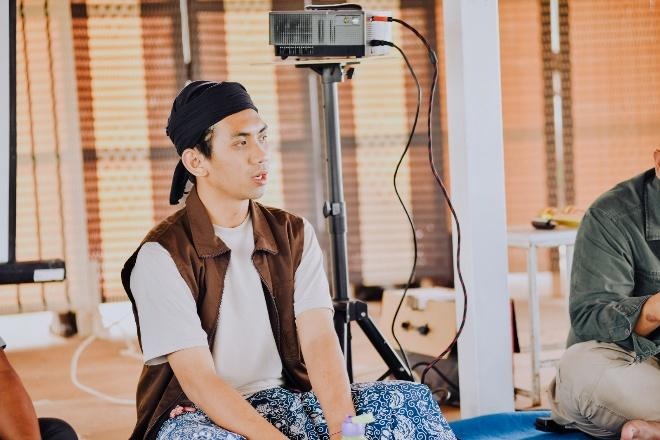
In the final part of his presentation, Didin reflected on the sacred status of three major Carita Pantun: Lutung Kasarung, Ciung Wanara, and Nyi Sumur Bandung. He explained that these narratives were once regarded almost as sacred texts because they contained guidance for agriculture, social conduct, and spiritual life. The stories also functioned as repositories of collective memory and visions of the future, often including predictions or warnings related to environmental changes and disasters. As Didin remarked “We may be skeptical about ancient prophecies, but many of them can be understood as forms of advice and preventive knowledge for facing future challenges.” He concluded by recounting the historical journey of Lutung Kasarung, from a sacred oral tradition to theatrical performances and eventually the first feature film produced in the Dutch East Indies in 1926. The session was attended by A/Prof. Lala Bumela Sudimantara, Ph.D. (Director of the International Office of UIN Siber Syekh Nurjati Cirebon), together with fellow speakers Sukad (cultural elder from Pasir Batang and Sagarahiang) and Intan Pusvitasari, M.Si. (academic influencer and author of Fisikologi). Joining them were Dra. Hj. Amroh Umaemah, M.Pd. (Head of the English Education Department), cultural practitioners, English teachers and lecturers from Cirebon and Kuningan, a UIN SSC alumnus, and International Office interns. Through this insightful explanations shared by Didin Misbahuddin, S.Hum., participants were encouraged to see Carita Pantun not simply as a traditional story, but as a valuable source of ecological, cultural, and educational wisdom that continues to hold relevance today.
Author: Salsabilla