Beyond Textual Epistemologies: Toward a Holistic and Regenerative 21st-Century Reconfiguration of Knowledge through Multisensory Learning, Eco-Theology, and the Ancestral Epistemics of Lutung Kasarung in Pasir Batang
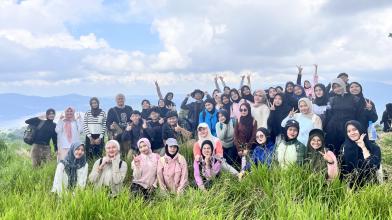
Kuningan, May 2, 2026 – In the Public Lecture Academic Voices for Sustainable Earth: Seminar Series on Sustainability and Eco-Theology organized by the International Office of UIN Siber Syekh Nurjati Cirebon at Pasir Batang, Lala Bumela Sudimantara, Ph.D., Director of the International Office and Professor of Multisensory Learning who advances Regenerative Material ELT, led a transformative academic engagement alongside Didin Mishbahuddin, S.Hum., an archaeologist, and Mr. Sukad, a key custodian of Sundanese cultural heritage in Kuningan, supported by the International Office team and 84 second-semester students of the Literacy course. In his opening speech, he emphasized that the activity was not merely outdoor learning, but a multisensory learning experience engaging sight, hearing, feeling, and affective awareness, while highlighting associative thinking as a means to connect seemingly unrelated fields of knowledge into a coherent and meaningful framework. The presence of the speakers was positioned not simply as contributors, but as integral elements of a living learning ecosystem that activates a sense of history, place, and culture. He further stressed that understanding the environment cannot rely solely on texts, as sustainability must emerge from lived experience rather than abstract theory. He stated, “Pasir Batang is not merely a place—it is a multisensory learning experience where knowledge is not only read, but lived, felt, and internalized.”
This perspective simultaneously exposes a critical limitation within dominant educational paradigms, which continue to privilege textual, abstract, and rational approaches over experiential engagement. In such systems, knowledge is often confined to written forms and detached from the realities it seeks to explain, resulting in a fragmented understanding that separates learners from ecological awareness and cultural context. The dominance of text-based epistemologies—largely shaped by Western intellectual traditions—has contributed to a condition in which sustainability is discussed conceptually but rarely experienced directly. Consequently, education risks producing learners who are intellectually informed yet experientially disconnected, unable to translate knowledge into meaningful action or ethical awareness.
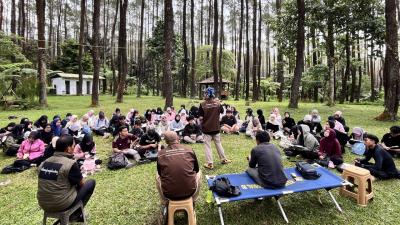
Addressing this epistemic gap, Mr. Sukad articulated that Carita Pantun, particularly Lutung Kasarung, represents a sophisticated ancestral knowledge system rather than a mere narrative tradition. He explained that the story operates through causal patterns and symbolic structures, where each element reflects a deeper logic of life mitigation and ecological understanding. Traditional knowledge bearers such as juru pantun and paraji, though increasingly rare, embody epistemological functions that sustain experiential and community-based learning. Through figures such as Nyi Pohaci, he illustrated an ecological worldview grounded in equality among living beings, positioning nature as a subject rather than an object. The forest, often misunderstood as a place of exile, is reframed as kamandalaan—a space of transformation, healing, and learning, where humans engage directly with the processes of life. He stated, “Lutung Kasarung is not simply a story—it is a way of understanding existence, where humans learn to experience, interpret, and live in harmony with nature.”
Further reinforcing this perspective, Didin Mishbahuddin emphasized that Lutung Kasarung functions as a real source of knowledge and a comprehensive educational system embedded within Sundanese civilization. He explained that traditional education historically operated through both elite systems, such as mandala or kamandalaan, and popular systems through carita pantun, allowing knowledge to be transmitted across different social layers. Knowledge preservation relied primarily on oral traditions, memory, and lived experience rather than textual dependency, enabling dynamic and contextual learning processes. He highlighted that carita pantun operates as a multilayered system through which individuals unconsciously internalize agricultural knowledge, social values, spirituality, and ecological awareness. In this context, Lutung Kasarung functions as a “manual book” for life, particularly in agricultural practices (huma), while also serving as a geographical and geological archive that encodes the environmental history of landscapes such as Mount Ciremai. He stated, “Lutung Kasarung is not merely told—it teaches, preserves, and transmits knowledge through experience, symbolism, and continuity across generations.”
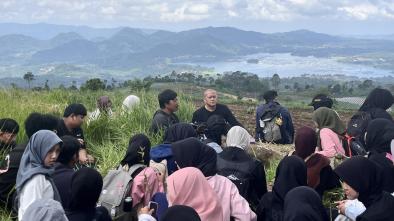
Integrating these perspectives, Lala Bumela Sudimantara, Ph.D. proposed a holistic and regenerative reconfiguration of learning, positioning Pasir Batang as a “living text” where knowledge is experienced rather than abstracted. He emphasized that education in the 21st century must move beyond textual epistemologies toward a multisensory framework that integrates language, emotion, and environment within a single learning process. Through the development of Regenerative ELT Materials, students are encouraged to observe, listen, and feel, transforming learning into an embodied experience where meaning is internalized rather than memorized. He further highlighted the role of ethno-science in translating ancestral knowledge (karuhun) into academic discourse without losing its experiential essence, contributing to the broader project of decolonization of knowledge. He stated, “Multisensory learning reconnects knowledge with lived reality, allowing local wisdom to evolve into a regenerative and globally relevant epistemology.”
In closing, Lala Bumela Sudimantara, Ph.D. emphasized that meaningful learning must integrate cognitive, affective, and sensory dimensions as an inseparable whole. He stressed that achieving sustainability requires a deep understanding of environmental ethics—an understanding that emerges through direct engagement with the environment rather than theoretical abstraction alone. He also underscored that multisensory, locally grounded knowledge holds significant potential to contribute to global academic discourse, positioning local experience as a source of universal insight. He concluded, “True knowledge emerges when cognition, emotion, and the senses work together—not only to understand the world, but to experience it, live within it, and transform it into meaningful knowledge for both local and global contexts.”