
Bridging Digital Innovation and Religious Harmony: International Office of UIN Siber Syekh Nurjati Cirebon Engages in Kemenag International Webinar Series
Cirebon, June 19, 2026 — In a profound testament to its burgeoning role as a beacon of global academic and cultural diplomacy, the International Office of Universitas Islam Negeri (UIN) Siber Syekh Nurjati Cirebon actively participated in the high-profile Webinar Series #Batch 2: Harmony Talks. Held virtually via Zoom on Friday, June 19, 2026, the prestigious forum centered around the critical theme of "Strengthening Institutional Capacity to Maintain Religious Harmony Amidst Digital Disruption". Representing the university’s commitment to fostering cross-cultural understanding and digital citizenship, the International Office engaged deeply with the discourse. Regarding this strategic engagement, Lala Bumela Sudimantara, Ph.D. explicitly stated, "Our involvement in this forum reflects UIN Siber Syekh Nurjati Cirebon's core mission to bridge cutting-edge digital literacy with the timeless values of religious moderation and local wisdom on a global scale."
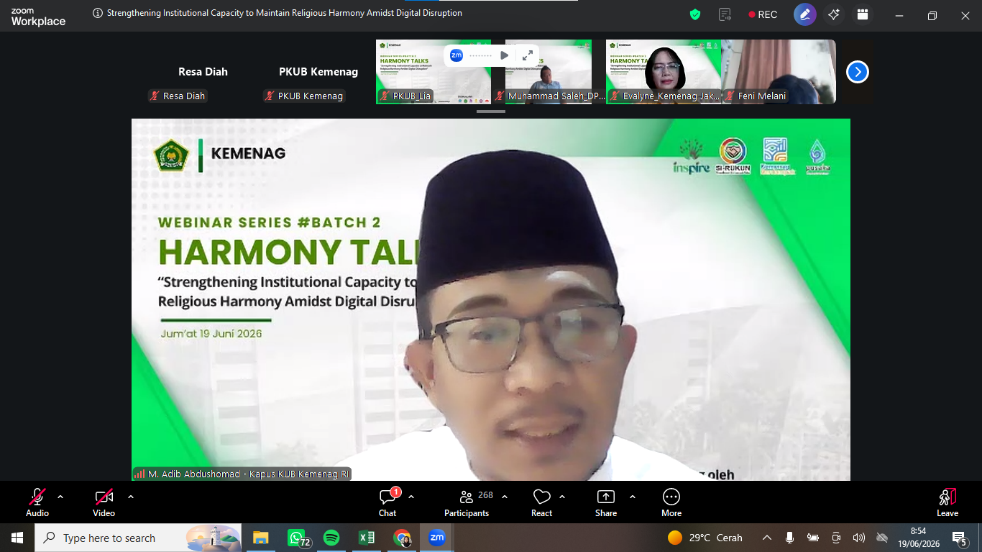
The webinar commenced with an inspiring and commanding keynote address by M. Adib Abdushomad, M.Ag., M.Ed., Ph.D., the Head of the Center for Religious Harmony at the Ministry of Religious Affairs (PKUB Kemenag RI). He forcefully articulated that social stability is not a passive state but a monumental nationwide investment that requires continuous institutional reinforcement and civic dedication. In an era where online spheres are increasingly volatile, he urged the younger generation, particularly tech-savvy students, to actively reclaim the digital narrative with messages of peace and verified information. Highlighting the strategic evolution of the ministry, he emphasized that maintaining peace requires a robust structural framework capable of navigating modern socio-technical challenges. He stated, "Harmony is an expensive social investment."
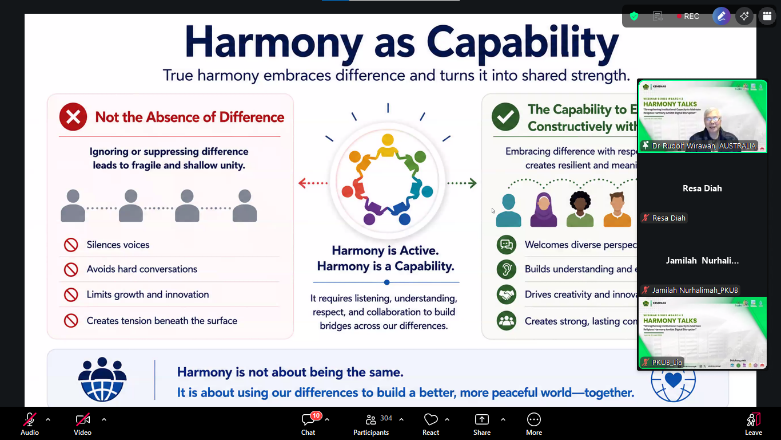
Elevating the dialogue to an extraordinary international level, Dr. Rudolf Wirawan, Ph.D., M.Sc., an eminent scholar from Australia, presented a groundbreaking pedagogical framework titled BIMA. Standing for Bridging Intelligence, Mindfulness, and Awareness, the BIMA framework serves as a sophisticated methodology to build institutional bridges across the education, business, and diplomatic sectors. Dr. Rudolf Wirawan captivated the audience by explaining how human capability expands through a spiral journey rooted in deep listening and harmonious relationships with the universe. He argued that true tolerance cannot exist without the willingness to listen, urging participants to approach unfamiliar perspectives with an open mind. His cross-disciplinary approach seamlessly connected ancient philosophical wisdom with the complex demands of contemporary organizational governance. Elevating the conceptual framework of the webinar, he explicitly remarked, "Religious harmony begins before belief".
The International Office observed with great interest how Dr. Rudolf Wirawan’s presentation brilliantly connected abstract philosophical constructs with cutting-edge artificial intelligence. He detailed how the BIMA framework utilizes Natural Language Processing and Deep Learning to process massive volumes of community feedback, effectively transforming raw digital data into actionable social insights. However, he issued a stern warning against becoming subservient to technology, emphasizing that moral decisions and the attribution of meaning must always remain strictly within human hands. This sophisticated integration of technology and humanism perfectly mirrors the core mission of UIN Siber Syekh Nurjati as Indonesia's pioneer cyber Islamic university.
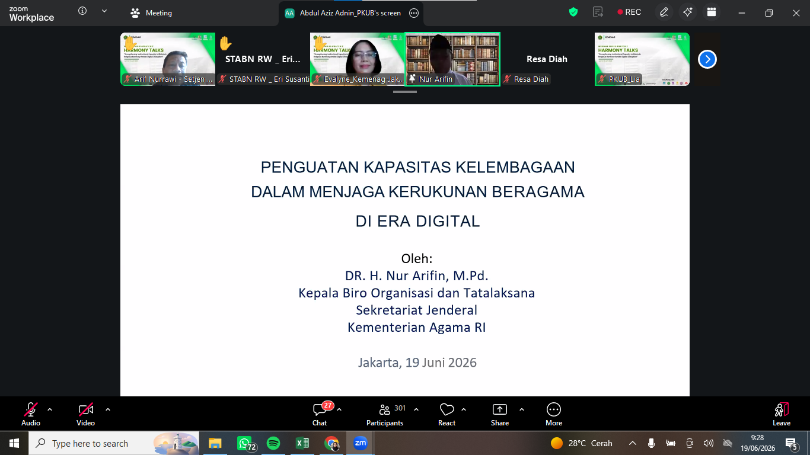
The academic narrative was further enriched by Dr. Drs. Nur Arifin, M.Pd., who provided a compelling historical and ethical roadmap for safeguarding national unity. He traced the profound origins of the Ministry of Religious Affairs back to the historic Jakarta Charter debates of June 22, 1945, illustrating how the institution has always functioned as a "Golden Bridge" for national harmony. Dr. Nur Arifin warned against the toxic proliferation of digital hoaxes, hate speech, and politically motivated cyber provocations that threaten to fracture society. He offered practical, culturally rooted advice for students to responsibly filter information rather than impulsively spreading digital negativity. Furthermore, he outlined the four pillars of social capital, Tolerance, Religious Moderation, Dialogue, and Gotong Royong as essential defenses for the digital age.
In a highly interactive question-and-answer session, delegates from various Islamic state universities engaged the speakers on the delicate balance between civil liberties and digital regulation. Dr. Rudolf Wirawan responded by advocating for cultural and dialogue-based conflict mitigation rather than relying solely on rigid state-enforced legal repercussions. He illustrated the dangerous consequences of losing community sovereignty and critical thinking by drawing a sobering analogy to agricultural exploitation in India. To counteract these modern threats, the Ministry of Religious Affairs proudly highlighted the implementation of "SI RUKUN" (Sistem Deteksi Dini – Indonesia Rukun), an innovative digital early-warning infrastructure designed to detect and defuse cyber-religious tensions. The session concluded with an empowering charge for all student participants to step forward as official global "Ambassadors of Harmony" in their respective digital environments.
The active participation of UIN Siber Syekh Nurjati’s academic community in compiling and validating the webinar’s official proceedings reflects the university's high standing in national intellectual circles. By collaborating closely with international minds and state ministries, the International Office successfully demonstrates its readiness to lead global discourses on digital peace and inclusive education. Moving forward, the International Office remains dedicated to empowering its scholars and students with the cross-cultural competencies needed to navigate the globalized digital landscape.