
Bridging Technology, Tradition, and Ecological Consciousness: Lala Bumela Sudimantara, Ph.D. and Prof. Rudolf Wirawan Lead a Transformative Dialogue on BIMA Framework, Ethnoscience, and Sustainable Education
Cirebon, April 15, 2026— A transformative meeting and discussion hosted by Lala Bumela Sudimantara, Ph.D. unfolded into a compelling exchange of ideas, enriched by key insights from Prof. Rudolf Wirawan. At the heart of the discussion was a bold vision to redefine how knowledge is constructed, particularly through the integration of the BIMA (Bridging Intelligence, Mindfulness, and Awareness) Framework and ethnoscience. Both scholars drew attention to the need for a more human-centered approach in responding to global challenges. Their perspectives invited participants to reconsider the role of education, not merely as a system of knowledge transfer, but as a space for cultivating awareness and connection. The conversation emphasized that knowledge must move beyond rigid structures and become more responsive to real-world complexities. This shared vision naturally drew strong engagement from participants throughout the session. It set the tone for a discussion that felt both urgent and transformative.
Yet beneath this vision lay an unsettling reality that could not be ignored. Environmental degradation, loss of ecological balance, and the overreliance on purely logical systems became underlying concerns shaping the conversation. Lala Bumela Sudimantara, Ph.D. highlighted how modern scientific practices often overlook emotional and cultural dimensions, reducing complex realities into simplified data. At the same time, Lala Bumela Sudimantara, Ph.D. pointed to the marginalization of traditional knowledge, which is frequently dismissed despite its depth and accuracy. This disconnect creates a widening gap between technological advancement and ecological consciousness. The situation becomes even more critical when such imbalance directly affects communities and natural resources. These tensions quietly framed the urgency of the discussion. Without addressing them, any form of progress risks becoming incomplete.
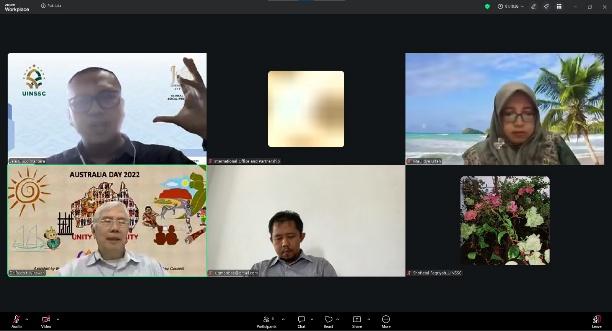
As the exchange of ideas deepened, both speakers began to weave their perspectives into a more interconnected narrative. Prof. Rudolf Wirawan described how data-driven approaches and traditional knowledge systems can complement one another when viewed from a broader lens. He argued that logic alone cannot fully capture the complexity of human experience, especially in relation to nature. Lala Bumela Sudimantara, Ph.D. further expanded this idea by emphasizing the importance of empathy toward the environment—something that cannot be replicated by artificial intelligence. “We need to focus on what AI cannot do, and one of those is developing empathy toward nature,” he stated. Their interaction reflected a dynamic balance between innovation and cultural rootedness. Rather than debating which approach is superior, they explored how both can coexist and strengthen each other. This exchange created a sense of intellectual harmony within the discussion.
Gradually, the conversation shifted from abstract ideas to more tangible possibilities. Prof. Rudolf introduced a community-based model that integrates Artificial Intelligence (AI), Internet of Things (IoT), and blockchain to address environmental issues through participatory data collection. This approach allows communities to share their experiences, which are then transformed into patterns and actionable insights. At the same time, Lala Bumela brought the discussion into the realm of education by proposing a curriculum that integrates ecological awareness with language learning. His idea of an ecotheology-based approach encourages students to engage with nature while developing their academic skills. The concept of regenerative learning further reinforced the importance of not only using resources but also restoring them. Together, these ideas showed how theory can be translated into practice. The discussion became increasingly grounded in real-world application.
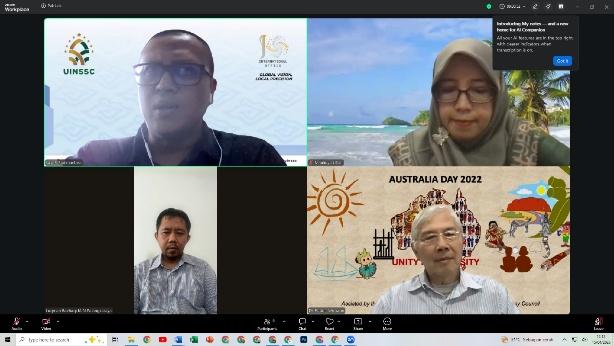
A sense of direction began to emerge as both perspectives converged on a shared understanding. The integration of modern technology with local wisdom was no longer seen as an option, but as a necessity. Rather than separating scientific innovation from cultural knowledge, both were positioned as equally valuable components of a sustainable future. The role of students and academic institutions also became more prominent, particularly as agents of change in implementing these ideas. There was a growing recognition that meaningful transformation requires collaboration across different levels of society. The conversation moved beyond questioning into envisioning actionable steps forward. This shift brought a sense of clarity to what initially seemed complex. It also left participants with a renewed sense of purpose.
In the end, the discussion carried a deeper reflection on the responsibility of knowledge itself. Education, as emphasized throughout the session, must extend beyond intellectual achievement and foster a deeper awareness of the world. Both Lala Bumela Sudimantara, Ph.D. and Prof. Rudolf Wirawan underscored the importance of reconnecting with nature while embracing innovation. “We must focus on what we can do and take real action, not just remain in theory,” Prof. Rudolf emphasized. This balance is essential in ensuring that progress does not come at the cost of sustainability. The ideas presented encouraged participants to rethink their roles, not only as learners but also as contributors to a larger ecosystem. Ultimately, the discussion highlighted that true advancement lies in harmony, not dominance.
Author: Salsabilla