Building Cultural Bridges through Indonesian Language and Arts Diplomacy in Russia and Belarus
Cirebon, August 07, 2026 – The session of the Seminar of the Education and Cultural Attachés and the Deputy Permanent Delegate of the Republic of Indonesia to UNESCO provided an in-depth overview of Indonesia’s language and cultural diplomacy across Russia and Belarus, highlighting how educational programs, artistic communities, and academic partnerships are being mobilized to strengthen Indonesia’s international presence. The presentation focused on the activities of the Education and Cultural Attaché of the Embassy of the Republic of Indonesia in Moscow (Atdikbud KBRI Moskow) and the extensive geographical scope of its diplomatic work. Rather than concentrating exclusively on Moscow, the Atdikbud network connects universities, language centers, and cultural communities across five major cities in Russia and Belarus, including Moscow, Kazan, Khabarovsk, and Minsk. Through this multi-city approach, Indonesian language learning, artistic development, and academic exchange can reach communities beyond the diplomatic capital, making cultural diplomacy more inclusive and geographically expansive. The network includes Indonesian language classes and Gamelan and dance studios in Moscow, the Indonesian Language Center at Kazan Federal University, the ASEAN Center at Pacific National University in Khabarovsk, and regular BIPA classes at Belarusian State University of Foreign Language in Minsk. This geographical expansion demonstrates that cultural diplomacy is increasingly being developed as a distributed network rather than a centralized diplomatic activity.
The presentation nevertheless reveals a challenge inherent in sustaining Indonesia’s cultural and linguistic presence across such a broad geographical area. Diplomatic engagement cannot rely solely on activities concentrated within a single capital city when the objective is to reach diverse communities across Russia and Belarus. The geographical distance between major centers, the diversity of local educational environments, and the need to provide continuing access to Indonesian language and cultural programs make the expansion and continuity of these initiatives increasingly important. In response to this condition, the Atdikbud KBRI Moskow has developed a multi-location approach that links universities, language centers, cultural organizations, and community initiatives. This model allows Indonesian language and culture to remain accessible in different regional contexts rather than becoming dependent upon a single institutional location. The establishment of Indonesian language and cultural activities in Kazan, Khabarovsk, and Minsk consequently demonstrates an effort to overcome geographical limitations through institutional networking. The approach also seeks to ensure that Indonesian cultural diplomacy remains sustainable, adaptive, and capable of reaching wider communities throughout the accreditation area.
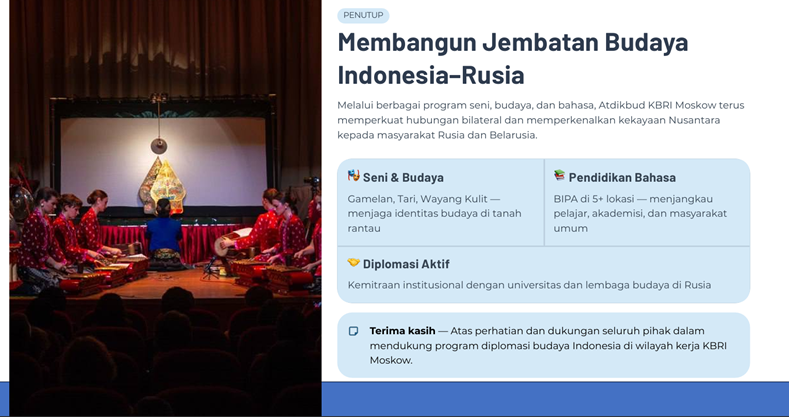
A particularly important dimension of this engagement is the direct interaction created through Indonesian artistic communities. Sanggar Gamelan Dadali, established on 21 July 2017, has become one of the important cultural diplomacy platforms in Moscow, focusing on the preservation and presentation of Javanese gamelan and wayang kulit. The studio has 25 active members, including Russian citizens who demonstrate strong interest in traditional Indonesian arts, and its activities include cultural performances and interactive workshops introducing participants to the philosophy and techniques of Indonesian traditional arts. Complementing this is Kirana Nusantara Dance, which has 20 active students and brings together Indonesian and Russian dance instructors to promote the diversity of traditional Indonesian dance. Its activities extend beyond Moscow to other Russian cities through performances, regular training, and educational activities. These artistic communities create forms of cultural dialogue that cannot be achieved through language instruction alone. Through music, dance, performance, and direct participation, Russian audiences encounter Indonesian cultural traditions as lived practices rather than distant representations. Such interaction consequently creates opportunities for familiarity and appreciation while strengthening the social connections underlying Indonesia–Russia relations.
The cultural engagement is further developed through non-formal education and the expansion of Indonesian language learning opportunities across the region. The Kelas Akhir Pekan at Rumah Nusantara KBRI Moskow, conducted every Saturday, provides Indonesian children in Moscow with six areas of development: Indonesian language through BIPA, Russian language, religious education, traditional dance, chess, and futsal. The program simultaneously supports linguistic development, adaptation to the local environment, cultural preservation, character formation, strategic thinking, physical well-being, cooperation, and community belonging. In 2026, the diplomatic network also expanded through the establishment of the Indonesian Language Center at Kazan Federal University, which provides regular BIPA classes, workshops on Indonesian culture and traditional arts, and partnerships with local educational institutions. At the ASEAN Center at Pacific National University in Khabarovsk, structured Indonesian language classes are combined with cultural and Indonesia–ASEAN studies as well as opportunities for student and academic exchange. These developments are complemented by BIPA classes at the Rudomino Library in Moscow, regular Indonesian classes at Rumah Nusantara, and BIPA Online, which extends language learning to participants throughout the region without geographical limitations.
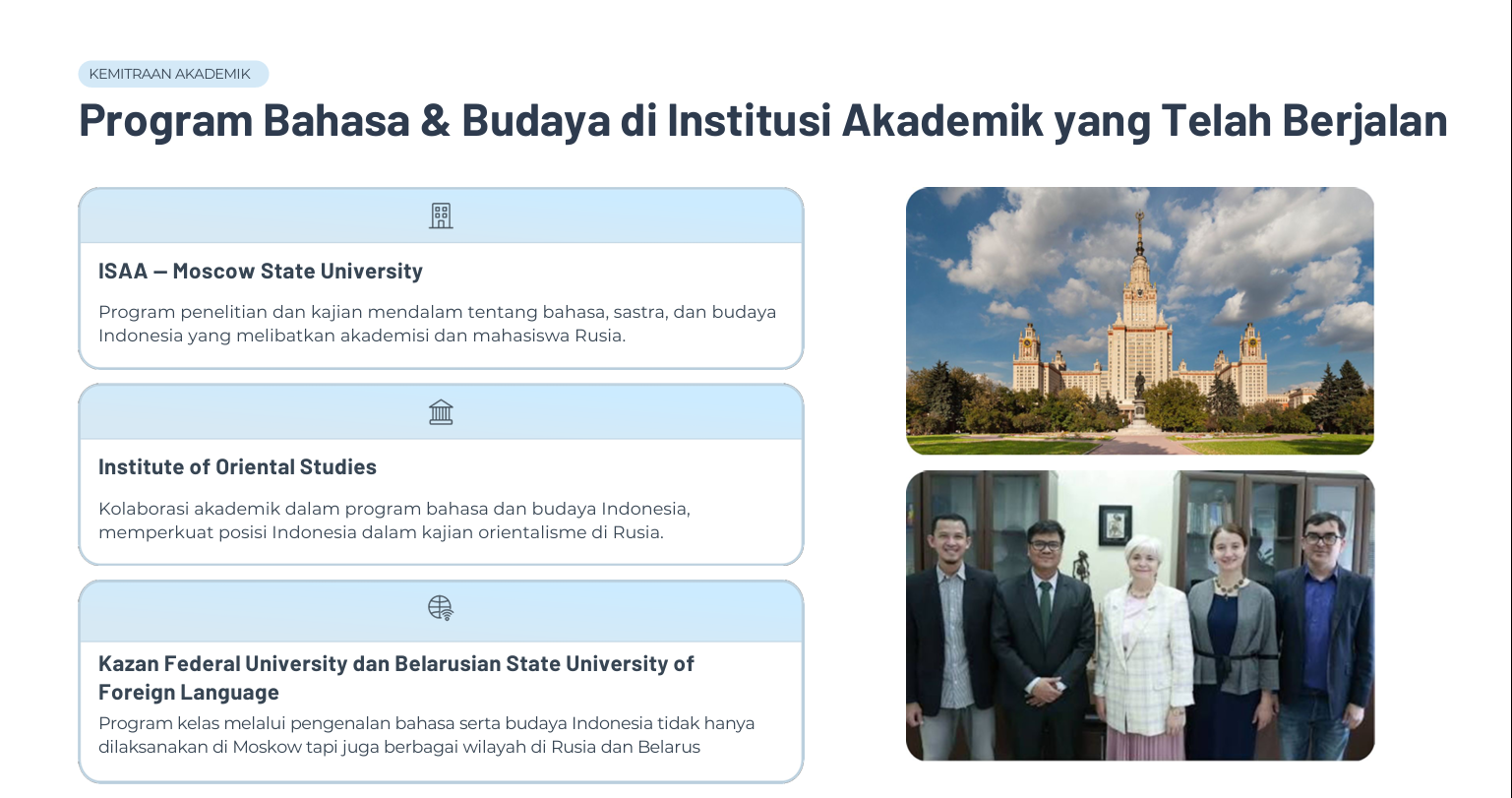
The expanding network is reinforced by academic partnerships that place Indonesian language and culture within more formal intellectual environments. Existing collaborations include ISAA at Moscow State University, which conducts research and in-depth studies on Indonesian language, literature, and culture involving Russian academics and students, as well as the Institute of Oriental Studies, where academic collaboration in Indonesian language and cultural studies strengthens Indonesia’s position within Oriental Studies in Russia. Partnerships with Kazan Federal University and Belarusian State University of Foreign Language further demonstrate that Indonesian language and cultural programs are no longer limited to Moscow but are increasingly embedded within academic institutions across Russia and Belarus. The available data illustrate the breadth of this network: Sanggar Gamelan Dadali has 25 active members, Kirana Nusantara Dance has 20 students, the weekend program provides six areas of non-formal education, the Kazan center offers BIPA and cultural workshops, the Khabarovsk ASEAN Center provides language and cultural programs, and regular BIPA activities serve communities in Minsk and the Russian public at the Rudomino Library. Together, these initiatives establish an interconnected infrastructure in which formal education, non-formal learning, academic research, artistic performance, and community participation support one another.
The presentation within the Seminar of the Education and Cultural Attachés and the Deputy Permanent Delegate of the Republic of Indonesia to UNESCO demonstrates that Indonesia’s cultural diplomacy can become most effective when it is transformed into a network of sustained relationships rather than confined to occasional diplomatic events. The experience of the Atdikbud KBRI Moskow illustrates how language, art, education, academic cooperation, and community participation can collectively create bridges between Indonesia, Russia, and Belarus. Gamelan, traditional dance, wayang kulit, BIPA classes, cultural workshops, university partnerships, and online learning each provide different entry points through which international communities can encounter Indonesia. The concluding framework of the presentation emphasizes the importance of building cultural bridges between Indonesia and Russia, while continuing to introduce the richness of the Nusantara to Russian and Belarusian communities. Within the broader seminar, this experience reinforces the responsibility of Indonesia’s Education and Cultural Attachés and the Deputy Permanent Delegate to UNESCO to ensure that educational and cultural diplomacy remains accessible, adaptive, and sustainable across different international contexts. More importantly, it demonstrates that diplomacy does not always begin with formal negotiations; it can begin with a language class, a gamelan performance, a dance workshop, a university seminar, or a child learning Indonesian on a Saturday. Through these seemingly simple encounters, Indonesia can cultivate familiarity, appreciation, mutual understanding, and enduring connections with communities far beyond its national borders.