
Coordination Meeting on Regenerative Human Capital: Discussing BIMA Framework, Eco-Theology, and Concrete Collaboration for Youth-Led Disaster Resilience in West Java
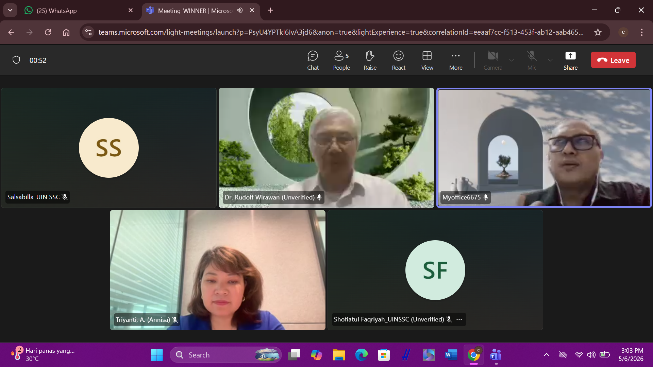
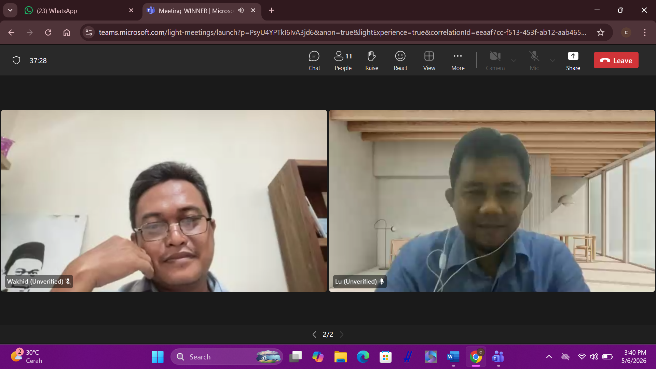
Cirebon, May 6, 2026 — Lala Bumela Sudimantara, Ph.D., director of the International Office of UIN Siber Syekh Nurjati Cirebon (UIN SSC), led a meaningful coordination meeting titled Regenerative Human Capital: Co-Creating Ancestral Wisdom and Geo-Science for Youth-Led Disaster Resilience in West Java, conducted online with international scholars and students. The discussion brought together Prof. Rudolf Wirawan, Ph.D. (University of Adelaide, Australia), Assoc. Prof. Annisa Triyanti, Ph.D. (Utrecht University, Netherlands) Luqman Baehaqi, Ph.D. (UIN Palangka Raya) and Wakhid Nashruddin, Ph.D. (UIN Siber Syekh Nurjati Cirebon). Six sixth-semester students from the English Education Department of UIN SSC also attended the meeting to deepen their understanding of eco-theology and the BIMA Framework. From the beginning, the forum created an atmosphere of intellectual curiosity and collaborative reflection. The meeting focused on exploring how ancestral wisdom, ethnoscience, and contemporary research can contribute to disaster resilience and regenerative education. It also highlighted the importance of connecting local knowledge with global academic discourse.
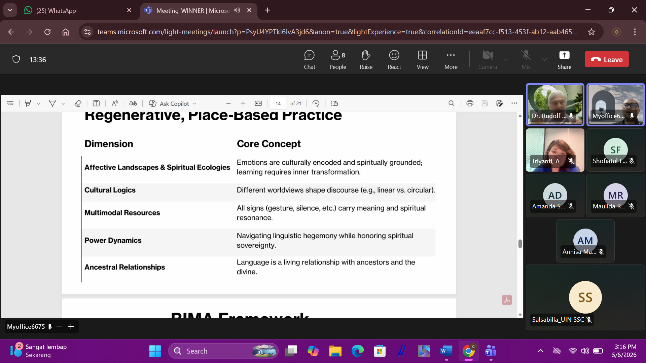
Opening the session, Lala Bumela Sudimantara, Ph.D. emphasized that resilience should be nurtured from an early age through culture and lived experience. He reflected on his encounters with Sundanese knowledge holders such as Mr. Sukad and archaeologist Didin Mishbahuddin, S.Hum., whose insights deepened his understanding of Sundanese cosmology. According to him, ancient Sundanese manuscripts and oral traditions reveal that eco-theological values have long existed within local culture. He explained that texts such as Lutung Kasarung contain messages about environmental stewardship and the preservation of water sources. Through his presentation, he proposed a new paradigm of English language education that moves beyond linguistic competence toward cosmological literacy. The session also introduced regenerative place-based practices that integrate affective landscapes, cultural logics, multimodal communication, power dynamics, and ancestral relationships into learning. These ideas reflected his effort to reconnect education with ecological consciousness and local epistemologies.
The presentation further explored how technology and ancestral knowledge can complement one another. Lala Bumela Sudimantara, Ph.D. introduced multisensory-CALL learning tools that combine technology, emotion, aesthetic intonation, and verbal communication to support deeper learning experiences. He also presented an AI-generated visualization titled The Emotional Arc of the Rajah: A Sacred Wave, which mapped the emotional progression of the opening of Lutung Kasarung. The visualization illustrated stages such as invocation, awakening, ancestral journey, divine revelation, offering, and moral resolution. In addition, he shared several recent international and community-based engagements related to water wisdom, oral ecological narratives in Cigobang, Cirebon, and sustainability seminars in Sagarahiang and Pasir Batang, Kuningan, West Java. He explained that these projects align closely with the BIMA Framework developed by Prof. Rudolf Wirawan, Ph.D. Through this framework, local wisdom and ethnoscience are positioned as essential foundations for regenerative learning and climate resilience.
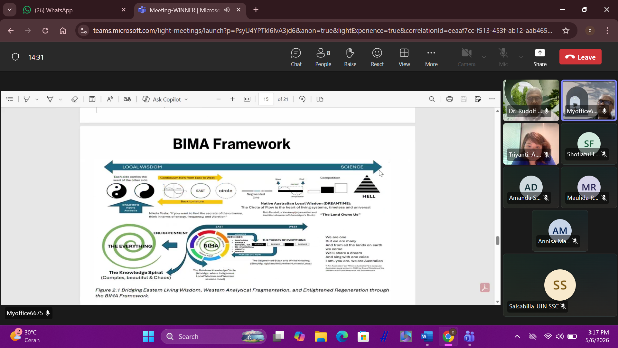
Responding to the discussion, Prof. Rudolf Wirawan, Ph.D. elaborated on the philosophical foundation of the BIMA Framework. He explained that many natural phenomena, such as wind and water, move in spiral patterns, reflecting a circular process of growth rather than rigid hierarchy. According to him, many societies in the Global South traditionally developed collaborative and circular ways of thinking, while modern hierarchical systems often encourage competition and imbalance. He stressed that ethnoscience and modern science should not be separated because both contribute to understanding reality. To illustrate this idea, he criticized exploitative systems that prioritize economic gain over ecological balance, such as excessive plastic production and environmentally damaging mining practices. To illustrate this idea, he criticized exploitative systems that prioritize economic gain over ecological balance, such as excessive plastic production and environmentally damaging mining practices. He also shared an example from Universitas Pahlawan Tuanku Tambusai in Riau, where he developed a sensor-based irrigation tool called Knowledge Tree designed to “listen” to the condition of the soil before watering plants. This example demonstrated how technology can operate in harmony with nature rather than dominating it.
A significant moment emerged when Assoc. Prof. Annisa Triyanti, Ph.D. reflected on the presentations and raised questions about concrete collaboration. She expressed appreciation for the discussions on local wisdom, ethnoscience, and eco-theology, noting that the topics reminded her of her own Sundanese cultural roots. She also shared her ongoing climate change and cultural heritage project in Lamalera, East Nusa Tenggara, where researchers document community knowledge without imposing scientific assumptions. Building on this experience, she asked what practical actions could be carried out collaboratively rather than limiting the partnership to theoretical discussions. As she stated, “If we can work together through small but concrete actions, it will be much more effective.” Her question shifted the discussion toward implementation and encouraged participants to think about collaborative projects that directly engage communities. The moment highlighted a shared desire to transform ideas into meaningful action.
Responding to this challenge, both Prof. Rudolf Wirawan, Ph.D. and Lala Bumela Sudimantara, Ph.D. emphasized the importance of action-oriented collaboration. Prof. Rudolf, Ph.D. explained that research should involve students directly in community observation, surveys, and interviews so that solutions emerge from real local needs. Meanwhile, Lala Bumela Sudimantara, Ph.D. proposed collaborative initiatives such as writing papers, developing books, and creating community-based projects connected to ancestral ecological wisdom. He also shared his experience in Cigobang Village, where local youth independently studied ancient Sundanese manuscripts and later initiated river conservation efforts along the Cisanggarung River. According to him, these young people demonstrated the spirit of researchers despite not pursuing higher education. The session concluded with hopes for future collaboration through research grants, the WINNER Conference, and continued interdisciplinary dialogue. More importantly, the meeting left participants with a renewed understanding that sustainable education must reconnect humanity with culture, community, and the living intelligence of the earth.
Author: Salsabilla