
Dancing with Heritage: Women Empowerment and Digital Expression in Tsamara Bahira’s Study from Cirebon, Presented during the Pre-Conference AsiaCALL 2025
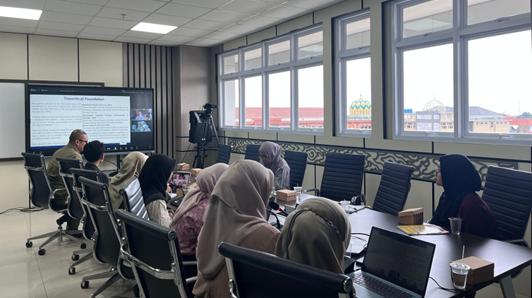
Cirebon, October, 11th 2025 — The Pre-Conference AsiaCALL 2025 Capacity Building Workshop, organized by the International Office and Partnership of UIN Siber Syekh Nurjati Cirebon under the direction of Lala Bumela, Ph.D., unfolded as more than just an academic training—it became a lively arena of creativity, intellect, and cross-cultural dialogue. The event aimed to prepare outstanding students to present their full papers at the upcoming AsiaCALL 2025 international conference, blending scholarly rigor with cultural expression. Guided by the university’s vision of nurturing global-minded learners, the workshop also featured academic mentoring from Emma L. Schuberg of Charles Darwin University, Australia. Seven members of the Global Engagement Team took the stage, each bringing unique research shaped by Indonesia’s diverse intellectual landscape. Among them, Tsamara Bahira Alzena captured attention through her captivating presentation, “Women Empowerment through Traditional Dance in the Digital Era: A Study from Cirebon, Indonesia,” where tradition met technology and heritage found its digital rhythm. As noted by Lala Bumela, the program symbolized “a step toward transforming students into cultural storytellers who connect the local to the global, and knowledge to identity.”
Tsamara began her presentation with a striking statement: “In every dance movement, there is a story of resistance, resilience, and rebirth.” Her words framed the tension between tradition and modernity, between the sacred stage and the glowing screen. She described how, in the era of social media and digital transformation, traditional Cirebonese dances—such as Topeng and Sintren—risked being reduced to mere aesthetic entertainment, detached from their deeper cultural and gendered meanings. Yet, Tsamara saw in this digital shift not a threat, but an opportunity: an opening for women dancers to reclaim space, express emotion, and assert agency through online platforms. Her concern stemmed from the observation that many young women dancers in Cirebon struggle to balance societal expectations with creative aspirations. Her study therefore sought to explore how the digital realm could serve as a bridge between cultural preservation and female empowerment.
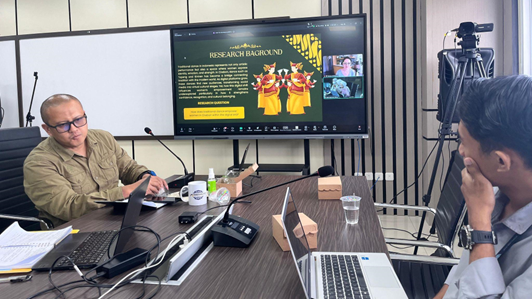
In the ensuing discussion, Lala Bumela emphasized that Tsamara’s research captured a fundamental shift in how culture interacts with technology. “We are witnessing a renaissance,” he remarked, “where tradition is not fading but transforming—and women are leading that transformation.” His reflection resonated with Tsamara’s vision of integrating cultural wisdom with digital literacy, echoing the broader educational goals of the university. The dialogue between Tsamara and the audience delved into questions about authenticity, representation, and the sustainability of cultural practices in a fast-changing media landscape. Participants discussed how digital spaces can serve as both a mirror and amplifier of identity—where performance becomes both personal expression and collective advocacy. This exchange illuminated how digital platforms, once dismissed as superficial, are now becoming sites of cultural negotiation and empowerment.
Tsamara’s research adopted a descriptive quantitative method enriched with ethnographic insights, combining Likert-scale questionnaires, observations, and documentation involving female dancers from campus-based and community groups in Cirebon. Grounded in Naila Kabeer’s (1999) framework of empowerment, Koentjaraningrat’s (1984) local wisdom theory, and Henry Jenkins’ (2006) digital culture paradigm, the study positioned traditional dance as a multidimensional space—where heritage, identity, and technology intersect. The findings were compelling: 87% of respondents reported increased confidence, 79% actively shared their dance performances on platforms like Instagram, TikTok, and YouTube, and 83% believed that digital platforms help preserve culture while enhancing public recognition. Through this data, Tsamara revealed that digital engagement empowers women not only to perform but also to narrate and reimagine their identities. The dance, once confined to the stage, now flourishes on the digital screen—transforming into a new medium of storytelling and social transformation.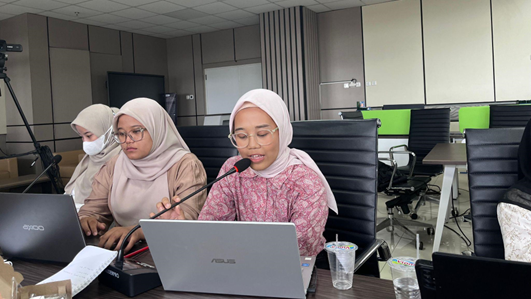
Reflecting on her findings, Tsamara asserted, “When women dance online, they are not just performing—they are rewriting their place in culture.” Her conclusion reframed traditional dance as both art and activism, where digital participation serves as a modern form of agency. She emphasized that the empowerment of women through dance is not about abandoning tradition, but about allowing it to evolve and breathe within the rhythms of contemporary life. By highlighting connections between traditional aesthetics and digital self-expression, her research demonstrated how Cirebonese women dancers utilize virtual spaces to negotiate identity, celebrate emotion, and challenge conventional boundaries. For Tsamara, empowerment is not only visible in the movement of bodies but also in the movement of ideas across cultural and digital terrains.
In closing, Lala Bumela reflected that Tsamara’s study embodies the spirit of transformative education and global citizenship that UIN Siber Syekh Nurjati aims to cultivate. “Empowerment begins when students learn to see culture not as inheritance, but as innovation,” he noted, underscoring how her work aligns with the Sustainable Development Goals—particularly SDG 5 (Gender Equality), SDG 4.7 (Cultural Literacy), and SDG 11.4 (Cultural Heritage Preservation). The Pre-Conference AsiaCALL 2025 thus became more than an academic rehearsal; it was a stage where intellect and heritage danced together in harmony. Through her study, Tsamara Bahira Alzena illuminated how women, tradition, and technology can converge to create a more inclusive and expressive world—proving that in the rhythm of heritage lies the pulse of empowerment.
Author: Muhammad Azkiya Bahtsulkhoir