
Didin Misbahuddin from Niskala Institute Demonstrates How Carita Pantun Serves as a Sacred Educational and Narrative Tradition Preserving Sundanese Knowledge, Ethical Values, and Cosmological Insights at the Regenerative International Seminar and Workshop Organized by IO UIN SSC
Cirebon, December, 2nd 2025 — The International Office of UIN Siber Syekh Nurjati Cirebon proudly orchestrated a monumental three-day international seminar and workshop under the visionary theme Returning to the Circle: A Regenerative Pathway Beyond Technocratic Sustainable Development Goals, an initiative designed to redefine the intersection of culture, education, and ecological sustainability in the global academic landscape. Guided by the inspiring leadership of Lala Bumela, Ph.D., Director of IO UIN SSC, the event unfolded as an unparalleled convergence of intellectual brilliance, spiritual insight, and practical ingenuity. The seminar featured an extraordinary assembly of luminaries from both domestic and international arenas, including Rudolf Wirawan, Ph.D. from the University of Adelaide, Australia; Ivan Chabibilah, S.S., M.Li. from ICCCM Malaysia; Luqman Baehaqi, Ph.D. from UIN Palangkaraya; Syarifuddin, S.S., a distinguished civil servant from the Protocol and Communication Section of Cirebon Regional Secretariat; Didin Misbahuddin, S.Hum., eminent researcher from Niskala Institute Bandung; and Ukad, revered Spiritual Elder and Guardian of the Sagarahiang Kuningan. Complementing this stellar lineup, representatives from Hakim Ventural International, Aries Endri Susanto, S.T., M.E., and Nur’aeni, S.E., M.E., alongside the diligent student internship team from IO UIN SSC, the Global Engagement Team (GET), meticulously ensured the seamless orchestration of the seminar, from behind-the-scenes logistics to the precise coordination of every session. As the inaugural speaker, Didin Misbahuddin captivated the audience with his presentation entitled Beyond Literature: Carita Pantun as a Heritage of Sundanese Knowledge Systems, illustrating that Carita Pantun transcends the mere realm of literary tradition to embody a profound intellectual and cultural repository. “Carita Pantun is not simply a form of entertainment; it is a sacred vessel carrying the accumulated wisdom, ethics, and cosmological insights of our ancestors,” Didin stated, emphasizing the enduring and transformative power of this tradition.
Delving into the heart of Sundanese narrative heritage, Didin masterfully distinguished Carita Pantun from its Malay counterpart, elucidating how these forms, though sharing common narrative roots, diverge in purpose and cultural function. While contemporary adaptations often reduce pantun to playful or poetic entertainment, historical Carita Pantun operated as a profound medium for preserving sacred knowledge, moral codes, and societal norms. In the intricate societal framework of ancient Sunda during the Hindu-Buddhist era, knowledge and governance were seamlessly intertwined: the ratu represented royal authority, the rama constituted the council of elders, and the resi, serving as a religious and educational institution akin to a combination of university and administrative bureau, ensured the propagation of intellectual and ethical wisdom. Didin explained that textual materials, such as lontar manuscripts for students and daun gebang as master texts, were meticulously preserved within these structures, reflecting both elite participation and broader societal engagement. The juru pantun, as appointed agents of these institutions, performed a dual role: safeguarding esoteric knowledge while transmitting its essence to the wider community, ensuring that wisdom permeated daily life, local rituals, and communal consciousness.
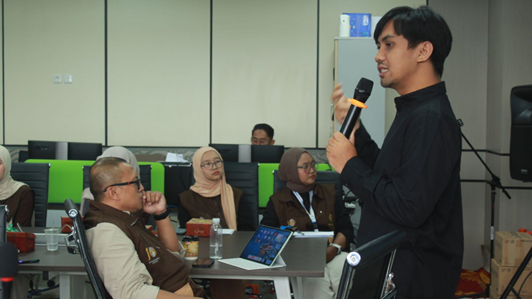
Emphasizing the dynamic performative aspect of Carita Pantun, Didin illuminated how these narratives construct an intricate cultural architecture that continues to shape Sundanese perceptions of the world. “Through Carita Pantun, communities internalized not only the contours of moral and ethical reasoning but also the cosmological frameworks that guide social relations and environmental understanding,” Didin noted. He illustrated this with ethnographic evidence from Mount Kumbang in Brebes, where localized sacred texts, including Sewa Kadarma, enabled broader societal engagement beyond the aristocracy or religious elites. The ritualized opening and closing ceremonies, along with specific narrative repetitions, reinforced learning and cultural retention, revealing an intentional pedagogical system wherein narrative, ritual, and spatial consciousness intertwined to embed knowledge within both individual cognition and communal practice. These methodologies reveal that Carita Pantun is more than storytelling; it is an active educational model that scaffolds comprehension, ethical reasoning, and cultural continuity.
Didin further elaborated on the methodical sophistication of Carita Pantun as an informal educational system. Repetition, adaptation to local contexts, and integration with daily rituals—particularly agricultural practices—constituted a highly effective framework for knowledge transmission. For instance, agricultural rites incorporated specific Carita Pantun narratives at each stage, reinforcing not only technical expertise in farming but also moral and cosmological understanding, reflecting the community’s symbiotic relationship with the land and spiritual realm. Variants of iconic stories, such as Lutung Kasarung, demonstrate adaptability across regions, each narrative tailored to local landscapes while preserving underlying principles. Didin emphasized that the significance of Carita Pantun lies not in literal accuracy but in the transmission of intellectual, ethical, and cosmological structures, forming both a model of the world and a model for practical engagement within it. Such a system ensures that cultural knowledge is internalized organically, equipping individuals with frameworks for navigating the world while remaining deeply rooted in ancestral wisdom.
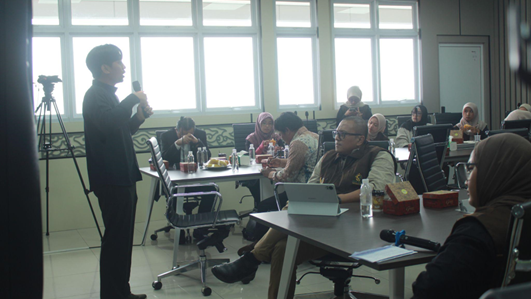
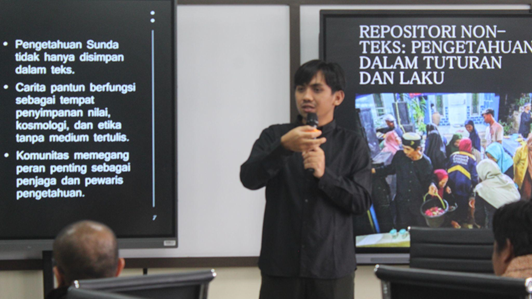
Recent archaeological discoveries further underscored the enduring relevance of Carita Pantun. The 2024 unearthing of Batu Lingga in Desa Kahuripan, symbolizing Shiva and Parvati, and the sacred site of Lemah Putih, corroborate the ongoing presence of ritual, cosmological symbolism, and ancestral knowledge embedded within Sundanese cultural practice. Didin remarked, “These discoveries highlight the continuity of Carita Pantun as a living repository where ritual, spatial awareness, and narrative knowledge converge. The tradition embodies a non-textual yet profoundly structured form of education, where communities serve as custodians and transmitters of wisdom.” Through this lens, Carita Pantun emerges not merely as cultural heritage but as a functional framework for ethical, social, and cosmological literacy, demonstrating its relevance for both contemporary scholarship and community practice.
Concluding his illuminating lecture, Didin powerfully emphasized that engaging with Carita Pantun is tantamount to accessing the cognitive and ethical frameworks of Sundanese ancestors. “To engage with Carita Pantun is to witness the models of thought, ethical reasoning, and cosmological insight meticulously encoded within ancestral narratives. It is an invitation to inherit not only stories but the very cognitive architecture that allowed our ancestors to understand and shape their world,” he asserted. This seminal presentation exemplifies the International Office of UIN SSC’s enduring mission to cultivate intercultural dialogue, preserve indigenous knowledge systems, and champion regenerative pathways that bridge past wisdom with contemporary societal challenges. Through its meticulous organization and inspirational scholarship, IO UIN SSC has reaffirmed its status as a beacon of knowledge, intercultural engagement, and ethical leadership on both national and global stages.
Author: Muhammad Azkiya Bahtsulkhoir