
Eco-Poetry from Lingga: Lala Bumela’s Creative Writing Class Revives the Sacred Dialogue Between Humanity and Nature as a Curriculum of Life
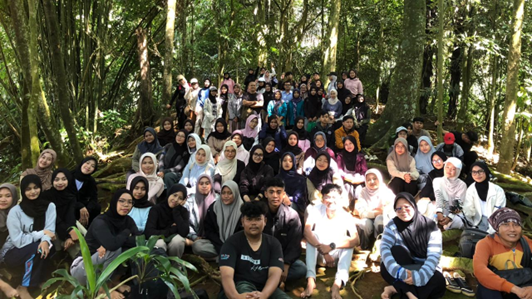
Cirebon, October, 5th 2025 — Lala Bumela, Ph.D., Director of the International Office and Partnership at UIN Siber Syekh Nurjati Cirebon (UIN SSC), is widely known for his innovative approaches to education. One of his latest breakthroughs lies in the transformation of the Creative Writing curriculum for students in the English Language Teaching Department, where he introduces a unique concept known as Eco-Poetry. This approach stems from the BIMA framework (Bridging Intelligence, Mindfulness, and Awareness) developed by Professor Rudolf Wirawan from the University of Adelaide, Australia. Rooted in ancestral transformative learning, this model encourages students to learn from nature and for nature. Unlike modern literary forms, the poetry here refers to the ancient oral traditions—stories and verses transmitted from one voice to another, embodying wisdom across generations. Nature becomes a kamandalaan—a sacred site for intellectual and spiritual discourse once used by the kings of the Sundanese civilization. One of the most prominent of these sites is Situs Sangiang in Sagarahiang, Kuningan Regency, where the Lingga Punden Berundak stands as tangible evidence of an ancient pedagogical system that once represented a revolutionary educational paradigm. With his far-sighted vision, Lala Bumela led 81 students into the depths of nature, accompanied by the Global Engagement Team of the International Office—Indra Maulana Arfan Ajiz and Tsamara Bahira Alzena—marking a historic journey in UIN SSC’s ongoing pursuit of life-long global learning. The group was guided by Mang Ukad, the site’s spiritual guardian, who shared profound insights into the essence of nature and its relationship with human education. “Education should not be confined to classrooms; it must breathe through the wind, speak through the stones, and whisper through the trees. That is where true learning begins,” said Lala Bumela.
In the midst of globalization’s deafening noise, the consciousness of existence has begun to fade from the younger generation—especially Gen Z and Gen Alpha. They may excel intellectually, but few are capable of mindfulness or awareness, the two essential pillars of holistic understanding. The rhythm of modern education, driven by deadlines and digital distractions, often isolates students from their most fundamental teacher: nature itself. Education today risks becoming a fragmented endeavor, disconnected from the sacred dialogue that binds the past, present, and future. In truth, education is not merely a process of accumulation but of connection—it links what has been, what is, and what will be. Yet to access that continuum, one needs a connector, a living medium that bridges intellect and spirit. For Lala Bumela, that connector is none other than the natural world. Nature, in his philosophy, is not a passive object but a conscious participant in the learning process—an archive of life’s curriculum waiting to be rediscovered by a generation that has lost its roots.
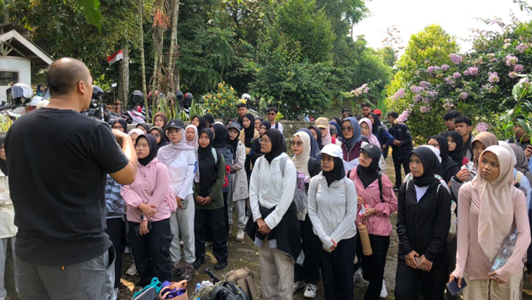
As the students walked through the sacred site of Lingga, they were invited to listen—not just with their ears, but with their entire being. Under the shade of ancient trees, surrounded by the murmur of wind and the echoes of unseen spirits, Lala Bumela began his dialogue on Eco-Poetry. He reminded his students that poetry was once a form of communication between humanity and the cosmos, an art that transcended the limits of written language. Each stone, he said, holds memory; each leaf, a metaphor. During the session, Mang Ukad, the spiritual guardian of the site, shared that the Lingga Punden Berundak was not merely an archaeological relic but a sacred observatory where ancient Sundanese kings and scholars once studied the movements of celestial bodies, observed the passage of time, and reflected upon the harmony between the earth and the heavens. The site, he explained, symbolized the wisdom of an era when learning was cosmic, and education was deeply intertwined with nature and the stars. Guided by Lala’s words that blended philosophy, spirituality, and literary craft, the class engaged in reflective writing beneath the ancient canopy. “When you write,” Lala said softly, “do not write to impress the world. Write to awaken it. Poetry is not about words—it is about listening to what the universe is trying to tell you through silence.”
The journey through Situs Sangiang became an experiential classroom, where students practiced field-based creative writing. Guided by Lala’s method, they explored how ancient Sundanese cosmology could inform contemporary environmental ethics. They learned that the ancestors once treated nature as a living scripture—where every contour of the earth and every movement of water conveyed divine meaning. Through their writing, students were encouraged to rediscover these connections and transform them into creative expressions that unite ecological consciousness with artistic vision. Lala’s integration of BIMA’s principles—Intelligence, Mindfulness, and Awareness—helped shape a holistic pedagogy that harmonized cognitive learning with emotional and spiritual depth. The result was more than literary output; it was the revival of an ancient form of knowledge transmission, one that acknowledges the soul of education as inseparable from the soul of the Earth.
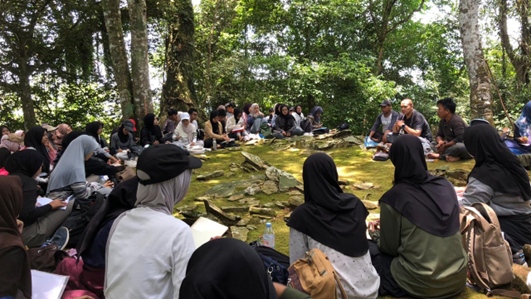
As the day ended and the sun began to dip behind the hills of Kuningan, the students gathered in a circle to share their reflections. One by one, they recited their eco-poems—each voice blending with the symphony of cicadas and rustling leaves. Their words carried the warmth of newfound understanding: that education, at its core, is about remembering the sacred relationship between humanity and creation. For many, the experience at Lingga became a moment of awakening, a realization that true creativity emerges not from isolation but from communion—with others, with history, and with nature. The Creative Writing class had transformed into a living ritual of learning, where art, ecology, and spirituality met in a single breath. This initiative by Lala Bumela not only revolutionized the way creative writing is taught but also redefined the meaning of education itself.
In the end, Eco-Poetry from Lingga stood not merely as a class project, but as a movement—a call to restore the sacred dialogue between humanity and the environment. It offered a curriculum that was not written in syllabi but lived through experience. By guiding students into direct interaction with the natural world, Lala Bumela reminded them that the greatest teacher has always been around us: the Earth. His vision for life-long global learning resonates deeply with the essence of Islamic education, which emphasizes harmony between intellect (‘aql) and nature (fitrah). “If we listen closely,” said Lala Bumela, “nature is always teaching us—about balance, humility, and gratitude. The future of education depends on how well we can hear her voice again.”Thus, through Eco-Poetry, the Creative Writing class at UIN SSC has become a bridge between modern academia and ancestral wisdom—a living testament that learning, in its truest sense, begins when we learn to listen.
Author: Muhammad Azkiya Bahtsulkhoir