
Elevating Pasir Batang into a Living Laboratory of Learning: Lala Bumela Sudimantara, Ph.D. on Multisensory Education and the Transformation of Ancestral Knowledge into Global Discourse
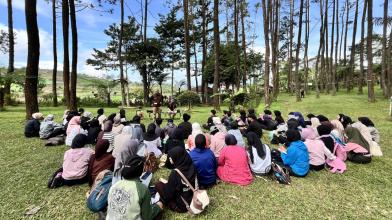
Kuningan, May 2, 2026 – In the Public Lecture Academic Voices for Sustainable Earth: Seminar Series on Sustainability and Eco-Theology organized by the International Office of UIN Siber Syekh Nurjati Cirebon at Pasir Batang, Lala Bumela Sudimantara, Ph.D., Director of the International Office and Professor of Multisensory Learning, positioned the site as a transformative multisensory learning space rather than a conventional outdoor classroom. Attended by Didin Mishbahuddin, S.Hum. (archaeologist), Mr. Sukad (a key custodian of Sundanese cultural heritage in Kuningan), the International Office team, and 84 second-semester Literacy students, the session emphasized learning as a holistic human experience. He stressed the importance of associative thinking in connecting disciplines such as history, culture, and environment into a unified framework that activates a sense of place, culture, and historical awareness. He stated, “Pasir Batang is not merely a place—it is a multisensory learning experience where knowledge is not only read, but lived through sight, sound, feeling, and affective awareness.”
Despite this vision, he highlighted a critical issue within contemporary education: the dominance of textual and theoretical approaches that separate knowledge from lived experience. He argued that environmental understanding cannot be achieved through texts alone, as such methods often produce a gap between knowledge and awareness. This condition reflects the limitations of dominant Western knowledge systems, which tend to emphasize abstraction and rationality while neglecting sensory engagement. In this context, discussions on environmental ethics—such as the upcoming Forum Group Discussion involving figures like Prof. Rudolf Wirawan, Intan Pusvitasari, and Lukman Baehaqi—risk remaining conceptual unless grounded in direct, multisensory experience, where sustainability is not only theorized but felt.
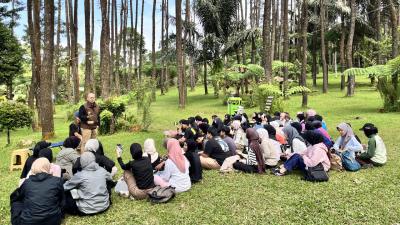
Responding to this condition, Lala Bumela Sudimantara, Ph.D. invited participants into a reflective dialogue on how knowledge should be understood and experienced. He explained that subjects such as Literacy and Academic Writing are not isolated academic domains but are inherently interdisciplinary, integrating the history of civilization, environmental studies, and eco-theology. This integration reflects embodied learning and contextualized cognition, where students engage with texts not as detached readers but as participants within real contexts. He remarked, “The question is no longer whether we have read, but whether we truly understand what we read through our own lived experience,” thereby opening a critical and reflective space among participants.
Building upon this perspective, he further developed a multisensory learning framework through his work in intonation-affective studies, which views language acquisition as both a cognitive and emotional process. This led to the development of Regenerative ELT Materials based on Multisensory Learning, characterized by the integration of language, emotion, and environment. In practice, students are encouraged to observe visual landscapes, listen to local narratives, and feel the natural and historical atmosphere of a place. Through this approach, grammar and meaning are not merely understood but internalized through sensory experience, transforming learning into an embodied and meaningful process.
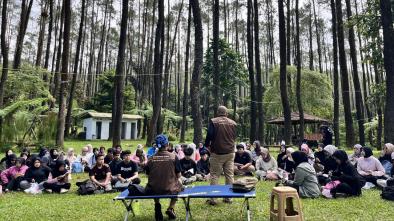
As a resolution to the disconnection between knowledge and experience, Pasir Batang is positioned as a “living text” that enables students to directly engage with the interconnectedness of history, culture, and environment. Narratives such as Lutung Kasarung and the historical traces of past civilizations are no longer abstract stories but become experiential realities within the space. Furthermore, he emphasized the importance of developing ethno-science, which translates ancestral knowledge (karuhun) into scientific frameworks without stripping away its sensory, affective, and contextual dimensions. This approach serves as a bridge between local wisdom and modern academic discourse, while also contributing to the decolonization of knowledge.
In closing, Lala Bumela Sudimantara, Ph.D. delivered a broader reflection on the future of knowledge and learning. He emphasized that multisensory, locally grounded experiences have the potential to contribute to global academic discourse, including his forthcoming presentation on eco-theology in international forums. He also stressed that achieving sustainability requires a deep understanding of environmental ethics, which, in his view, is not merely theoretical but emerges through lived, sensory engagement with the environment. In this context, he highlighted the importance of decolonization of knowledge—challenging the dominance of abstract, Western-centered epistemologies by elevating locally rooted, experiential ways of knowing. He underscored that knowledge should not be confined to rational and textual dimensions alone but must involve the integration of cognitive, affective, and sensory experiences. He concluded, “True knowledge emerges when cognition, emotion, and the senses work together—not only to understand the world, but to feel, experience, and transform it into meaningful knowledge for both local and global contexts.”
Author: Muhammad Azkiya Bahtsulkhoir