
Exposing the Gap: Muhammad Azkiya’s AI-Assisted AQRF Study Calls for Educational Revolution in Indonesia’s English Curriculum — Presented at the Pre-Conference AsiaCALL 2025
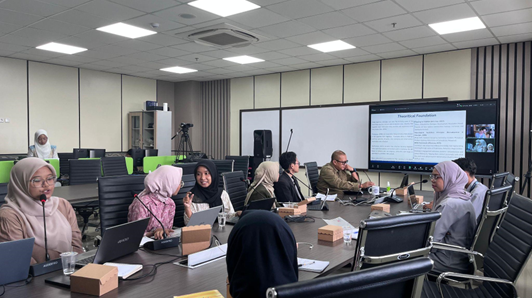
Cirebon, October, 11th 2025 — The Pre-Conference AsiaCALL 2025 Capacity Building Workshop, hosted by the International Office and Partnership of UIN Siber Syekh Nurjati Cirebon under the leadership of Lala Bumela, Ph.D., served as a dynamic platform for nurturing research excellence and international collaboration. The program aimed to train selected students to present their full papers at the AsiaCALL 2025 International Conference, emphasizing both academic depth and global engagement. Supported by expert mentoring from Emma L. Schuberg of Charles Darwin University, Australia, the workshop brought together seven members of the Global Engagement Team—young scholars representing Indonesia’s emerging voice in global academia. Among them was Muhammad Azkiya Bahtsulkhoir, whose paper titled “Exposing the Gap: AI-Assisted AQRF Evaluation of Grade 12 English Textbooks in Indonesia’s Kurikulum Merdeka for Edu-Revolution” stood out for its bold integration of artificial intelligence in educational assessment. As stated by Lala Bumela, “This program is more than just preparation for an international conference—it’s a space where our students learn to bridge research, technology, and culture as one academic identity that represents Indonesia to the world.”
For Muhammad Azkiya, the motivation behind his research began with a moment of frustration and curiosity. While reviewing Indonesia’s Grade 12 English textbooks, he noticed an inconsistency between the curriculum’s stated goals and the learning outcomes experienced by students. The materials, though well-structured, often failed to meet international standards of the ASEAN Qualifications Reference Framework (AQRF). “There was a gap,” Azkiya recalled. “The textbooks encouraged communication but lacked depth in critical and affective learning. I wanted to know—can AI help us see this gap more clearly?” This question led him to design an innovative AI-assisted evaluation model that could objectively analyze how well Indonesian textbooks align with the competencies expected across ASEAN. His work, thus, was not born from convenience but from a desire to challenge the educational status quo through data-driven reform.
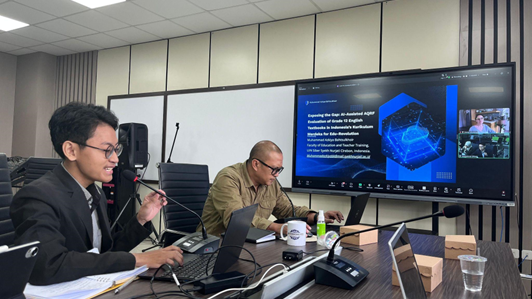
Reflecting on Azkiya’s initiative, Lala Bumela shared his admiration for the project’s depth and purpose. “What Azkiya is doing,” he said, “represents the kind of intellectual courage our generation needs. He’s not only using AI as a tool for automation but as an instrument for educational reflection.” Lala emphasized that the research aligned perfectly with the vision of UIN Siber Syekh Nurjati Cirebon—to build globally competent scholars rooted in both scientific literacy and human values. “His paper,” he continued, “invites policymakers to rethink how we define quality education. If Merdeka Curriculum aims for freedom in learning, then freedom must also include awareness, empathy, and evidence-based reform.” Through his words, the dialogue between mentor and mentee symbolized a shared vision: education must evolve not only through innovation but also through critical introspection.
Azkiya’s research developed through a mixed-method approach combining AI data analysis and AQRF benchmarking. Using natural language processing tools, he evaluated how closely the learning outcomes of Indonesia’s English textbooks align with ASEAN standards in communication, creativity, and critical thinking. The findings were striking: while the textbooks met linguistic and structural requirements, they showed deficiencies in encouraging higher-order thinking and emotional engagement. This revelation supported his argument that Indonesia’s educational revolution should go beyond curriculum reform—it must integrate AI-driven evaluation systems that reveal both cognitive and affective learning patterns. The workshop audience, including international educators, noted that Azkiya’s method represented a model of “AI for empathy,” demonstrating that technology, when guided by human intention, can expose not just academic gaps but emotional and cultural disconnects in learning materials.
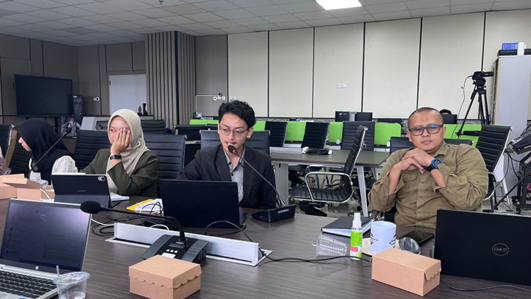
Azkiya’s presentation resonated deeply with both local and international participants. His AI-assisted AQRF evaluation framework was praised for providing measurable insight into how education systems can balance technology and humanity. “AI shouldn’t replace teachers or students,” Azkiya remarked, “but it should help us read education differently—through data that feels.” His study proposed a revolutionary model of assessment that integrates emotional understanding into language learning evaluation, bridging the divide between affect and intellect. By visualizing empathy as quantifiable data, Azkiya offered a new perspective for curriculum designers and policymakers. His research did not merely expose a gap—it invited a movement to close it through innovation, awareness, and shared responsibility.
As the workshop concluded, Lala Bumela highlighted how Azkiya’s study embodied the essence of the Merdeka Curriculum: independent yet interconnected, critical yet compassionate. “What we see here,” he said, “is the beginning of an educational awakening. Azkiya’s work calls for Indonesia to embrace AI not as a threat, but as a partner in reflection—a mirror for our educational soul.” The event closed with a renewed sense of purpose among the participants: to make education in Indonesia not only competitive at the ASEAN level but also humane and emotionally intelligent. Through his work, Muhammad Azkiya Bahtsulkhoir reminded everyone that the true revolution in education begins when data meets empathy, and when technology serves the human heart.
Author: Muhammad Azkiya Bahtsulkhoir