
From Campus to Sacred Grounds: Lala Bumela Sudimantara, Ph.D. Leads English Language Teaching Department Students on Immersive Journey into Sundanese Wisdom at Sagarahiang
Kuningan, April 25, 2026 – In a powerful demonstration of experiential pedagogy, students from the second semester of the Tadris Bahasa Inggris program at UIN Siber Syekh Nurjati Cirebon embarked on a transformative fieldtrip to Sagarahiang Village in Kuningan Regency, an area revered as the sacred setting of the Sundanese epic Lutung Kasarung. Led by Lala Bumela Sudimantara, Ph.D., Director of the International Office and lecturer in the English Language Teaching Department, the journey transformed the landscape into a living classroom where language learning merged with cultural immersion and ecological awareness. The event was part of "Academic Voices for a Sustainable Earth: Seminar Series on Sustainability and Eco-Theology", a two-part academic series. The field trip served as Part I: Sagarahiang Gathering (Saturday, April 25, 2026), which precedes Part II: Pasir Batang Forum (Saturday, May 2, 2026). This seminar series represents a key component of the institution's Curricular Enhancement and English Language & Literacy for Academic Purposes initiative, integrating experiential learning with academic rigor.
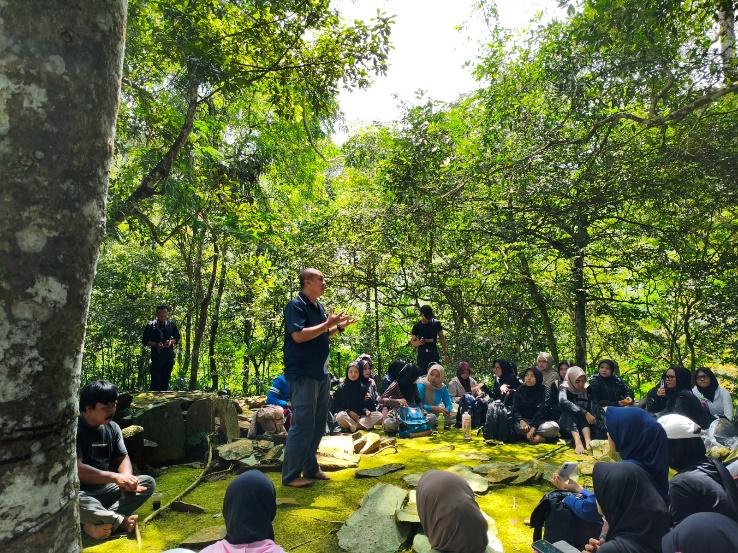
After having successfully hosted international delegates just one week prior, this visit further reinforced Lala Bumela Sudimantara, Ph.D.’s unique position as a bridge between global academic discourse and Indonesia’s most profound local knowledge systems. The field trip exemplified UINSSC’s institutional commitment to grounding English language education in place-based, culturally rooted epistemologies. The day began with Lala Bumela Sudimantara, Ph.D. contextualizing Sagarahiang not as a tourist destination but as a living archive, a site where oral tradition, ecological ethics, and spiritual governance converge. He emphasized that this area, nestled in the foothills of Mount Ceremai, is the authentic setting of Lutung Kasarung. “This is not merely folklore,” he explained, “but a pedagogical blueprint for relational intelligence, environmental stewardship, and community resilience.” Students listened intently as he connected classroom concepts, such as Reading for Emotion and Aesthetic and Multisensory CALL to tangible landscapes, the sacred springs of Citampian, the terraced agricultural zones, and the ritual pathways that encode centuries of ecological observation. For many students, this was their first encounter with learning that transcends textbooks and enters the realm of embodied experience.
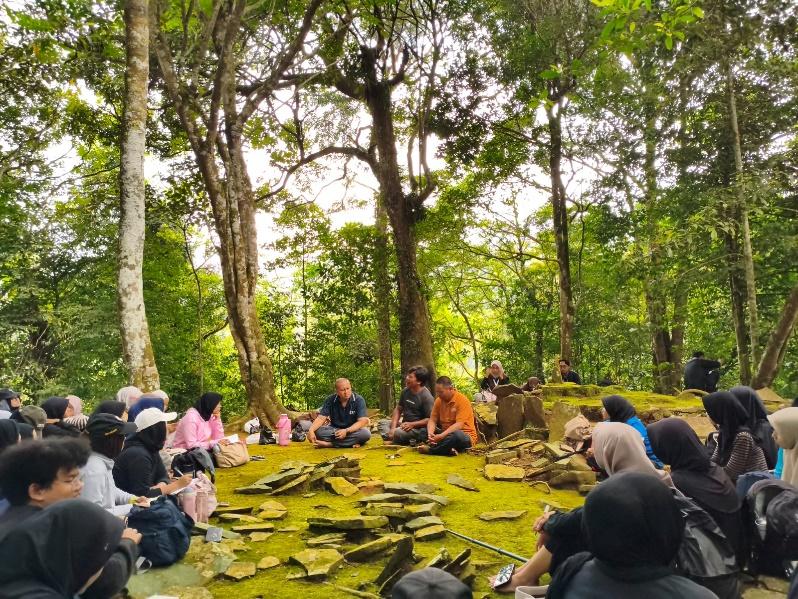
Central to the visit was engagement with Mr. Sukad, Spiritual Elder and Guardian of Saragahiang, who shared the tripartite ecological zoning system still practiced today, they are larangan (forbidden zone), tutupan (protected buffer), and baladahan (cultivation area). Mang Ukad detailed how traditional calculations, dividing mountain slopes by seven and multiplying by nine, determine protected radii around water sources like Ibu Pertiwi, Sekadel, and Seke Menger. “From any spring upward approximately 100 meters is protected territory, nothing may be disturbed, not even cigarette butts,” he stated, underscoring the scientific rigor embedded in ancestral practice.Lala Bumela Sudimantara, Ph.D. translated these insights into pedagogical frameworks, showing how such systems reflect non-linear, spiral models of sustainability that directly challenge technocratic SDG approaches. International Office interns documented these teachings for future curriculum integration, recognizing their relevance to global discussions on climate resilience and indigenous knowledge.
The group also explored the archaeological significance of the site, including the lingga-yoni stone complex, a symbol of gender balance and cosmic harmony dating back over 4,000 years. Unlike the Monas in Jakarta, Sagarahiang’s lingga functioned as an ancient astronomical instrument, its shadow tracked seasonal cycles, guiding agricultural and ritual calendars. They highlighted how such artifacts are not relics but active components of a knowledge ecosystem, one that integrates cosmology, hydrology, and social ethics.
Lala Bumela Sudimantara, Ph.D. further framed the fieldtrip as a direct extension of his scholarly mission which is to decolonize English Language Teaching by anchoring it in local epistemologies. He demonstrated how Carita Pantun functions as a multisensory mnemonic architecture, embedding agricultural knowledge, ethical codes, and ecological forecasting through rhythm and ritual. This insight directly informs his development of Multisensory CALL methodologies. The students and International Office interns noted how this approach transforms language acquisition from linguistic mimicry into identity-affirming practice.
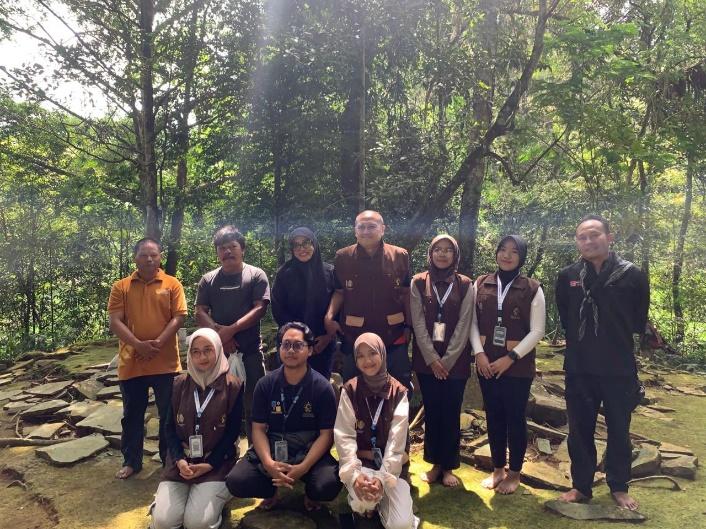
Reflecting on the day’s significance, Lala Bumela Sudimantara, Ph.D., stated: “True internationalization begins when we move beyond counting foreign delegations and start measuring shared human impact. By bringing our students to Sagarahiang, we prove that Indonesian wisdom can shape global educational paradigms.” His words captured the essence of the public lecture: not as an excursion, but as a strategic act of epistemic recentering. They embodied the very principle Lala Bumela Sudimantara, Ph.D. champions that learning must be relational, regenerative, and rooted in place.
UIN Siber Syekh Nurjati Cirebon has once again demonstrated that Indonesia is not merely a host country but a living laboratory where ancestral intelligence and global scholarship co-create regenerative futures. Through Lala Bumela Sudimantara, Ph.D. 's leadership, Sagarahiang becomes a global reference point for education that honors both Earth and Creator.
Author: Resa Diah Gayatri