
From Questions to Reflection: Focus Group Discussion on Sundanese Ecotheology Generates Critical Dialogue Through an Engaging Question-and-Answer Session
Kuningan, May 23, 2026 — The concluding session of the Focus Group Discussion (FGD) From Erasure to Emplacement: Reclaiming Sundanese Ecotheology in Digital English Language Teaching provided participants with an opportunity to engage directly with the speakers through an interactive question-and-answer forum. The discussion session opened with a series of reflective questions raised by Wulan Rahmatunnisa, M.Pd., a lecturer from Universitas Kuningan, who invited the speakers to connect personal experiences with broader educational and cultural practices. Addressing Sukad, she asked, “Although you did not receive extensive formal education, how did you develop such a deep understanding of nature and local knowledge?” She then directed another question to Didin Misbahuddin, S.Hum., asking, “When I was a child, many teachers used songs and chants to help students memorize learning materials. Is this practice related to Sundanese oral traditions such as Carita Pantun?” Wulan also raised a practical question for Intan Pusvitasari, M.Si., concerning emotional wellbeing in daily life. She remarked, “When work-related pressures are brought home, what can we do to avoid transferring negative emotions to our family members?” These questions set the tone for a discussion that connected local wisdom, oral tradition, and personal development. The session encouraged participants to reflect on how knowledge is acquired, transmitted, and practiced in everyday life.
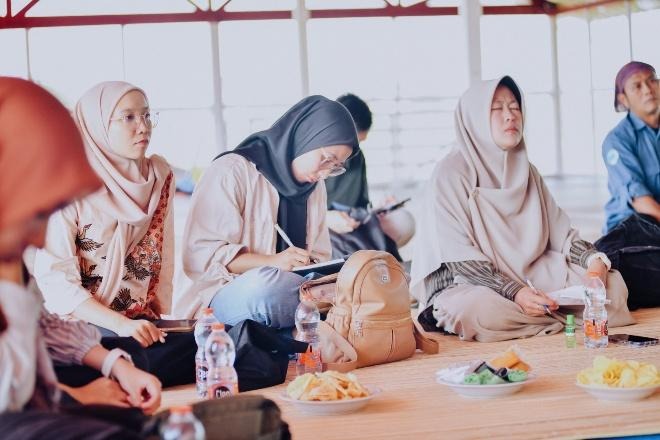
Responding to Wulan’s questions, the speakers offered complementary perspectives rooted in their respective experiences and fields of expertise. Sukad explained that much of his knowledge was developed through direct encounters with people, places, and nature, emphasizing that learning can emerge from continuous observation and lived experience rather than formal education alone. For the second question, Didin Misbahuddin, S.Hum. then highlighted the long-standing Austronesian tradition of oral transmission, explaining that storytelling and chanting have historically functioned as important vehicles for preserving knowledge and values. Meanwhile, Intan Pusvitasari, M.Si. addressed the issue of emotional pressure by encouraging participants to create a transition period between work and home life before interacting with family members. She also suggested viewing everyday tensions as natural elements within human relationships rather than solely as negative experiences. Reflecting on this idea, Intan remarked, “Before entering the house, release the accumulated energy first, even a short walk can make a difference.”
Another meaningful discussion emerged when Nurfitri Habibi, M.Pd. raised two questions concerning student motivation and the educational philosophy behind traditional agricultural practices. Referring to Intan’s earlier explanation, she asked, “If students have a large ‘inertia mass’ and lack motivation to learn, what can teachers do to help them move and engage in learning?” In response, Intan explained that excessive external pressure sometimes increases resistance rather than encouraging growth. She suggested that educators first reduce students’ “cognitive friction” by creating supportive learning spaces where learners can reflect, regain confidence, and develop gradually. According to her, meaningful motivation often emerges after students feel emotionally secure and free from unnecessary burdens. Nurfitri also asked, “Why did Ki Hadjar Dewantara compare educating children to cultivating rice, and how can this be understood from the perspective of ancient Sundanese traditions?” Responding to this question, Didin explained that in Sundanese cosmology, rice cultivation was not merely an agricultural activity but also a spiritual practice that reflected gratitude, care, and responsibility toward life. He stated, “For ancient Sundanese communities, planting rice was a form of devotion and a reminder that growth requires patience, attention, and continuous nurturing.”
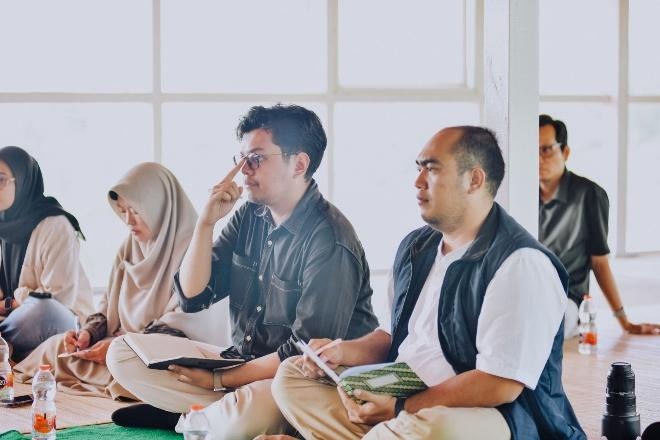
The discussion then shifted toward practical implications for English language teaching when Dadang Setiawan, S.Pd. raised a question about transforming the insights gained from the FGD into concrete educational action. Reflecting on the presentations, he asked, “How can teachers translate the ideas discussed in this FGD into real classroom practices that integrate local wisdom into English language learning?” Responding to the question, Lala Bumela Sudimantara, Ph.D. emphasized that meaningful educational change depends more on teachers than on curriculum documents alone. He argued that learning should extend beyond classroom walls and encourage students to engage directly with nature, culture, and their surrounding communities. Drawing from his own teaching experience, he explained that many of his courses intentionally include outdoor learning activities to reduce excessive screen time and create deeper learning experiences. He further observed that many educational institutions continue to rely heavily on conventional assessments despite claiming to adopt innovative approaches. As he stated, “Curriculum doesn’t matter as much as the people who bring learning to life.” Lala Bumela Sudimantara, Ph.D. also shared his vision of developing Pasir Batang and Sagarahiang as a local wisdom learning hub where educators, cultural elders, environmental activists, and academics could collaboratively contribute to future educational initiatives.
Another thought-provoking question was raised by Galang Adhitia Mahardika, M.Pd., who reflected on Intan Pusvitasari’s explanation of mechanical incubation and emotional release. He asked, “What should we do when the people we trust as mentors or safe spaces for sharing personal problems end up disclosing our stories to others?” In response, Intan acknowledged that finding trustworthy individuals requires patience, experience, and careful judgment. She explained that disappointment resulting from misplaced trust can become an opportunity to evaluate relationships more critically and develop stronger emotional awareness. Rather than relying entirely on others, she encouraged participants to first process their emotions independently through reflective writing, physical activity, or other healthy forms of self-expression. According to her, these practices can help reduce emotional pressure before seeking support from others. She emphasized that sharing personal struggles should not always be the first response to emotional distress. As Intan remarked, “Sometimes the safest place to begin processing our emotions is within ourselves, before entrusting them to someone else.”
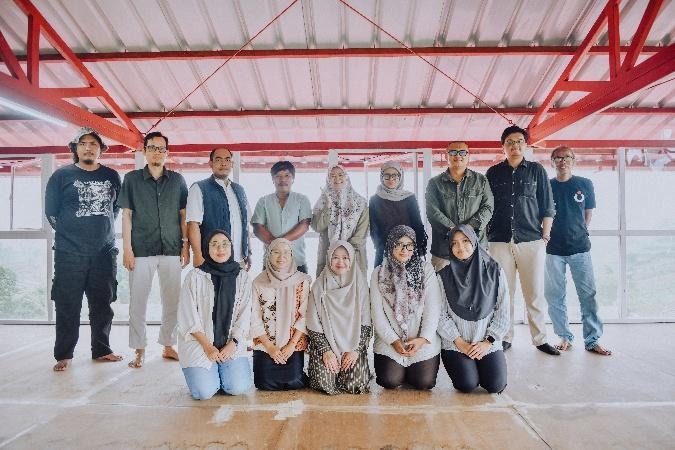
As the session drew to a close, participants left with a deeper appreciation of how local wisdom can illuminate contemporary educational and personal challenges. The discussion demonstrated that questions about learning, culture, emotional well-being, and community development are closely connected rather than separate concerns. Through the diverse perspectives shared by Sukad, Didin Misbahuddin, S.Hum., Intan Pusvitasari, M.Si., and A/Prof. Lala Bumela Sudimantara, Ph.D., the audience was encouraged to reconsider the relationship between knowledge and lived experience. The exchange also reinforced the broader theme of the FGD, namely the importance of reclaiming indigenous knowledge as a meaningful resource for education and sustainability. Attended by educators, cultural practitioners, alumni, and International Office interns, the forum concluded with a shared commitment to building learning environments that are more reflective, culturally grounded, and ecologically conscious.
Author: Salsabilla