
From Technocracy to Regeneration: Prof. Rudolf Wirawan, Ph.D. Inspires Global Sustainability Thought with BIMA Framework at the Final Day of International Seminar and Workshops 2025
Cirebon, December 4, 2025 — The International Office of UIN Siber Syekh Nurjati Cirebon successfully held the final day of the International Seminar and Workshops 2025 with the theme “Returning to the Circle: A Regenerative Pathway Beyond Technocratic Sustainable Development Goals,” conducted in a hybrid setting at the International Office, 5th floor of the Cyber Building. The session was attended by the Director of the International Office, Lala Bumela Sudimantara, Ph.D., along with virtual speakers Prof. Rudolf Wirawan, Ph.D. (Adelaide University, Australia) and Luqman Baehaqi, Ph.D. (UIN Palangka Raya), as well as Ivan Chabibillah, M.Li. (International Cultural Communication Center, Malaysia) and members of the Global Engagement Team. The keynote session by Prof. Rudolf, moderated by Nurhusni Yusriyyah Yumna from the Global Engagement Team, presented a critical reflection on current development paradigms, especially the technocratic tendencies within the SDGs. In his introduction, he emphasized that sustainability must be re-rooted in natural principles and relational balance rather than rigid measurement systems. Prof. Rudolf stated, “My presentation is not to attack SDGs, but to understand why they become technocratic, why they produce an intended extraction, and how we can return to the ancient, natural, and universal principles of balance.”
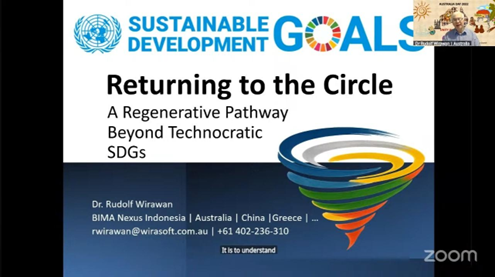
In his presentation, Prof. Rudolf explained how technocratic approaches to the Sustainable Development Goals (SDGs) often prioritize targets, deadlines, and linear growth without considering the deeper ecological and social systems they influence. He argued that such SDG frameworks tend to centralize decision-making and remove agency from local communities who possess valuable ecological knowledge. These limitations highlight the disconnect between global SDG agendas and the lived realities of local contexts, especially in regions facing rapid development pressures. Prof. Rudolf emphasized that a relational and regenerative approach is needed, one that recognizes the interconnectedness of ecosystems and communities rather than focusing solely on numeric targets. He warned that continuing along the path of rigid technocracy risks reinforcing global inequalities and ecological degradation. His analysis encouraged participants to critically reflect on how SDG implementation can unintentionally reproduce extraction rather than support genuine regeneration.
Moving forward, the keynote discussed the contradictions within economic systems tied to SDG implementation, particularly those relying heavily on measurable growth indicators. Prof. Rudolf noted that an exclusive focus on GDP expansion within SDG strategies often overlooks environmental degradation and social displacement, particularly in areas such as Sumatera and Kalimantan, where local communities may not perceive or benefit from such growth. He highlighted the risk that rigid SDG frameworks can alienate local voices and knowledge, limiting the capacity for contextualized sustainability. Moreover, he emphasized that green growth narratives embedded in some SDG programs may mask greenwashing practices, creating superficial alignments with sustainability while failing to transform core systems. The integration of SDGs with broader development initiatives brings both opportunities and challenges, requiring policymakers to rethink what equality and sustainability truly mean. His critique underscored the need for SDG frameworks that value ecological wisdom, community empowerment, and environmental integrity.
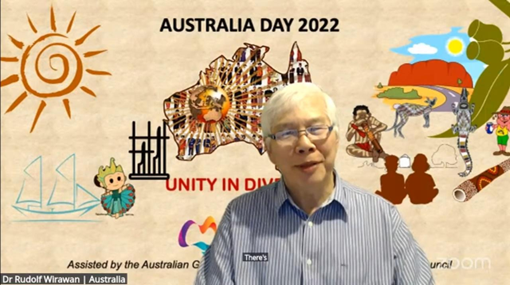
In the following section, Prof. Rudolf introduced the importance of circular thinking as a method of fostering generative and restorative systems. Circular thinking reframes development as a dynamic and adaptive cycle rather than a linear path dependent on fixed metrics. This model encourages ongoing reflection, regeneration, and responsiveness to ecological changes, offering a counterpoint to the rigid structure of SDG targets. He discussed how the mismatch between SDG indicators and global power dynamics reveals deeper systemic issues that simplistic measurements cannot capture. To illustrate alternatives, he presented the BIMA framework (Bridging Intelligence, Mindfulness, and Awareness) as an example of a holistic and context-sensitive approach. BIMA, he explained, enables a more grounded understanding of sustainability by centering relationality, cultural narratives, and local wisdom. Through this perspective, development becomes a living process rooted in balance, evaluation, and continuous adaptation.
The philosophical foundation of BIMA was further explored through the concepts of Yin and Yang, representing regeneration and transformation. Yin symbolizes renewal, sustainability, and the restorative qualities essential for ecological and social well-being. In contrast, Yang represents action, transformation, and the necessary steps toward implementing sustainable practices. According to Prof. Rudolf, sustainable progress arises when Yin and Yang operate in harmony, ensuring that proactive actions do not overshadow the vital processes of renewal. He positioned BIMA as a living, circular system that continuously evolves with changing social and environmental conditions. This stands in contrast to the SDGs’ more rigid timelines, which may not fully capture the complexity of global ecological challenges. Through this framework, he encouraged academia, policymakers, and communities to adopt a more balanced and regenerative approach to development.
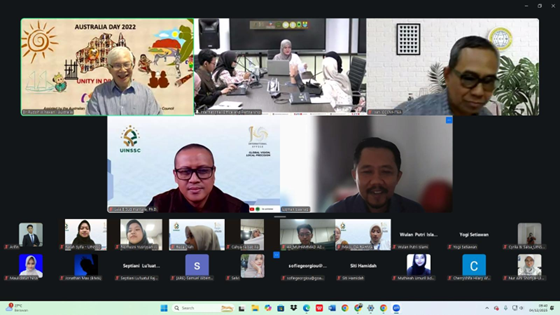
Closing the event, the session remained highly interactive despite being conducted online, with many participants actively sharing insights, raising questions, and responding to the critical points presented by Prof. Rudolf. The discussion covered various SDG traps, emphasizing the interconnected challenges of poverty, food security, education, gender equality, water management, energy transition, economic growth, and climate action. Participants engaged deeply with the idea that addressing these issues requires not only technical solutions but also systemic awareness, cultural wisdom, and ecological sensitivity. As the peak agenda of the three-day program, the keynote successfully opened a reflective space for reimagining global sustainability beyond its technocratic boundaries. At the end of the session, Prof. Rudolf expressed his appreciation and stated, “With the insights I gained from the other audiences, I am inspired to write a white paper about Cirebon and its local wisdom to be shared with the world.” He concluded by reaffirming that sustainable regeneration must begin with restoring balance between humans and the natural cycles that sustain life.
Author: Salsabilla