
Historical Roots and the Institutionalization of Language Diplomacy: A Critical Evaluation of BIPA Programs and Cultural Assimilation in China from 1949 to the Era of Artificial Intelligence
Cirebon, August 06, 2026 – The Thursday session of the Seminar of the Education and Cultural Attachés and the Deputy Permanent Delegate of the Republic of Indonesia to UNESCO opened with a comprehensive examination of the Chinese landscape, where Indonesian studies have been institutionally embedded for more than seven decades. Lestari Puspitaningsih, Ph.D., the Education and Cultural Attaché of the Indonesian Embassy in Beijing, reminded the forum that Peking University inaugurated its Malay program in 1949, only four years after Indonesian independence, before transforming it into a full Indonesian language and culture program. From the standpoint of the International Office, such longevity signals that any contemporary partnership with Chinese universities must be read as the continuation of an already mature scholarly tradition rather than as an experimental outreach. The presentation therefore functioned as both a historical audit and a prospective roadmap for Indonesian campuses seeking engagement in East Asia.
Today, twenty-four Chinese universities administer Indonesian language programs, although their institutional commitments vary considerably because several campuses open and close classes annually according to internal staffing policies. The establishment of the Indonesian Language Teachers Association of China on 8 May 2026, the seventh such branch globally, introduces a professional body capable of standardizing modules and certifying instructors across this fragmented landscape.
Parallel to this consolidation, a Chinese technology company has proposed the joint development of an artificial intelligence platform dedicated to Indonesian language learning, an initiative that would partially compensate for the chronic scarcity of native-speaker lecturers. Cultural houses anchored at Tianjin Foreign Studies University with Universitas Brawijaya, and a second one under administrative preparation at Fujian Normal University with Universitas Hasanuddin, extend the diplomatic footprint beyond the capital. These layered institutions demonstrate that language promotion in China increasingly operates through a hybrid architecture of profession, technology, and campus-based cultural infrastructure.

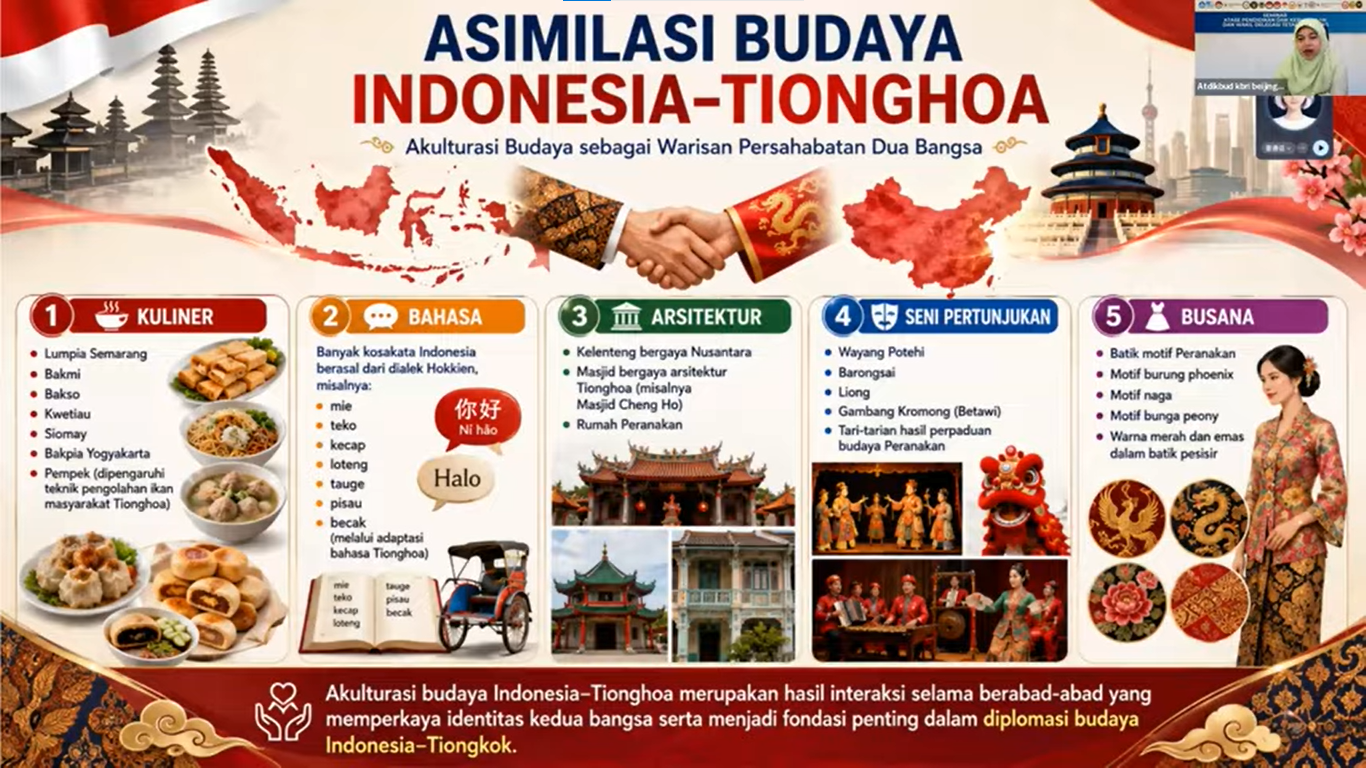
Linguistic assimilation between the two civilizations predates formal diplomacy, as the Hokkien dialect contributed essential vocabulary such as mie, kecap, loteng, and becak to everyday Indonesian. Architectural and performative traces, from kelenteng temples to barongsai processions and batik motifs bearing dragons and phoenixes, confirm a centuries-old osmosis that contemporary cultural programming deliberately reactivates. Within the academy, the Central Conservatory of Music has integrated Javanese and Sundanese gamelan into its world music curriculum, employing a native Indonesian lecturer and serving as the embassy's principal partner for cultural performances.
Culinary festivals, orchestral collaborations, short-film discussions, and the recurring speech contest co-hosted with Beijing Foreign Studies University sustain a rhythm of public engagement that reaches well beyond enrolled students. For the International Office, this evidence suggests that cultural familiarity, rather than novelty, constitutes Indonesia's strongest negotiating asset in the Chinese public sphere.
Nevertheless, the expansion of Indonesian presence in China is mirrored by a reverse flow of Chinese workers into Indonesian industrial zones, where cross-cultural friction has become an unavoidable sociological fact. Companies investing in regions such as Central Sulawesi have frequently prioritized technical competence over linguistic and cultural preparation, leaving expatriate staff without adequate Indonesian language facilities before deployment. The resulting misunderstandings have, in several semesters, produced a situation in which Mandarin courses proliferate while the host country's language receives minimal institutional accommodation.
Addressing this asymmetry during the discussion, the attaché stated, "Indeed, language is not the only obstacle; culture is the primary source of friction." The remark obliges Indonesian higher education institutions to design compulsory cross-cultural modules for foreign workers and students, transforming a labor-market problem into an academic service opportunity.
On the mobility front, the scholarship architecture connecting the two countries is unusually diverse, ranging from the Indonesian Dharma Siswa program to the Chinese Government Scholarship and, distinctively, to industry-sponsored schemes. Chinese enterprises operating in Indonesia now recruit graduating vocational and senior high school students, finance their language year and tuition in China, and reabsorb them into industrial plants upon completion. Although such corporate scholarships typically cover tuition without living allowances, they create a predictable pipeline of bilingual technicians whose formation Indonesian campuses can influence through preparatory partnerships.
The attaché further confirmed that Indonesian universities may channel cooperation proposals through the embassy, through the Indonesian Language Teachers Association of China, or directly through member campuses whose financing and policies remain autonomous. For the International Office, this multiplicity of entry points demands a coordinated strategy that aligns faculty expertise with the specific expectations of each Chinese partner university.
Ultimately, the Chinese case illustrates that language diplomacy matures when it is delegated to durable institutions rather than to episodic events. Professional associations, artificial intelligence platforms, cultural houses, and corporate scholarships together compose an ecosystem in which Indonesian campuses can insert visiting lecturers, joint research, and student exchange with minimal reinvention of existing structures.
The International Office concludes that early correspondence with the embassy in Beijing, coupled with membership in the teachers' association network, should precede any formal memorandum of understanding. Equally important is the preparation of intercultural curricula that respond to the frictions identified in Indonesian industrial zones, thereby converting a defensive need into an exportable academic product. Pursued with this dual orientation, engagement with China can evolve from historical inheritance into a deliberately engineered partnership of knowledge.