
In a Visionary Opening Address, Lala Bumela, Ph.D., Highlights Cirebon’s 700-Year Intellectual Heritage and UIN SSC’s Leap into a Fully Digital Islamic Cyber University at the AsiaCALL 2025 Pre-Conference
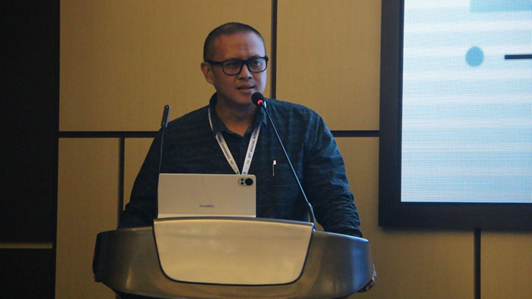
Cirebon, November, 14th 2025 — The Pre-Conference of The 22nd AsiaCALL International Conference 2025 opened with a grand and intellectually charged atmosphere as Lala Bumela, Ph.D., President of the AsiaCALL International Conference 2025 and Director of the International Office UIN Siber Syekh Nurjati Cirebon, delivered a visionary address that set the tone for the entire event. The hall was filled with distinguished figures, including Assoc. Prof. Hassan Khosravi, Ph.D. (The University of Queensland, Australia), Prof. Shameem Rafik-Galea, Ph.D. (SEGi University, Malaysia), Assoc. Prof. Dr. Pham Vu Phi Ho, Ph.D. (Industrial University of Ho Chi Minh City, Vietnam), and Made Hery Santosa, Ph.D. (Universitas Pendidikan Ganesha, Indonesia), accompanied by the core leaders of UIN SSC’s International Office—Ghina Amaliyah Sholihah, S.Sos and Ivo Dinasta Yanuar, S.S., M.Appling. Also present were invited pre-conference speakers, Sirniawati, M.A. and Wulan Rahmatunnisa, M.Pd., whose contributions enriched the academic momentum. Hundreds of students and faculty members from English Language Education filled the hall, eager to engage in discussions on AI-driven language education. In his opening, Lala Bumela, Ph.D. anchored the audience to Cirebon’s intellectual ancestry, declaring, “Seven centuries ago, Cirebon was a meeting point for scholars from the Middle East—an intersection of linguistics, anthropology, medicine, and culture. Today, through AsiaCALL, we reconnect with that legacy.” His words served as an intentional reminder that the conference was not only an academic endeavor but a historical continuation of the city’s long-standing relationship with global scholarship.
However, Lala Bumela, Ph.D. did not romanticize history without critique. He firmly acknowledged that Cirebon’s illustrious intellectual identity did not remain uninterrupted. In his speech, he addressed the profound disturbance that came with colonial intrusion, explaining that the once vibrant intellectual center gradually lost its scholarly visibility and influence. “The intellectual light of this city was dimmed,” he noted, “not because its people lacked vision, but because history imposed silence on a vibrant center of knowledge.” He extended this historical disturbance into a modern-day parallel, asserting that the digital age—despite its promises—casts new shadows over education. Questions arise about the overwhelming flood of information, the risk of superficial learning, and the fear that artificial intelligence may overshadow human reflection. By highlighting these disturbances, he invited participants to recognize that innovation must emerge from awareness, not naïveté, and that progress is meaningful only when built on critical consciousness. His reflection framed the conference as a space to confront these tensions, rather than escape them.
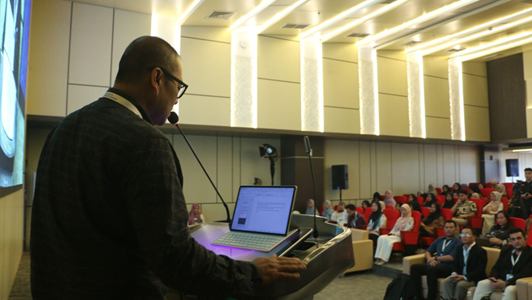
Addressing the audience with a dialogical approach, Lala Bumela, Ph.D. positioned the AsiaCALL Pre-Conference as a platform to grapple with these challenges through collective inquiry. He emphasized that the theme AI in Language Education: Opportunities, Challenges, and Future Directions should not be interpreted as a celebration of technology alone but as an intellectual responsibility that demands rigorous questioning. “We are not here to celebrate technology blindly,” he asserted. “We are here to ask difficult questions—how AI can support creativity, deepen comprehension, and elevate human intellect.” His statement served as an intellectual provocation, inviting both seasoned scholars and young academics to challenge assumptions, interrogate methodologies, and explore the philosophical implications of machine intelligence in educational spaces. Lala Bumela, Ph.D. underscored that every participant—whether academic, practitioner, or student—plays a role in shaping the narrative of AI in education. Rather than positioning technology as a savior or threat, he encouraged a nuanced dialogue that situates AI as a tool that must be directed with wisdom, intentionality, and ethical foresight.
To build on the intellectual foundations laid earlier, Lala Bumela, Ph.D. narrated UIN SSC’s remarkable transformation into Indonesia’s pioneering fully digital Islamic cyber university. He reminded the audience that this transformation, completed only a year prior, marked a historic milestone not only for UIN SSC but also for the evolution of Islamic higher education nationwide. He articulated that the transition was not a superficial modernization but a profound institutional shift that redefined the university’s identity, academic architecture, and global positioning. “We did not become a cyber university to follow a trend,” he emphasized. “We did it to honor a legacy and shape a future.” He celebrated the contributions of pre-conference speakers, Miss Nia and Miss Wulan, highlighting how their research and practice illustrate the delicate balance between pedagogical tradition and technological innovation. Their presence, he noted, symbolizes UIN SSC’s commitment to bridging local intellectual talent with global knowledge networks. Through this developmental narrative, he illustrated that UIN SSC stands not merely as a participant in the digital transformation discourse, but as a leader charting a unique and values-driven path.
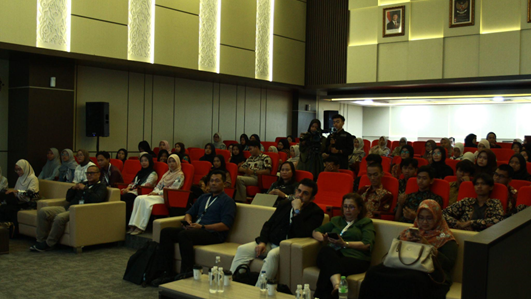
In bringing coherence to the historical, philosophical, and institutional threads woven throughout his speech, Lala Bumela, Ph.D. articulated a resolution rooted in purpose and direction. He argued that UIN SSC’s transformation is ultimately a mission to restore Cirebon’s historic intellectual role while adapting it to the demands of the digital age. The AsiaCALL Pre-Conference thus becomes more than an academic event—it becomes a symbolic restoration of Cirebon’s identity as a global center of knowledge exchange. The presence of scholars from Australia, Vietnam, Malaysia, and across Indonesia affirms this reawakening. He emphasized that the dialogues transacted in this pre-conference will ripple outward, influencing how AI education is developed, theorized, and implemented across diverse contexts. The resolution he offered was not merely institutional but civilizational: a call for UIN SSC to embody the spirit of intellectual revival, ethical digitalization, and cross-cultural academic collaboration.
Concluding with a powerful moral reflection, Lala Bumela, Ph.D. urged all attendees to internalize the significance of the moment and to see themselves as contributors to a broader global educational transformation. He reminded the audience that the future of AI, language education, and digital pedagogy will be shaped not only by algorithms and systems but by human imagination, ethical responsibility, and collaborative spirit. “Let this conference ignite ideas that move beyond this room,” he proclaimed with resolve. “May UIN SSC continue to lead with integrity, innovation, and the courage to imagine a future where technology strengthens—not replaces—human wisdom.” His final message transformed the pre-conference into a philosophical mandate: that the pursuit of knowledge, when guided by historical awareness and moral purpose, becomes a force capable of shaping not only academic discourse but the future of humanity. With this, he framed the AsiaCALL 2025 Pre-Conference as both a scholarly milestone and a moral compass for generations to come.
Author: Muhammad Azkiya Bahtsulkhoir