
Indonesia–South Korea: Strengthening Cultural Diplomacy through Bahasa Indonesia, BIPA, and University Partnerships
Cirebon, August 05, 2026 – The session on Indonesian Language and Culture in South Korea provided an overview of Indonesia’s cultural diplomacy strategies and educational cooperation in South Korea. The session, delivered by Dr. Amaliah Fitriah, Ph.D., Education and Cultural Attaché of the Embassy of the Republic of Indonesia (KBRI) in Seoul, highlighted how Indonesian language education, cultural programs, and university partnerships have become important channels for strengthening mutual understanding between Indonesia and South Korea.
One of the key initiatives presented was the Indonesia Centre (IC) at Busan University of Foreign Studies (BUFS). The centre was officially inaugurated on June 2, 2022, as a result of collaboration between BUFS and KBRI Seoul. The inauguration brought together representatives from Indonesian and Korean institutions, including the Rector of BUFS, the Indonesian Ambassador to Korea, the former Korean Ambassador to Indonesia, and representatives of Indonesian institutions in South Korea. The Indonesia Centre serves as a platform for promoting Indonesian culture and strengthening cultural diplomacy while providing opportunities for collaboration between Indonesian and Korean higher education institutions.
Rather than functioning solely as a cultural exhibition space, the Indonesia Centre facilitates various activities, including festivals, workshops, cultural classes, and cultural exchanges. However, its activities are closely connected to the academic calendar of BUFS because the centre operates within the university environment. Limited funding and capacity also mean that individual programs often depend on support from participating institutions or organizers. Despite these limitations, the Indonesia Centre provides an important entry point for Indonesian universities seeking to establish cooperation with BUFS and expand their international engagement in South Korea.
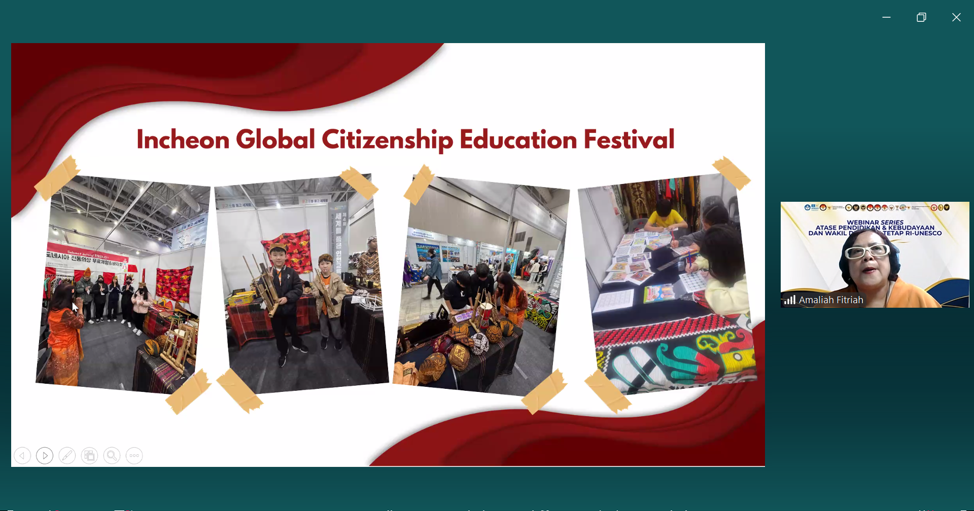
Cultural diplomacy is also implemented through major multicultural and educational festivals in South Korea. The Busan Global Citizenship Festival, organized by the Busan Metropolitan Government, is an annual multicultural event regularly attended by KBRI Seoul in cooperation with Perpika. With an international audience, the festival provides an effective platform for introducing Indonesian culture to a broader community. Similarly, the Incheon Global Citizenship Education Festival, organized by the Incheon Metropolitan Office of Education, is one of the largest education and cultural festivals in the city. The event attracts approximately 1,200 participants from schools and educational communities and features conferences, university promotion booths, cultural booths, and cultural performances.
Another important initiative is Indonesian Embassy Goes to School, a KBRI Seoul program designed to introduce Indonesia to students in Korean schools. The program works with Perpika, APP BIPA Korea, and local governments, including cooperation with Yongin City at Seongji Middle School. Beyond introducing Indonesian language and culture, the program utilizes the growing interest in Global Citizenship Education (GCED) among Korean schools and education authorities. This creates opportunities for Indonesian universities to participate in international community service programs when their schedules align with the embassy's school outreach activities.
Student and teacher exchanges also form an important component of Indonesia’s cultural diplomacy. These initiatives aim to develop deeper intercultural understanding through direct educational interaction. The presentation also highlighted cooperation involving Korean Official Development Assistance (ODA), KBRI, APCEIU-UNESCO, and the Seoul Metropolitan Office of Education, demonstrating that educational diplomacy can extend beyond language instruction into broader international education and citizenship initiatives.
A particularly significant area of cooperation is Bahasa Indonesia bagi Penutur Asing (BIPA). The BIPA program in Korea has demonstrated strong public interest, receiving a MURI award in 2023 for the largest number of online learners and recognition from the Indonesian Language Agency in 2025 as one of the 15 Indonesian representative offices with the highest number of learners. The program currently accommodates an average of approximately 800 South Korean participants per year, including Korean nationals residing overseas.
The BIPA program is supported by 13 teachers and offers instruction from Level 1 to Level 7, covering beginner to advanced proficiency. Each batch averages approximately 22 classes and utilizes an online Learning Management System (LMS). This structure enables Indonesian language education to reach learners across different levels while maintaining a relatively broad and accessible learning environment.

Importantly, BIPA learning in Seoul goes beyond language acquisition. Learners are also introduced to Indonesian cultural practices through offline classes, Indonesian cultural classes, and BIPA competitions. Cultural activities include learning traditional batik, gamelan, and Indonesian dances. The KBRI Seoul also holds a gamelan class every Saturday afternoon, providing learners with opportunities to experience Indonesian culture directly rather than encountering it solely through language materials.
At the university level, Indonesian language and culture are also taught through Malay-Indonesian Studies programs. Two institutions specifically highlighted in the presentation are Busan University of Foreign Studies (BUFS) and Hankuk University of Foreign Studies (HUFS). These programs demonstrate that Indonesian studies have an established place within the Korean higher education landscape and create opportunities for further academic cooperation between Indonesian and South Korean universities.
For Indonesian higher education institutions, the South Korean context therefore offers several strategic opportunities. The Indonesia Centre at BUFS can serve as an institutional gateway for cultural and academic collaboration, while school outreach programs provide potential spaces for international community service. Meanwhile, BIPA programs and Malay-Indonesian Studies demonstrate sustained interest in Indonesian language education among Korean learners and university communities.
The session ultimately emphasized that Indonesian cultural diplomacy in South Korea operates through multiple interconnected channels: language education, cultural learning, festivals, school outreach, student and teacher exchanges, and university partnerships. By combining these approaches, Indonesia can move beyond one-way cultural promotion toward sustained educational and intercultural engagement. For Indonesian universities, strengthening partnerships with Korean institutions can therefore provide valuable opportunities for internationalization, cultural exchange, community service, and the wider promotion of Indonesian language and culture abroad.