
Indonesian Language and Literature at Al-Azhar: Educational and Cultural Diplomacy between Indonesia and Egypt
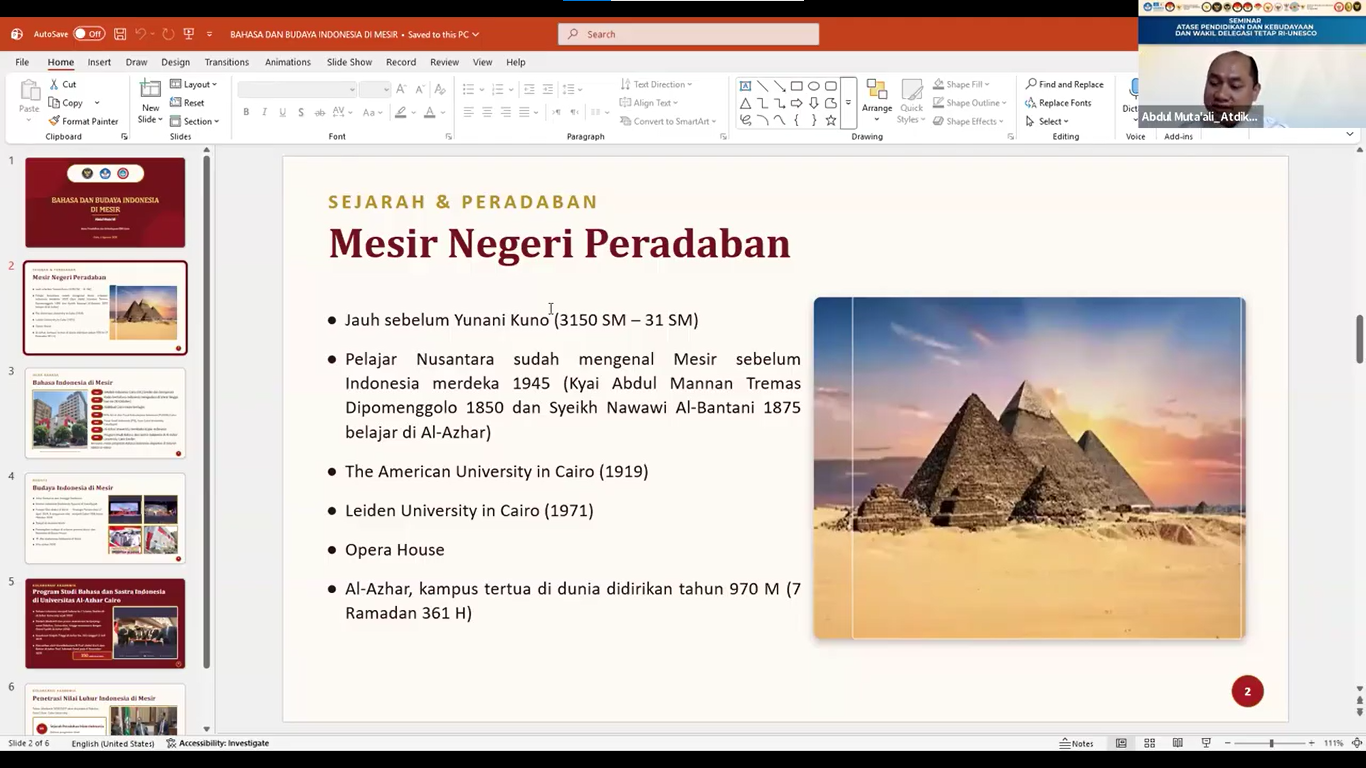
Cirebon, August 04, 2026 – Continuing the Seminar of the Education and Cultural Attachés and the Deputy Permanent Delegate of the Republic of Indonesia to UNESCO, the Tuesday session explored the development of Indonesian language and culture in Egypt, Saudi Arabia, and the Netherlands. This virtual event, carrying the central topic of information on cultural and Indonesian language activities in various countries. The Egyptian segment was presented by Doctor Abdul Muta'ali, the Education and Cultural Attaché of the Indonesian Embassy in Cairo, who described Egypt as a civilization state older than ancient Greece. He recalled that as early as the nineteenth century, Indonesian scholars such as Syekh Nawawi al-Bantani had studied at Al-Azhar and later became a mufti for the Arabian Peninsula.
Institutionally, Indonesia opened its first overseas school, Sekolah Indonesia Kairo, in 1952, established directly by President Soekarno. One year later an Indonesian-language radio broadcast began airing in Cairo, and the Education and Cultural Attaché office officially started its duty in 1958. The BIPA program was then formally opened in 1987 at the Indonesian Cultural Center, locally known as Puskin, which has its own building. Today the attaché office estimates that Indonesian speakers reach about one percent of Egypt's 110 million people, and many hotel employees along the Nile are BIPA alumni. The language has also entered Suez Canal University through a Center for Indonesian Studies, and since 2016 it has been taught as a second language in Islamic Studies at Al-Azhar. These achievements show a steady institutional penetration of the Indonesian language into the Egyptian education system.
The peak of this long process was the opening of the Indonesian Language and Literature Study Program at Al-Azhar University, inaugurated on 6 November 2025. The proposal traveled through a long approval chain, from the Grand Syekh to the Dean of the Faculty of Languages and Translation, the faculty senate, the university senate, and finally the Supreme Council of Al-Azhar. When the council asked what justified Al-Azhar in opening such a program, the attaché answered directly, "Egypt and Indonesia have the same global homework, so why not work together?" This logical argument was accepted, and the Supreme Council issued its decision number 343 on 12 July 2025 approving the study program. Beyond expectations, the new program attracted 350 new students in its first intake, and within two months a vice minister visited to witness its progress. Seven Indonesian consortium universities, including UI, UGM, UNPAD, and several Islamic state universities, now support the program with curriculum and lecturers.
On the cultural front, Indonesia is not a stranger to Egypt, because the friendship of Soekarno and Nasser during the Non-Aligned Movement era still resonates today. The city of Shubra honors this memory with Soekarno Street and a mango variety named after the Indonesian founding president, who introduced the fruit to Egypt. In Ismailia, the province through which humanitarian aid enters Rafah, a large Indonesia Square testifies to the close relationship between the two peoples.
The joint strategic partnership of April 2025, containing twenty articles, further recognized pencak silat as a sport to be competed in Egypt's national sports week in October 2026. With around seven thousand practitioners from eight silat schools, Egypt hopes to advance the martial art to the African continent and eventually to the Olympics. Indonesian culture has also gained popularity through popular films and the appearance of an Indonesian actress in Egyptian television dramas. During Ramadan, the embassy regularly stages cultural performances, and Indonesian troupes have appeared in nearly all of Egypt's twenty-seven provinces.

Despite these successes, the attaché office also faces several challenges that require careful management. The influx of Indonesian students has become overwhelming, because around 25,000 students are now concentrated in Cairo instead of being spread across the provinces. The flow of students remains imbalanced, as far more Indonesians study in Egypt than Egyptians who study in Indonesia. To address this, the office promotes double degree schemes, such as the partnership between UI and Al-Azhar, in which part of the program can be taken online. The new study program itself is still searching for its best model, which is why the office invites Indonesian campuses to contribute through visiting professor schemes, community service, and joint research. Fortunately, the National Language Agency has guaranteed the salaries of Indonesian lecturers for the next five years, providing a strong foundation for sustainability.
The penetration of Indonesian noble values also progresses through the academic recognition of Indonesian Islamic thought. Starting from the 2026–2027 academic year, Cairo University's Faculty of Darul Ulum will teach the history of Indonesian Islamic civilization in Arabic for undergraduate students. At the graduate level, the course on Indonesian Islamic thought will be delivered in English. Moreover, Al-Azhar accepted the idea of Miss Al-Azhar 2026 as an alternative pageant that combines humanism, global insight, academic quality, and local wisdom. In the grand final held on 28 July, an Indonesian student named Siti Maryam emerged as the winner. The attaché office has also received a grant of 2,700 square meters of land to build an Indonesian House that will function as a comprehensive center for language, culture, and economy.