
International Office of UIN Siber Syekh Nurjati Cirebon Bridges Students to Global Academic Discourse through an International Doctoral Proposal Seminar at Charles Darwin University
Cirebon, May 12, 2026 — Lala Bumela Sudimantara, Ph.D., Director of the International Office of UIN Siber Syekh Nurjati Cirebon (UIN SSC), played an important bridging role in connecting UIN SSC students with an international academic forum held at Charles Darwin University through an online doctoral proposal seminar. The seminar, titled “Emotional and Neuroaesthetic Approaches to Evaluating and Teaching Abstract Reasoning of Pre-Service Teachers,” was presented by Jian Wu under the supervision of Dr. Ania Lian and Dr. Angelica Carlet. The forum was attended by academic participants from Charles Darwin University, including Ivamere Fong, Mercy Kimenju, Sangar Jamtsho, Parthasarathi Banerjee, Lindsay Parry, Sonia Valizadeh, and Li Jao, alongside several English Language Department student from UIN SSC. From the beginning, the seminar reflected a strong atmosphere of interdisciplinary academic exchange and global collaboration. The session encouraged participants to rethink how reasoning, emotion, and aesthetics intersect within modern teacher education. It also demonstrated how international academic dialogue can create new perspectives in educational research.
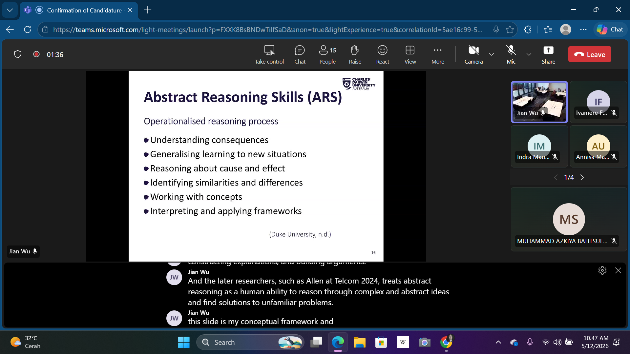
During the presentation, Jian Wu explained that the research focuses on how emotional approaches and neuroaesthetic approaches can function as pedagogical tools to evaluate and teach Abstract Reasoning Skills (ARS) among pre-service teachers. Rather than developing Reading for Emotion (RfE) or Aesthetic Principles (AP) as standalone models, the study examines how these approaches support conceptual interpretation, adaptive reasoning, and reflective thinking in complex learning situations. Jian Wu argued that modern teacher education still relies too heavily on psychometric assessments and standardized reasoning tests that reduce reasoning into technical problem-solving. According to the presentation, instruments such as Raven’s Progressive Matrices often measure symbolic recognition without fully capturing how reasoning operates in authentic classroom contexts. This condition, he explained, may lead to procedural reductionism where students focus on finding correct answers rather than building interpretive understanding. Therefore, the research attempts to shift educational focus from merely “measuring intelligence” toward understanding how reasoning develops through emotional engagement and aesthetic interpretation. This perspective positioned reasoning as a deeply human and contextual process.
As the theoretical foundation of the study, Jian Wu utilized Cognitive Load Theory to explain how learning becomes more effective when cognitive overload is minimized and working memory is optimized. Within this framework, Abstract Reasoning Skills are understood as the ability to resolve ambiguity, organize concepts, build inferences, and interpret unfamiliar situations strategically. The presentation also integrated several intelligence theories, including Charles Spearman’s concept of General Intelligence and the Cattell-Horn-Carroll Theory distinguishing fluid and crystallized intelligence. Jian Wu emphasized that abstract reasoning should not be viewed merely as the ability to answer logic questions, but as an integrated cognitive capacity for recognizing relationships among ideas, concepts, and experiences. As Jian Wu stated, “Abstract reasoning is not only about solving problems correctly, but about understanding relationships, meanings, and possibilities within unfamiliar situations.” In this context, reasoning becomes closely connected to interpretation, reflection, and adaptive problem-solving within educational environments. The seminar highlighted six operational dimensions of Abstract Reasoning Skills: understanding consequences, generalizing learning into unfamiliar situations, causal reasoning, identifying similarities and differences, conceptual manipulation, and theoretical interpretation.
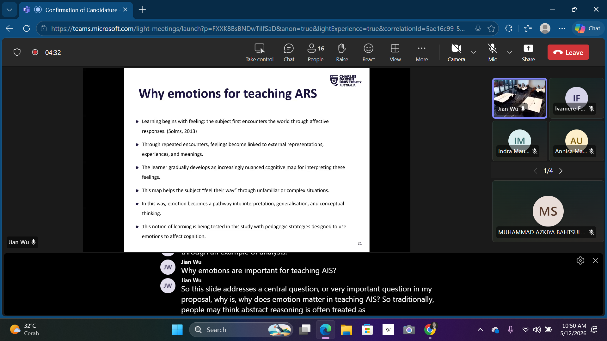
One of the most engaging discussions emerged when Jian Wu elaborated on the relationship between emotion and cognition in learning processes. Drawing from affective neuroscience and educational psychology, the presentation argued that cognition does not begin solely through rational analysis, but also through emotional responses toward experiences and environments. In this research, emotion is positioned not as an obstacle to rationality, but as a neurological mechanism that supports meaning construction and inferential reasoning. Through the Reading for Emotion (RfE) approach, the study investigates how emotional tension, uncertainty, and textual disturbance encourage students to conduct reflective inquiry while interpreting academic texts. Jian Wu explained that emotional disturbance often pushes learners to search for conceptual and logical connections more deeply. As a result, emotional engagement functions as a cognitive catalyst that strengthens analytical exploration and conceptual understanding. The discussion suggested that meaningful learning frequently begins from emotional resonance rather than detached analysis.
Alongside emotional approaches, the seminar also explored Aesthetic Principles (AP), which was influenced by Neuroaesthetics theories developed by Vilayanur S. Ramachandran and William Hirstein. Jian Wu explained how aesthetic perception, ambiguity resolution, and pattern recognition can help students construct coherent understanding when dealing with complex texts. The proposal incorporated eight neuroaesthetic principles, including Peak Shift, Isolation, Perceptual Grouping, Contrast, Perceptual Problem Solving, Symmetry, Generic Viewpoint, and Metaphor. These principles were used to analyze how learners process information and organize meaning during academic reasoning activities. For example, the principle of Isolation helps learners focus attention on key conceptual elements by reducing distracting dimensions, while Metaphor supports conceptual transfer through hidden structural similarities. According to Jian Wu, when students successfully resolve ambiguity within texts or conceptual patterns, neurological systems associated with pleasure, attention, and engagement become activated. Consequently, aesthetic cognition was presented not as artistic decoration, but as an important component of conceptual learning and cognitive flexibility.

The seminar received highly positive academic appreciation from participants, including Lindsay Parry, who joined the session online. During the feedback discussion, the proposal was praised for its strong novelty and interdisciplinary contribution because it successfully connected cognitive science, affective neuroscience, neuroaesthetics, educational psychology, psychometrics, and teacher education within one comprehensive research framework. One of the notable comments expressed during the seminar described the proposal as “proposing some successful research candidature,” reflecting confidence in its academic potential at Charles Darwin University. Lindsay Parry also highlighted the significance of the study by emphasizing that the research offers “a meaningful and innovative contribution to understanding reasoning, emotion, and learning in teacher education.” Overall, the forum demonstrated how international collaboration can create spaces for innovative educational discourse that transcends disciplinary boundaries. The involvement of UIN SSC students through the facilitation of Lala Bumela Sudimantara, Ph.D. also strengthened the global academic exposure experienced by the participants. In this sense, the event became not only an academic presentation, but also a reflection on how education may evolve toward more humanistic, adaptive, and neurologically informed approaches.
Author: Salsabilla