
International Office of UIN Siber Syekh Nurjati Cirebon Promotes Global Perspectives on Assessment and Quality Assurance Through Assoc. Prof. Ania Lian’s Presentation at Minhaj University Lahore Webinar
Cirebon, June 3, 2026 — The second presentation of the webinar What if We Truly Put the Learner at the Center? Implications for Language and Literacy Theory, Practice, and Assessment featured Assoc. Prof. Ania Lian, Ph.D. from Charles Darwin University, Australia. In her session titled Quality Assurance, Assessment, and the Politics of Evidence, she explored how assessment practices are shaped by broader educational values, policies, and institutional frameworks. Rather than treating assessment as a collection of isolated tasks, she emphasized the importance of understanding the conceptual foundations that guide educational decision-making. Her presentation complemented the webinar’s broader focus on learner-centered education by examining how evidence of learning is interpreted and validated within different educational systems. The session provided participants with an opportunity to reflect on the relationship between policy, assessment, and educational quality in contemporary learning environments.
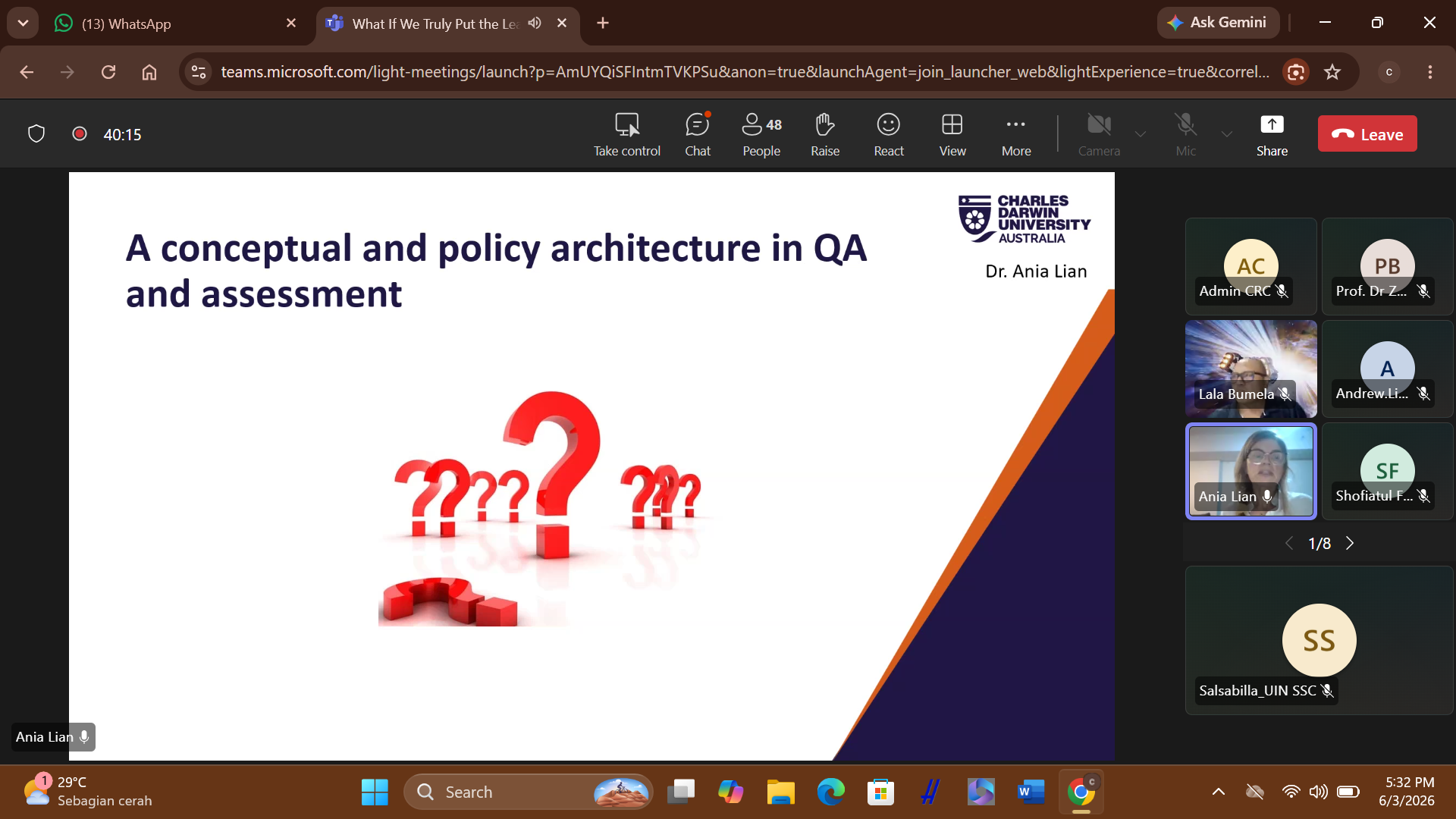
Assoc. Prof. Ania Lian, Ph.D. began by presenting an example from early childhood education in Australia, illustrating how schools prioritize communication skills, confidence, and social interaction before formal literacy instruction. Through a dialogue involving educators and researchers, she demonstrated that meaningful learning is not limited to mastering technical skills such as reading or recognizing letters. Instead, educational systems increasingly value learners’ ability to express ideas, participate in discussions, and engage with others. This example served as a foundation for discussing how educational values influence the way learning outcomes are defined and assessed. According to her, assessment should reflect the broader purposes of education rather than merely measuring isolated competencies.
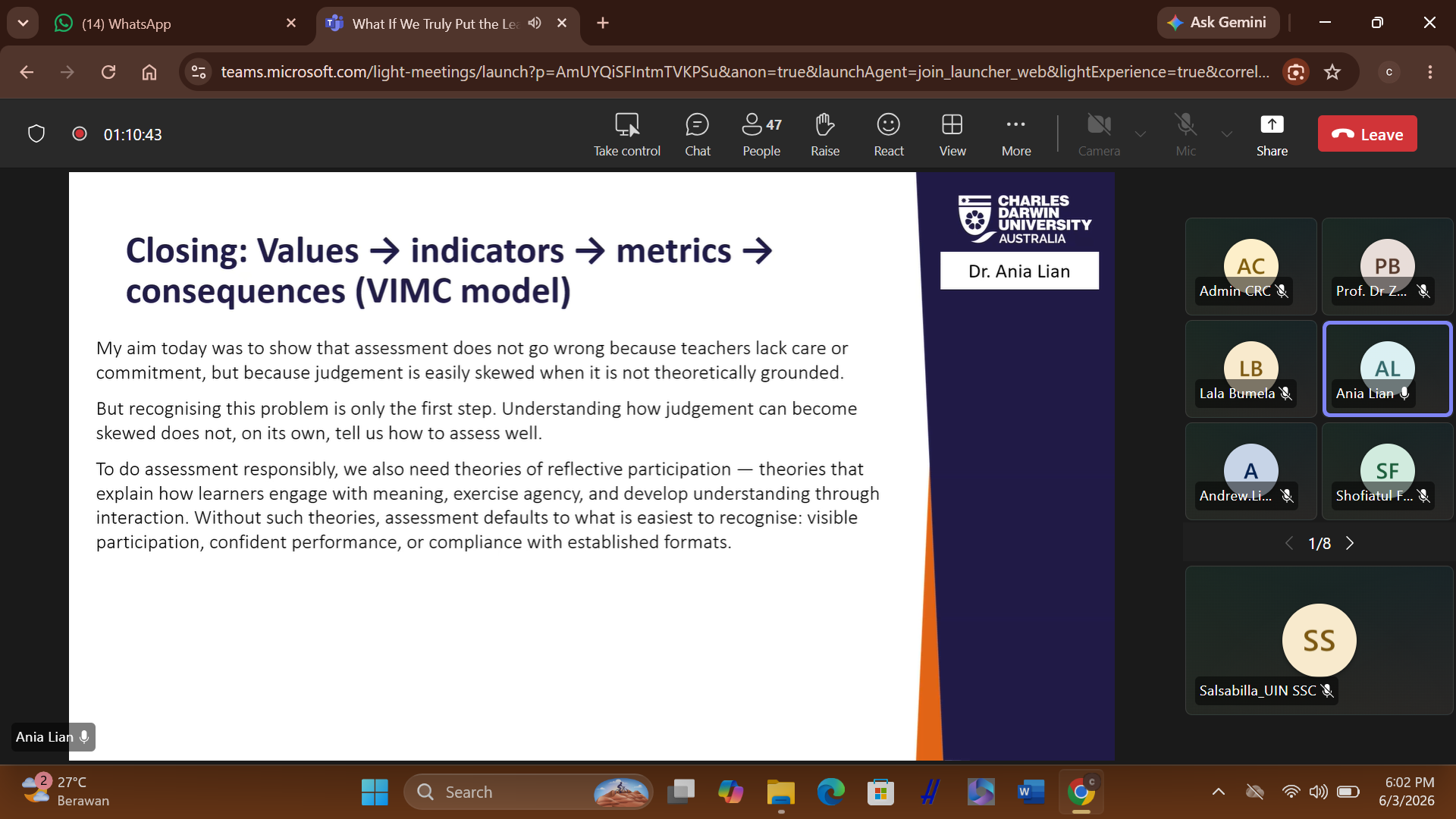
Building on this discussion, she introduced the relationship between values, indicators, metrics, and consequences, commonly referred to as the VIMC framework. She explained that educational systems first establish core values such as inclusion, equity, learner-centeredness, respect, and wellbeing. These values are then translated into indicators, learning outcomes, and assessment practices that ultimately shape educational consequences. Drawing on the Australian context, she highlighted how policy frameworks such as the Alice Springs (Mparntwe) Declaration and the Australian Curriculum provide conceptual foundations for assessment. She emphasized that accountability should not be constructed solely from test results or task completion, but must be grounded in a coherent policy architecture that reflects educational goals. “Without a clear conceptual framework, evidence can easily be reduced to simple task completion rather than meaningful learning,” she noted.
Another important aspect of the presentation focused on how credibility and recognition influence assessment judgments. Assoc. Prof. Ania Lian, Ph.D. encouraged participants to consider questions such as whose voices are considered legitimate, whose knowledge is recognized, and who determines what counts as meaningful learning. She argued that assessment is never entirely neutral because judgments are shaped by assumptions about competence, participation, and relevance. To address this issue, she proposed that educators should move beyond surface-level indicators and pay greater attention to learners’ engagement with meaning-making processes. Through the VIMC model, she demonstrated how teachers can align assessment practices with educational values while accommodating diverse forms of participation. This approach, she explained, helps create more inclusive and equitable learning environments.
The presentation also addressed several contemporary challenges related to quality assurance in education. Among the issues highlighted were unequal school resources, increasing demands on teachers, limited follow-up after professional development programs, and the need for stronger collaboration between universities and schools. Assoc. Prof. Ania Lian, Ph.D. emphasized that sustainable quality assurance requires continuous cycles of diagnosis, reflection, revision, and collaboration rather than one-time interventions. During the QnA session, one faculty member asked about the role of teachers in an era increasingly influenced by artificial intelligence. Responding to the question, she stated, “Teachers need to help students learn how to work intelligently with AI, not simply rely on it as an oracle.” She further explained that effective AI use requires critical thinking, abstract reasoning, and the ability to guide machine-generated responses through thoughtful questioning and evaluation.

Organized by the Corpus Research Center of Minhaj University Lahore, Pakistan, the webinar connected participants from UIN Siber Syekh Nurjati Cirebon, Minhaj University Lahore, Charles Darwin University, and other educational practitioners interested in language and literacy studies. The event featured Assoc. Prof. Lala Bumela Sudimantara, Ph.D. and Assoc. Prof. Ania Lian, Ph.D. as keynote speakers, while Prof. Dr. Zafar Iqbal Bhatti, Director of the Corpus Research Center at Minhaj University Lahore, served as host. Through discussions on regenerative education, literacy, assessment, and quality assurance, the webinar provided valuable opportunities for international academic exchange and collaboration. More importantly, it encouraged participants to critically examine how educational values are translated into classroom practice and assessment systems. The event is expected to inspire future partnerships between institutions while supporting the development of more reflective, inclusive, and learner-centered educational practices.
Author: Salsabilla