
International Office of UIN Siber Syekh Nurjati Cirebon Reinforces Its Bridging Role Through International Webinar Hosted by Minhaj University Lahore, Pakistan
Cirebon, June 3, 2026 — The International Office of UIN Siber Syekh Nurjati Cirebon (UIN SSC), under the leadership of Assoc. Prof. Lala Bumela Sudimantara, Ph.D., strengthened its role in fostering international academic collaboration through participation in an international webinar entitled What if We Truly Put the Learner at the Center? Implications for Language and Literacy Theory, Practice, and Assessment. Organized by the Corpus Research Center of Minhaj University Lahore, Pakistan, this event connected participants from UIN Siber Syekh Nurjati Cirebon, Minhaj University Lahore, Charles Darwin University, and other educational practitioners interested in language and literacy studies. The webinar featured Assoc. Prof. Lala Bumela Sudimantara, Ph.D. and Assoc. Prof. Ania Lian, Ph.D. from Charles Darwin University, Australia, as keynote speakers, also Prof. Dr. Zafar Iqbal Bhatti, Director of the Corpus Research Center at Minhaj University Lahore as host. In his opening remarks, Prof. Bhatti welcomed participants, expressed appreciation for their attendance, introduced the speakers, and emphasized his hope that the webinar would generate meaningful insights while opening opportunities for future international collaboration.

During the first presentation, Assoc. Prof. Lala Bumela Sudimantara, Ph.D. delivered a talk entitled When Learners Rewrite the Language and Literacy Curriculum: Affective Epistemic Co-Creation for Regenerative Human Capital. He began by discussing the interconnected crises that characterize the twenty-first century, including climate instability, ecological degradation, technological acceleration, social fragmentation, and cultural dislocation. According to him, these challenges cannot be addressed through conventional educational approaches that separate environmental issues from social, cultural, psychological, and spiritual dimensions. He argued that sustainability education requires a fundamental shift from transmissive and reductionist learning models toward participatory, relational, and ecological approaches. Emphasizing the importance of reconnecting education with nature, he stated, “Actually, we have to focus on rebuilding the relationship with nature. I don't think we can achieve sustainability without rebuilding a strong relationship with nature.” His remarks invited participants to reconsider the broader purpose of education in addressing contemporary global challenges.
Building on this foundation, Assoc. Prof. Lala Bumela Sudimantara, Ph.D. introduced participants to his ongoing work on Sundanese cosmology and Carita Pantun, particularly Lutung Kasarung, as a source of ecological and educational knowledge. He encouraged participants to reflect on a simple yet profound question: “What kinds of texts truly resonate with you and your students?” Drawing on examples from Pasir Batang in Kuningan, he explained how local narratives contain layers of agricultural, cosmological, and ecological wisdom that remain relevant today. He also presented several recent studies conducted with his students, demonstrating how emotional progression within traditional stories can enhance reading engagement and critical literacy development. One of the findings revealed that many contemporary reading materials emphasize initial engagement but rarely guide learners toward deeper reflection and moral understanding. To address this issue, he proposed positioning learners as epistemic agents who actively co-create knowledge by integrating ancestral wisdom, scientific inquiry, and community participation. Through examples such as participatory research involving Juru Pantun, environmental scientists, and local communities, he argued that literacy education should not only teach language skills but also cultivate regenerative human capital capable of contributing to society and the environment.
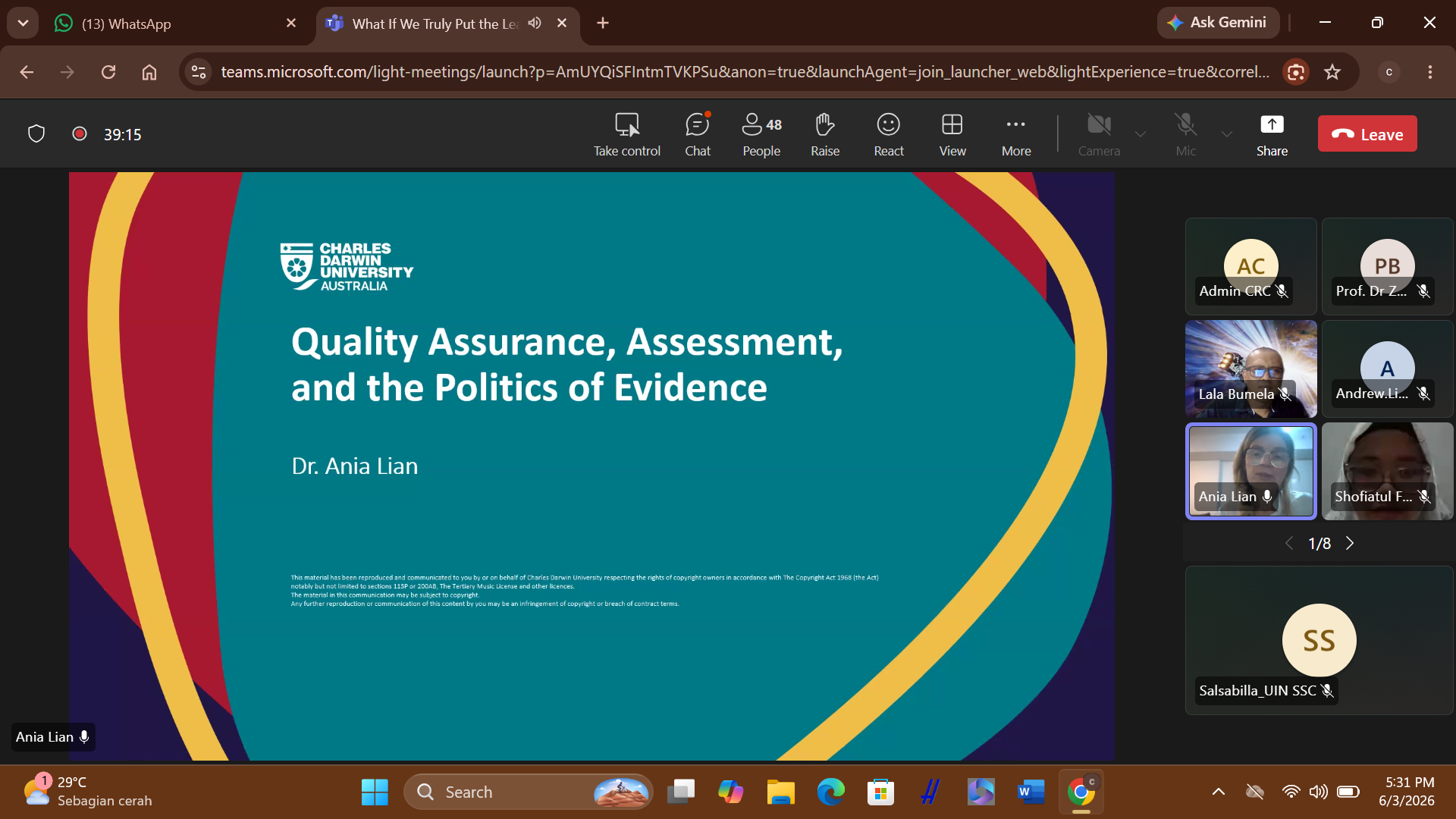
The second keynote presentation was delivered by Assoc. Prof. Ania Lian, Ph.D. from Charles Darwin University, Australia, under the title Quality Assurance, Assessment, and the Politics of Evidence. Her presentation explored how educational assessment should be grounded in coherent theoretical and policy frameworks rather than relying solely on isolated outcomes or standardized measurements. Drawing on examples from the Australian education system, she explained how values such as inclusion, equity, learner-centredness, respect, and wellbeing influence curriculum design, assessment practices, and educational accountability. She highlighted that evidence in education should not be reduced to task completion alone, since such an approach often overlooks the broader goals of learning. Instead, assessment should recognize diverse forms of participation, meaning-making, and learner agency. Throughout her presentation, she emphasized that educational quality emerges when values, indicators, metrics, and consequences are aligned within a clear conceptual architecture. Her discussion encouraged participants to critically examine how assessment practices shape the ways learners are recognized and evaluated.
Further elaborating on this framework, Assoc. Prof. Ania Lian, Ph.D. introduced the Values–Indicators–Metrics–Consequences (VIMC) model as a tool for understanding assessment and quality assurance. She explained that teachers should first consider the vision of the learner promoted by educational policies before designing assessment activities. According to her, meaningful assessment requires conceptual clarity regarding what participation, understanding, and learning actually look like in practice. She also highlighted several contemporary challenges, including unequal school resources, limited teacher support, weak follow-up after professional development programs, and the gap between universities and school realities. These issues, she argued, require collaborative and sustainable quality-assurance mechanisms involving both schools and higher education institutions. Concluding her presentation, she remarked, “Assessment does not go wrong because teachers lack care or commitment, but because judgement is easily skewed when it is not theoretically grounded.” Her presentation reinforced the importance of reflective and evidence-informed approaches to assessment in language and literacy education.
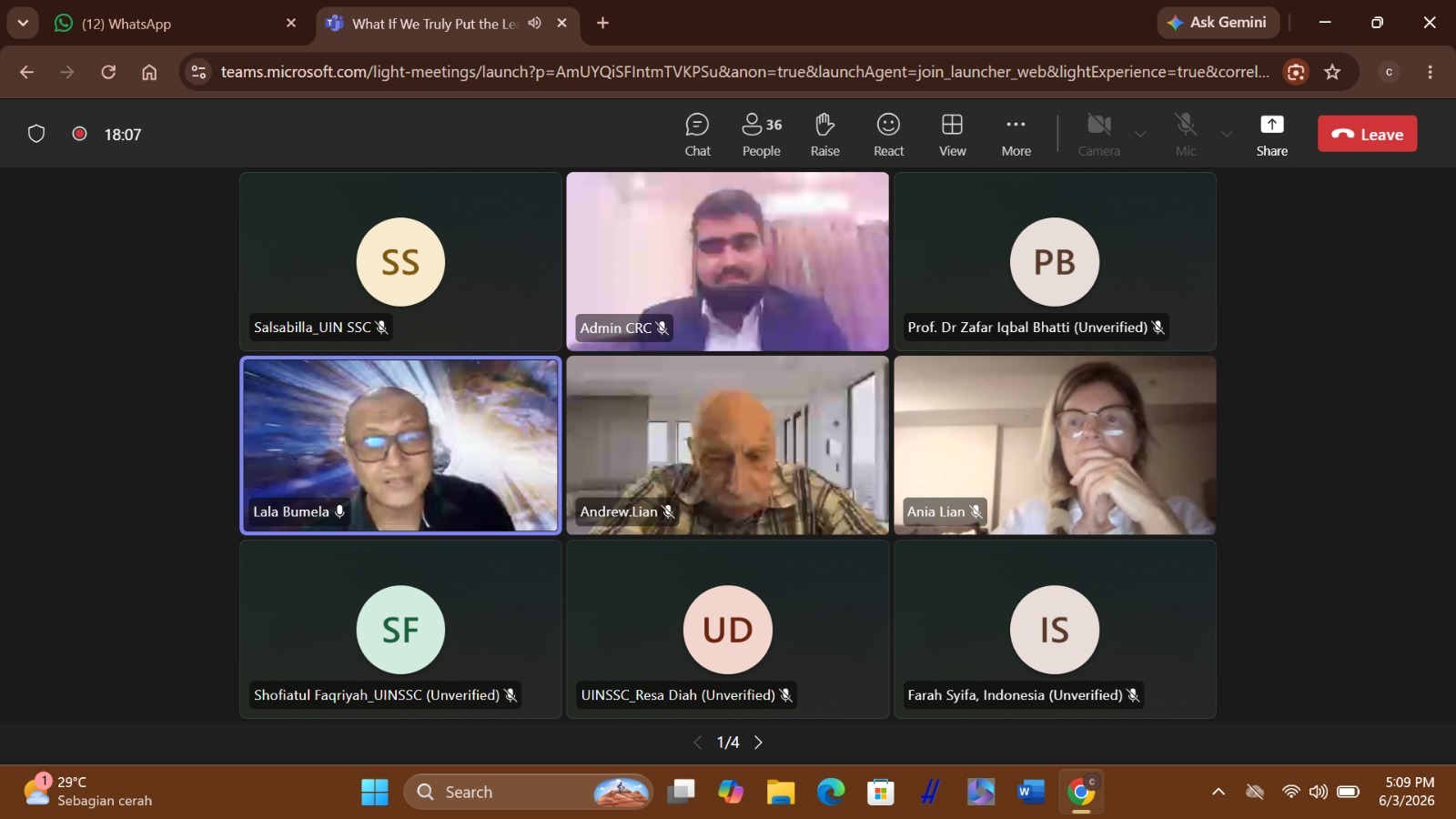
The webinar concluded with an interactive discussion session that allowed participants to engage directly with both speakers. Responding to a question about the biggest challenges in implementing learner-centred approaches in higher education., Assoc. Prof. Lala Bumela Sudimantara, Ph.D. identified four major concerns: transforming students’ mindsets about learning, developing more meaningful assessment practices, managing limited instructional time, and sustaining long-term classroom and research initiatives. He explained that many students still perceive learning as a passive activity, whereas his goal is to encourage exploration, inquiry, and collaboration with local communities, cultural elders, and researchers. For the second question, Assoc. Prof. Ania Lian, Ph.D. was asked regarding the role of teachers in the era of artificial intelligence. She emphasized that educators must help students develop critical thinking and abstract reasoning skills while learning how to interact responsibly with AI technologies, stating that AI should be understood as a machine (tool) rather than an unquestionable source of answers. The session ultimately highlighted the shared commitment of both speakers to learner-centred education that empowers students to become active knowledge creators. By bringing together perspectives from the speakers’ viewpoint, the webinar provided valuable insights into curriculum innovation, assessment reform, ecological literacy, and international collaboration in language education.
Author: Salsabilla