
International Office of UIN Siber Syekh Nurjati Cirebon Strengthens Its Bridging Role Through Diaspora Talks on Global Collaboration, Technology, and Sustainable International Networks
Cirebon, May 13, 2026 — The International Office of UIN Siber Syekh Nurjati Cirebon (UIN SSC), under the leadership of Lala Bumela Sudimantara, Ph.D., once again demonstrated its role as an international bridge by actively participating in Series 1: Diaspora Talks — Building Global Networks: Indonesian Diaspora Connecting Global Opportunities. The event featured presentations by Prof. Rudolf Wirawan, Ph.D. (Founder of BIMA Nexus Global) and Dr. Mulyoto Pangestu (Lecturer and Laboratory Manager at Monash University) as the main speakers. The forum was also attended by Bernard Tampubolon (President of the Indonesian Diaspora Network Australia) and Yulia Rahmawati (Representative from the Education and Cultural Attaché of the Embassy of the Republic of Indonesia in Canberra) as special guests. Moderated by Sarina Hanifah, the discussion brought together Lala Bumela Sudimantara, Ph.D. (Director of the International Office of UIN SSC), Ivan Chabibilah, S.S., M.Li. (ICCCM), members of the Indonesian diaspora from various countries, as well as lecturers and students from different educational institutions as the participants. The program was organized through collaboration between the Education and Cultural Attaché of the Indonesian Embassy in Canberra and the Indonesian Diaspora Network Australia. Opening the event, the moderator, Sarina Hanifah, emphasized that the forum aimed to expand access to information, strengthen international networks, and open wider opportunities for collaboration in education, research, technology, and human resource development. The event immediately created an atmosphere of optimism and intellectual openness among participants from various backgrounds.
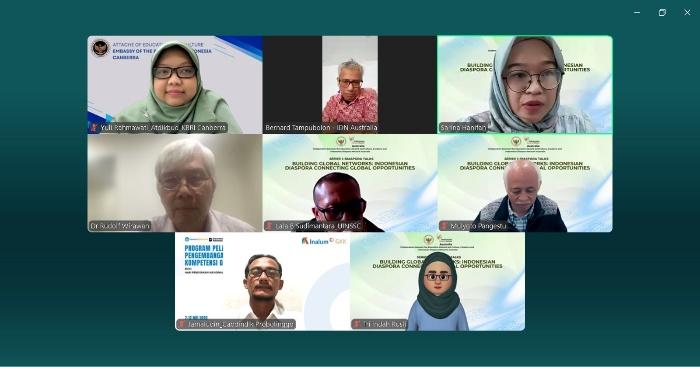
The series of activities began with welcoming remarks delivered by Yulia Rahmawati, a representative from the Education and Cultural Attaché of the Indonesian Embassy in Canberra, and Bernard Tampubolon, President of the Indonesian Diaspora Network Australia. Yulia Rahmawati explained that Diaspora Talks was designed as a sustainable collaborative platform connecting diaspora communities, researchers, academics, governments, and institutions across countries. She highlighted Australia as one of Indonesia’s strategic educational partners, particularly with around 32,000 Indonesian students currently studying there. “Diaspora should become a living bridge connecting Indonesian knowledge, innovation, and global partnerships,” she stated. Meanwhile, Bernard Tampubolon emphasized that Indonesian diaspora communities live within “two worlds,” actively engaging abroad while still maintaining strong emotional and intellectual ties to Indonesia. He stressed the importance of technology transfer, innovation, and global academic collaboration to help Indonesia move beyond dependence on raw material exports and strengthen technology-based development. According to him, diaspora communities have strategic potential to connect universities, industries, UMKM, and international networks for Indonesia’s long-term transformation.
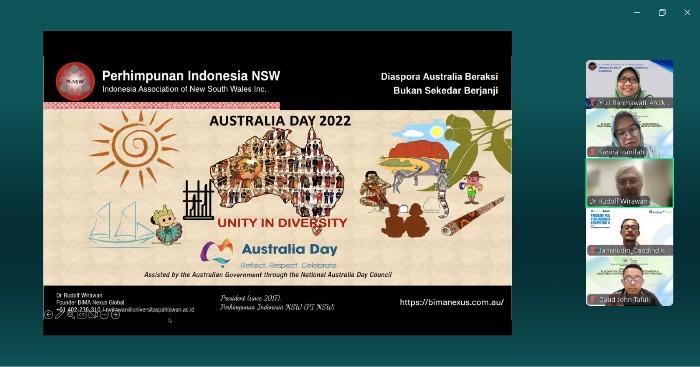
A major highlight of the forum emerged during the presentation by Prof. Rudolf Wirawan, who framed diaspora not merely as a symbolic identity, but as a real collaborative movement capable of generating social transformation. Introducing the concept of BIMA Nexus, Prof. Rudolf Wirawan explained how diaspora communities can connect universities, governments, industries, and local communities within one collaborative ecosystem. One of the most memorable moments came when he used the angklung as a philosophical metaphor for collective harmony. “One angklung produces only a single tone, but when played together, harmony emerges,” he explained. Prof Rudolf Wirawan also shared stories about empowering street children in Penjaringan, Jakarta through angklung performances, including dreams of bringing them to perform at the Sydney Opera House. Beyond cultural narratives, he discussed Smart Village initiatives, circular economy systems, environmental sensor technologies, and local Wi-Fi educational servers designed to strengthen communities while preserving local identity. According to him, technology should never erase culture, but instead amplify local wisdom and human connection.
Another important perspective was delivered by Dr. Mulyoto Pangestu, lecturer and laboratory manager at Monash University, who challenged the common assumption that diaspora communities represent “brain drain.” Instead, he introduced the idea of brain circulation, emphasizing that diaspora members continue contributing through knowledge exchange, global networks, teaching, seminars, and collaborative research. “Nationalism is not determined by where people live, but by how they contribute,” he stated during the session. Dr. Mulyoto Pangestu explained that studying abroad should not be seen as a symbol of superiority, but as part of an intellectual process that can eventually benefit Indonesia. He also highlighted how diaspora communities possess wider access to international journals, research ecosystems, and global academic networks that could strengthen Indonesian education. Furthermore, he emphasized that local wisdom contains valuable scientific knowledge often overlooked within modern academic systems. Using examples such as ethnochemical studies of keris-cleaning traditions, he argued that Indonesian cultural practices hold deep intellectual significance deserving greater academic attention.
One of the most reflective moments during the Q&A session came from Lala Bumela Sudimantara, Ph.D., Director of the International Office of UIN SSC, who shared his experiences developing community-based environmental and educational initiatives in Cirebon, Mount Ciremai, and Cigobang Village. His projects focus on environmental conservation, local wisdom-based education, sustainability, disaster mitigation, organic farming, and Cisanggaraung River conservation. “Our local communities already have powerful initiatives, but they still need wider access, collaboration, and global support systems,” he explained while discussing the challenges faced by grassroots communities. Responding to his reflection, Rudolf Wirawan emphasized the importance of documenting local cultural knowledge through research, technology, and international publication. “Indonesia’s local wisdom contains extraordinary knowledge that must be preserved and brought into global conversations,” Rudolf stated. Meanwhile, Dr. Mulyoto Pangestu added that many foreign researchers are often more serious in studying Indonesian culture than Indonesians themselves, showing how valuable local knowledge actually is. He also supported the integration of local wisdom into education as a way to strengthen Indonesia’s intellectual and cultural identity.
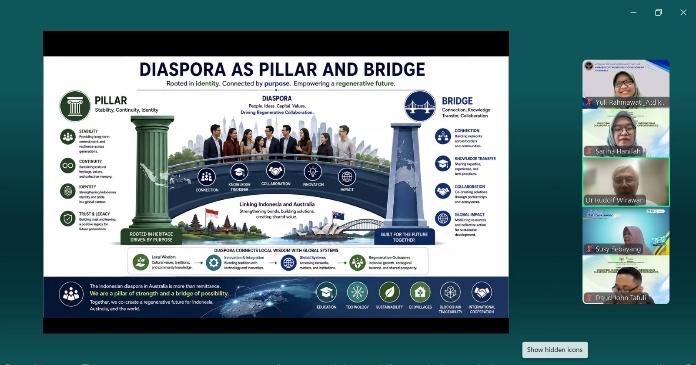
During the final discussion session, participants once again emphasized the importance of building a more integrated and sustainable diaspora network system. Prof. Rudolf Wirawan proposed the development of a digital database application capable of connecting education, competencies, and industry needs more systematically, while Yulia Rahmawati introduced the ongoing “Diaspora Connect” initiative aimed at mapping Indonesian diaspora communities based on expertise, academic background, and collaboration potential. Ivan Chabibilah, S.S., M.Li. from ICCCM also expressed appreciation for Diaspora Talks, describing the forum as highly relevant for strengthening higher education collaboration in Indonesia, especially by involving smaller regional universities beyond Java. “Collaboration should not be centralized only in major cities and large universities,” he remarked. In the closing statement, Yulia Rahmawati emphasized that diaspora identity is no longer limited to Indonesian citizens alone, but also includes individuals abroad who continue contributing to Indonesia despite changes in citizenship status. She expressed hope that Diaspora Talks would continue as a sustainable platform for collaboration, intellectual exchange, and global networking. Ultimately, the forum reaffirmed the role of the International Office of UIN SSC and Lala Bumela Sudimantara, Ph.D. as active bridges connecting local academic initiatives with global diaspora communities and international opportunities.
Author: Salsabilla