
International Office of UINSSC and Sagarahiang Elders Co-Host Global Tapestry of Alternatives Delegation on Sundanese Mountain Ecotheology
Cirebon, April 12, 2026 — Under the intellectual and diplomatic stewardship of Lala Bumela Sudimantara, Ph.D., Director of the International Office of UIN Siber Syekh Nurjati Cirebon, the International Office of UINSSC, in conjunction with the revered elders of Sagarahiang, Kuningan, West Java, convened an extraordinary global delegation centered on Sundanese mountain ecology. This epistemic gathering welcomed the Global Tapestry of Alternatives (GTA) network to engage with a historically embedded cosmology of Sunda within a circular eco-theological learning framework. The delegation comprised approximately 70 participants representing 23 countries, with the Facilitation Team spanning Indonesia, the United States, the United Kingdom, Colombia, India, Mexico, New Zealand, Argentina, South Africa, Denmark, France, Spain, the Philippines, Nepal, and Kenya. Additional participants included Paolo Orozco (Mexico), Camilo Torres (Colombia), Xochitl Leyva Solano (Mexico), Mauricio del Villar (Mexico), Setyo Gryh (India), Indah Fana Ragas (Colombia), and Alvaro Salazar (Colombia). As a global initiative inaugurated in 2019, GTA operates as a horizontal, non-centralized network interlinking movements that cultivate alternatives to dominant paradigms such as capitalism, patriarchy, and ecological exploitation, thereby nurturing a pluriversal horizon of justice, sustainability, and participatory democracy. Acting as both epistemic mediator and cultural translator, Lala Bumela Sudimantara, Ph.D., who advances a multisensory and regenerative learning paradigm, illuminated the historical ontology of Sagarahiang, rooted in the ancestral wisdom of Mang Ukad. Historically known as a Kamandalaan or Kabuyutan, this site functioned as a center of knowledge at the foothills of Mount Ciremai, structured through the tripartite ecological zones of Larangan (sacred conservation), Tutupan (protected forest), and Baladahan (productive land). Although often veiled in historical obscurity, Sagarahiang now emerges into global consciousness, echoing the Sundanese aphorism “Cikaracak Ninggang Batu Laun-Laun Jadi Legok.” Visitors were guided to the Lingga-Yoni site an ancient pre-Abrahamic symbol of fertility, where Lala Bumela Sudimantara, Ph.D. affirmed, “What we encounter here is not merely heritage, but a living epistemology, one that reconfigures how humanity situates itself within the sacred continuum of nature.”
However, the encounter also unveiled a profound epistemological dissonance between indigenous knowledge systems and modern institutionalized education. Lala Bumela Sudimantara, Ph.D., alongside Mang Ukad, introduced a paradigm that remains largely absent from contemporary geography and formal curricula: a holistic, multiliteracy-based mode of learning deeply embedded in ecological consciousness. Historically, centers of education were not confined within architectural institutions but were situated in elevated terrains mountain foothills such as Sagarahiang and Pasir Batang, where knowledge was cultivated through direct engagement with the natural world. Within this cosmology, mountains were not merely topographical entities but functioned as kanagaraan, the very nucleus or capital of civilizational life, from which socio-cultural and ecological systems emerged. Yet, such ontologies remain marginalized, unarticulated within dominant pedagogical frameworks, thereby severing learners from the very sources of life and meaning. The mountain, as articulated in this indigenous epistemology, is not an object of study but a living subject, a primordial origin from which existence unfolds, and to which all knowledge must return.
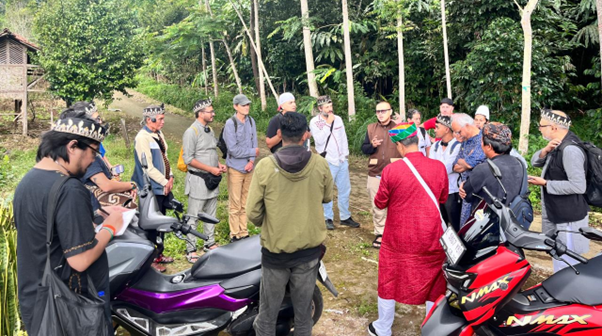
Engaging in a dialogical exchange that traversed cultures, disciplines, and ontologies, Lala Bumela Sudimantara, Ph.D. articulated the necessity of reconfiguring knowledge beyond reductionist paradigms. He stated, “Modern education has excelled in classification, yet it has often failed in connection; what Sagarahiang offers is a pedagogy of reconnection—between human cognition, ecological balance, and spiritual consciousness.” This statement resonated deeply among the international delegates, many of whom recognized parallels within their own indigenous and alternative knowledge movements. The dialogue thus transcended mere academic discourse, evolving into a reflexive space where participants interrogated the epistemic limitations of modernity while collectively envisioning integrative frameworks that honor both scientific inquiry and ancestral wisdom.
As the program unfolded, participants were immersed in a multisensory learning experience that operationalized regenerative pedagogy in situ. Through guided walks, narrative transmissions, and symbolic interpretations of sacred sites, the delegation encountered knowledge not as abstraction but as lived reality. Crucially, what emerged from the Sagarahiang experience is the recognition that the integration of ecology and theology, often theorized in contemporary discourse as eco-theology is not a novel construct, but rather an ancient epistemological foundation within Sundanese civilization. Long before its formal articulation in modern academic frameworks, Sundanese cosmology had already embodied a seamless interweaving of the sacred and the ecological, wherein nature is not merely an object of preservation, but a living manifestation of divine order and metaphysical continuity. This ontological synthesis repositions eco-theology from a modern intellectual construct into a rediscovered civilizational memory. Consequently, the integration of eco-theology, cosmology, and cultural praxis enabled participants to perceive the environment as an active interlocutor in the learning process, one that speaks, responds, and co-constitutes meaning. This methodological shift from extractive observation to relational engagement facilitated a deeper comprehension of sustainability, not merely as a policy objective but as an ontological commitment. In this expanded horizon, Sagarahiang emerges not only as a geographical location but as a pedagogical ecosystem, an epistemic landscape where knowledge is continuously co-created between humans, nature, and the metaphysical order.
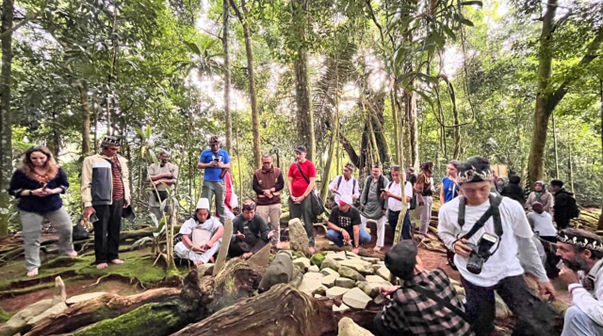
Ultimately, the convergence of global perspectives within the sacred terrain of Sagarahiang generated a renewed commitment to epistemic plurality and ecological justice. The delegation reaffirmed the urgency of integrating indigenous knowledge systems into global discourses on sustainability and education. By situating Sundanese cosmology within the broader GTA framework, the event catalyzed transnational collaborations aimed at reimagining education as a transformative, life-centered practice. The once-obscured narratives of Sagarahiang began to crystallize within the collective consciousness of the participants, signaling a shift from marginalization to recognition. This resolution underscores the potential of localized wisdom to inform global futures, particularly in an era marked by ecological crises and epistemological fragmentation.
In its moral culmination, the event foregrounds a critical imperative: that the future of knowledge lies not in epistemic homogenization but in the dignified convergence of diverse ways of knowing. As Lala Bumela Sudimantara, Ph.D. poignantly asserted, “If we continue to educate the mind while neglecting the soul of the earth, we are not advancing civilization—we are eroding it.” This assertion not only encapsulates the ethical and philosophical essence of the gathering, but also gestures toward a horizon that moves beyond the instrumental frameworks of the Sustainable Development Goals toward a deeper civilizational reorientation grounded in relationality, consciousness, and ecological reverence. In this expanding trajectory, the presence of Prof. Rudolf Wirawan from the University of Adelaide signals a forthcoming transnational initiative through the development of a StoryPathway, envisioned as a narrative-based epistemic bridge to amplify the global visibility of Sagarahiang and its cosmological heritage. Rooted in his BIMA Framework, Bridging Intelligence, Mindfulness, and Awareness, this initiative seeks to reconfigure how knowledge is not only disseminated but also experienced, integrating cognitive, affective, and existential dimensions of learning. Thus, what emerges is not merely a call for sustainability, but a reawakening of consciousness where education becomes an act of remembering, reconnecting, and re-aligning humanity with the living intelligence of the earth.
Author: Muhammad Azkiya Bahtsulkhoir