
Lala Bumela Acts as Institutional Linkage Facilitator Between UIN SSC and Charles Darwin University in Supporting UIN SSC Students’ Engagement in Jian Wu’s Doctoral Seminar on Emotional and Neuroaesthetic Approaches to Abstract Reasoning in Pre-Service Teacher Education
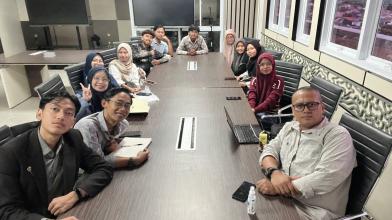
Cirebon, May 13, 2026 –Lala Bumela Sudimantara, Director of International Office UIN Siber Syekh Nurjati Cirebon, acted as an institutional linkage facilitator between UIN Siber Syekh Nurjati Cirebon and Charles Darwin University in supporting the participation of UIN SSC students in the doctoral proposal seminar presented by Jian Wu entitled Emotional and Neuroaesthetic Approaches to Abstract Reasoning in Pre-Service Teacher Education. The seminar involved supervisors Ania Lian and Angelica Carlet, alongside academic participants from Charles Darwin University including Ivamere Fong, Mercy Kimenju, Sangar Jamtsho, Parthasarathi Banerjee, Lindsay Parry, Sonia Valizadeh, and Li Jao. Student participants from UIN SSC included Muhammad Azkiya Bahtsulkhoir, Shofiatul Faqriyah, Indra Maulana Arfan Aziz, Annisa Maharani, Dimas Rizky Albar, and Maulida Rahma. Through this academic engagement, Lala Bumela emphasized the importance of establishing global knowledge networks in the 21st century. “In today’s interconnected academic landscape, universities must actively create bridges that allow students to engage with global discussions and interdisciplinary perspectives,” stated Lala Bumela Sudimantara, Ph.D.
The seminar highlighted contemporary challenges in teacher education, particularly the limitations of conventional psychometric approaches that often measure abstract reasoning solely through technical and cognitive dimensions. Such approaches were considered insufficient in addressing the growing complexity of educational environments that require reflective, adaptive, and humanistic thinking among future educators. This concern became the foundation of Jian Wu’s research proposal, which explored emotional engagement and neuroaesthetic interpretation as complementary pathways to strengthen higher-order reasoning skills in pre-service teacher education.
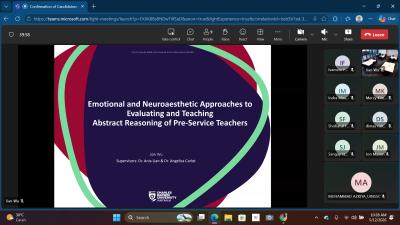
During the academic discussion, participants exchanged perspectives regarding the integration of emotional and neuroaesthetic frameworks into pedagogical practice. Jian Wu explained how Reading for Emotion (RfE) and Reading for Aesthetics (RfA) could assist future teachers in navigating ambiguity, reflection, and conceptual understanding in educational settings. Academic participants from Charles Darwin University responded with constructive dialogue surrounding the interdisciplinary potential of the study, particularly in connecting cognitive science, affective neuroscience, and teacher education. The active involvement of UIN SSC student participants also reflected growing enthusiasm among Indonesian students toward international scholarly engagement and cross-cultural academic discourse.
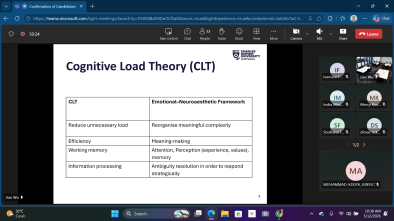
The doctoral proposal further demonstrated significant academic development by grounding its framework in theories such as Cognitive Load Theory, General Intelligence, and the Cattell-Horn-Carroll model. The proposal was recognized for its novelty and interdisciplinary contribution in advancing approaches to abstract reasoning within modern teacher education. Through this collaboration, UIN SSC students gained direct exposure to international academic environments and contemporary research methodologies. “International academic participation is not only about attending seminars, but also about developing intellectual openness, critical engagement, and collaborative perspectives that are essential for future educators,” said Lala Bumela Sudimantara, Ph.D.
As the seminar concluded, the collaboration between UIN Siber Syekh Nurjati Cirebon and Charles Darwin University reflected a shared commitment to fostering globally connected academic communities. The participation of UIN SSC students in the doctoral seminar strengthened opportunities for future partnerships, scholarly exchanges, and interdisciplinary learning initiatives between both institutions. The event also reinforced the importance of positioning students within broader international academic conversations that encourage innovation, reflection, and intellectual adaptability.
The seminar ultimately conveyed a broader moral value regarding the importance of global academic collaboration in shaping future education. By integrating emotional, aesthetic, and cognitive dimensions into reasoning and learning, the discussion encouraged educators and students alike to approach knowledge with empathy, flexibility, and creativity. “Education in the 21st century requires not only intellectual competence, but also emotional awareness and the ability to connect knowledge across cultures and disciplines,” concluded Lala Bumela Sudimantara, Ph.D.
Author: Muhammad Azkiya Bahtsulkhoir