
Lala Bumela, Ph.D. Delivers Profound Welcoming Remarks at the Final Day of UIN Siber Syekh Nurjati Cirebon’s International Seminar and Workshops on Regenerative Pathways
Cirebon, December 4, 2025 — The International Office of UIN Siber Syekh Nurjati Cirebon successfully held the final day of the International Seminar and Workshops 2025 under the theme “Returning to the Circle: A Regenerative Pathway Beyond Technocratic Sustainable Development Goals.” The event took place at the International Office on the 5th floor of the Siber Building, conducted in a hybrid format with both onsite and virtual participants. Present at the session were Director of the International Office, Lala Bumela Sudimantara, Ph.D., invited speakers joining via Zoom: Prof. Rudolf Wirawan (Adelaide University, Australia) and Luqman Baehaqi, Ph.D. (UIN Palangka Raya), along with Ivan Chabibillah, M.Li. (International Cultural Communication Center, Malaysia), the Global Engagement Team, and the students from UIN Palangka Raya as participants. Before the keynote session began, Lala Bumela, Ph.D. delivered a comprehensive and heartfelt set of welcoming remarks by expressing gratitude and enthusiasm, “I am very happy today that we can invite Prof. Rudolf Wirawan, Ph.D. from Adelaide University, Australia and Luqman Baehaqi, Ph.D. from UIN Palangka Raya who will both address the importance of regenerative approach to learning, economics, and governance.” His opening set the tone for a reflective and intellectually grounded final day.
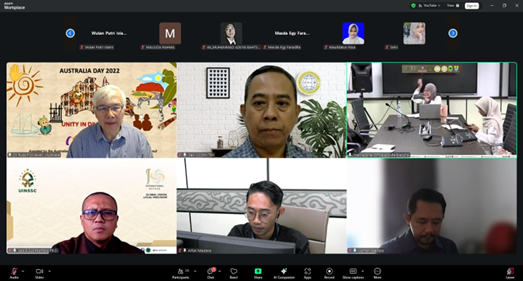
Lala Bumela, Ph.D. continued his welcoming remarks by acknowledging the recent large-scale natural disasters occurring across Indonesia, emphasizing how these events reflect the nation’s fragile ecological condition. He reminded the audience that human activity has reached a dangerous threshold, “we can do everything to nature, and that’s dangerous,” urging everyone to rethink how knowledge and action intersect with environmental responsibility. He emphasized that the seminar should inspire a deeper moral and intellectual awakening rather than function as a routine academic gathering. He strengthened this message by stating, “This gathering is not merely a simple webinar, but I really wish to transform these ideas that we are collecting today into a form of movement.” Through this reflection, Lala Bumela, Ph.D. invited participants to see the event as a catalyst for long-term regenerative change. His remarks encouraged the audience to situate their academic work within a broader cultural and ecological consciousness. These reflections created an atmosphere of seriousness and purpose, bridging personal, institutional, and national realities.
Building upon this foundation, Lala Bumela, Ph.D. shared his evolving understanding of spiritual awakening within the context of education and cultural ecology. He explained that intelligence is not a machine-like computation but an imaginative capacity that grows from cultural memory and relational presence. He elaborated that mindfulness requires active listening not only to oneself and others but also to the unseen dimensions of life that shape collective existence. According to him, awareness is never an isolated faculty (passive); it emerges from communal, multisensory, and interdependent realities. Lala Bumela, Ph.D. noted that frameworks such as BIMA help bridge ancestral wisdom, creative ecology, and cognitive grounding in ways that honor local identity. This framework helps envision a regenerative future for education and acts as a meaningful orientation for institutions navigating global challenges.
In the continuation of his remarks, Lala Bumela, Ph.D. introduced the audience to the concept of Structured Dialogic Design (SDD), which he described as a participatory methodology of collective intelligence introduced by Prof. Alexander Christakis, Ph.D.. He expressed that he is currently learning this concept and sees it as an important tool to make regenerative practices possible in real-world contexts. Lala Bumela, Ph.D. explained that in community dialogues, such as those occurring in Sagarahiang, Kuningan, SDD provides a way to surface complexity without oversimplifying lived experiences. He emphasized that SDD teaches communities to listen before solving and to map before acting, ensuring that every decision respects local knowledge. He further observed that SDD embodies epistemic moderation by honoring multiple voices, avoiding premature consensus, and preserving sacred spaces within systemic processes. Through this synthesis, he explained that BIMA and SDD together form the backbone of a regenerative paradigm. He stressed that education, viewed through this paradigm, becomes not an extractive or transactional process but a form of reciprocal becoming.
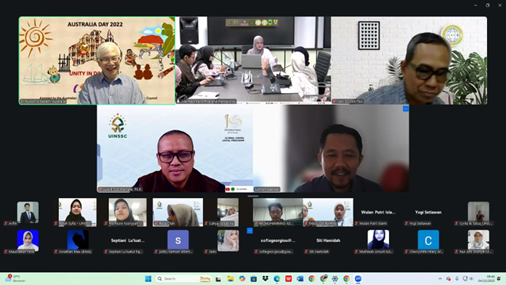
Lala Bumela, Ph.D. then expanded on what regeneration personally means to him, tying it back to the responsibilities of educators, researchers, and institutions. He described regeneration as restoring relational integrity among humans, re-rooting knowledge in place and story, and reimagining intelligence as a service to life. These ideas, he explained, must guide not only classroom practices but also administrative decision-making and institutional culture. His remarks encouraged listeners to reassess how their work aligns with ecological and cultural continuity. He invited the academic community to treat education as a living, evolving relationship rather than a fixed system. Through these reflections, Lala Bumela, Ph.D. connected individual agency with collective transformation. His vision underscored the moral imperative for institutions to participate actively in shaping regenerative futures.
Moving toward the opening of the day’s agenda, Lala Bumela, Ph.D. officially began the final-day session with a clear invitation to intellectual and ethical engagement. He stated, “As we begin this webinar, I invite us to think how our teaching, research, and institutions can become acts of regeneration, and how we use BIMA and SDD not just as tools but as a sacred commitment to epistemic justice.” This final day marked the culmination of a three-day program featuring diverse and meaningful themes. On the first day, participants explored Carita Pantun with Didin Misbahuddin, S.Hum. (Niskala Institute Bandung) and reflected on ecological guardianship of Mount Ciremai with Sukad, the mountain’s spiritual elder. The second day featured discussions on Wasathiyah, or moderate religious perspectives, by Ivan Chabibillah, M.Li., followed by Environmental Ethics delivered by Syarifuddin, S.S.. Through this meaningful event, Lala Bumela, Ph.D. expressed hope that the entire sessions would enrich the participants’ worldview, strengthen the institution’s commitment to regenerative knowledge, and inspire future collaborations. His welcoming remarks concluded by grounding the event’s intellectual journey within a collective aspiration for sustainable, culturally rooted transformation.
Author: Salsabilla