
Lala Bumela Sudimantara, Ph.D. Acts as Academic Connector Linking UIN SSC and Charles Darwin University in Jian Wu’s Doctoral Seminar on Emotional and Neuroaesthetic Approaches to Abstract Reasoning in Pre-Service Teacher Education
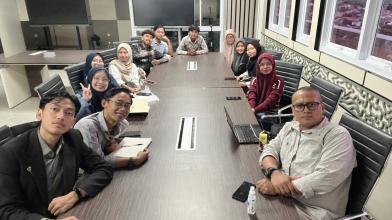
Charles Darwin, May 13, 2026 – International academic collaboration continues to become a strategic focus in strengthening global knowledge exchange in the 21st century. Through the initiative of Lala Bumela Sudimantara, Ph.D., Director of the International Office at Syekh Nurjati Cyber State Islamic University Cirebon (UIN SSC), the university established an academic connection with Charles Darwin University, Australia, during a doctoral proposal seminar presented by Jian Wu entitled Emotional and Neuroaesthetic Approaches to Abstract Reasoning in Pre-Service Teacher Education. The seminar featured Jian Wu as the presenter, with supervision from Dr. Ania Lian and Dr. Angelica Carlet. Academic participants from Charles Darwin University included Ivamere Fong, Mercy Kimenju, Sangar Jamtsho, Parthasarathi Banerjee, Lindsay Parry, Sonia Valizadeh, and Li Jao. Student participants from Syekh Nurjati Cyber State Islamic University Cirebon consisted of Muhammad Azkiya Bahtsulkhoir, Shofiatul Faqriyah, Indra Maulana Arfan Aziz, Annisa Maharani, Dimas Rizky Albar, and Maulida Rahma. Lala Bumela Sudimantara, Ph.D. emphasized that international academic engagement is essential in fostering broader perspectives and strengthening global knowledge networks in the modern educational era. “International collaboration is an important bridge for universities to engage with global knowledge development and to prepare students and academics for the challenges of the 21st century,” stated Lala Bumela Sudimantara, Ph.D.
The seminar highlighted important concerns regarding conventional approaches in evaluating Abstract Reasoning Skills (ARS) among pre-service teachers. Traditional psychometric assessments were critically discussed for their tendency to focus predominantly on technical and analytical reasoning while often overlooking emotional engagement, reflective interpretation, and humanistic dimensions of learning. This issue has become increasingly relevant in contemporary teacher education, where future educators are expected not only to master cognitive competencies but also to navigate ambiguity, adaptive thinking, and complex educational realities.
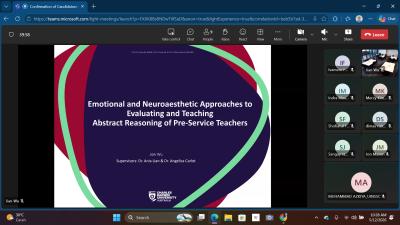
During the discussion session, the interdisciplinary approach proposed by Jian Wu generated meaningful academic dialogue among participants. The research integrates Reading for Emotion (RfE) and Reading for Aesthetics (RfA) as pedagogical tools to encourage reflective thinking, emotional awareness, and aesthetic interpretation in educational practices. Drawing from Cognitive Load Theory, General Intelligence Theory, and the Cattell-Horn-Carroll model, the proposal demonstrated how emotional and neuroaesthetic dimensions can contribute to higher-order thinking and flexible reasoning. Participants from both Charles Darwin University and UIN SSC actively exchanged perspectives on how these approaches could reshape future teacher education in a more holistic and human-centered direction.
The development of this international academic engagement reflects UIN SSC’s broader commitment to expanding collaborative learning opportunities across borders. Through connections facilitated by the International Office, students and academics are encouraged to participate in scholarly discussions that integrate global perspectives, interdisciplinary methodologies, and innovative educational frameworks. According to Lala Bumela Sudimantara, Ph.D., such collaborations are valuable in strengthening institutional partnerships while opening opportunities for students to become active contributors in international academic discourse. “We believe that academic collaboration across institutions and countries can nurture innovative thinking, intercultural understanding, and transformative educational practices,” he explained.
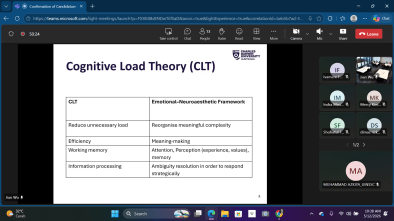
The seminar proposal was recognized for its strong novelty and interdisciplinary contribution, particularly in combining insights from cognitive science, affective neuroscience, and teacher education. The study offers the potential to improve reflective, adaptive, and humanistic reasoning among future educators by emphasizing the importance of emotional and aesthetic engagement in the learning process. The participation of students from UIN SSC in this academic forum also reflects the university’s growing involvement in global scholarly activities and its commitment to preparing graduates with international perspectives.
Ultimately, the seminar demonstrated how international academic partnerships can become meaningful platforms for knowledge exchange and educational transformation. By connecting institutions, scholars, and students from diverse backgrounds, initiatives such as this contribute to the advancement of inclusive and forward-looking education. Lala Bumela Sudimantara, Ph.D. concluded that fostering global academic collaboration is not only about institutional networking, but also about building a shared commitment toward innovative, reflective, and humanistic education for future generations. “Education in the global era requires collaboration, openness, and the willingness to learn from diverse perspectives in order to create meaningful impact for society,” he stated.
Author: Muhammad Azkiya Bahtsulkhoir