
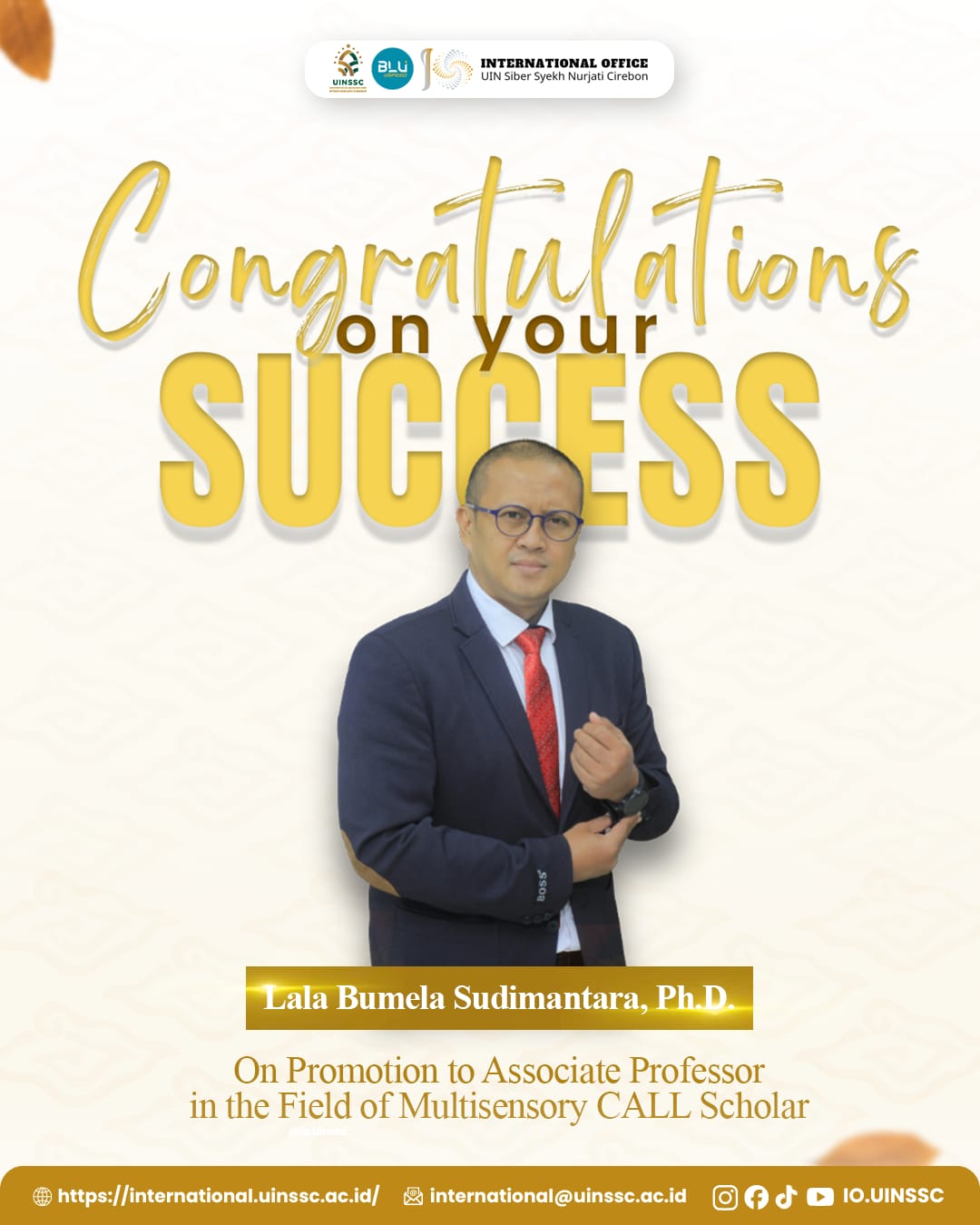
Lala Bumela Sudimantara, Ph.D. Appointed as the First Associate Professor in Multisensory Computer-Assisted Language Learning in Indonesia: Advancing Human-Centered and Sustainable Education
Cirebon, January 15, 2026 – The International Office of UIN Siber Syekh Nurjati Cirebon proudly announces the formal appointment of its Director, Lala Bumela Sudimantara, Ph.D., as Associate Professor (Lektor Kepala) in the field of Multisensory Computer-Assisted Language Learning (Multisensory CALL) by the Directorate General of Higher Education, Ministry of Higher Education, Science, and Technology (Kemendiktisaintek). This academic promotion recognizes his pioneering contributions to language education through the development of Multisensory CALL, a neuroscience-based pedagogical framework that closely reflects UNESCO’s vision of human-centered, culturally grounded, and holistic learning ecosystems. His work directly advances the spirit of Sustainable Development Goal 4 (Quality Education) by promoting inclusive, meaningful, and lifelong learning experiences. It represents a clear departure from technocratic and efficiency-driven models of educational technology, emphasizing embodied cognition, emotional engagement, and relational learning. Notably, he is recognized as the first Indonesian scholar to formally specialize and receive academic scholarship in this emerging field. As Director of the International Office, Lala Bumela Sudimantara, Ph.D. has played a central role in advancing international collaboration and strengthening UIN Siber Syekh Nurjati Cirebon’s presence within global academic networks.
A defining feature of Lala Bumela Sudimantara, Ph.D.’s academic profile lies in his integration of educational neuroscience particularly affective neuroscience and neuroaesthetics into digital language pedagogy, an approach that resonates strongly with UNESCO’s emphasis on educating the whole person. His research examines how emotion, attention, perception, and sensory engagement shape language acquisition in technology-mediated environments. Rather than relying on text-based or screen-centered instruction alone, Multisensory CALL engages visual, auditory, tactile, kinesthetic, and emotional modalities in a coordinated learning design. This approach reframes language learning as an embodied and relational process, positioning learners as active meaning-makers shaped by context, identity, and lived experience. Lala Bumela Sudimantara, Ph.D. conceptualizes these settings as “regenerative learning environments,” where cognition, emotion, and culture interact dynamically. Within this framework, technology functions not as an end in itself, but as a medium that supports deeper, more humane learning.
Lala Bumela Sudimantara, Ph.D.’s scholarship further demonstrates strong alignment with UNESCO’s recognition of ethnoscience as a vital foundation for sustainable and inclusive development. His work acknowledges that learning technologies must engage with local epistemologies and cultural knowledge systems to remain ethical and socially relevant. By grounding AI-augmented language learning in Indonesian cultural values and knowledge traditions, he illustrates how local wisdom can inform contemporary pedagogical design. These practices support sustainable communities and cultural continuity, reflecting the spirit of SDG 11 (Sustainable Cities and Communities). In this sense, ethnoscience functions as a critical corrective to decontextualized global frameworks. His classrooms become living laboratories where ancestral knowledge encoded in myth, ritual, and landscape, converses with contemporary tools to foster what UNESCO describes as “relational intelligence” and “ecological ethics.”
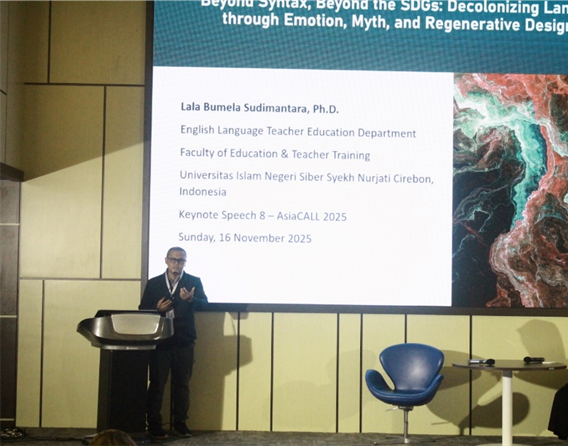
This appointment marks a historic milestone for Indonesian higher education. As the nation’s first scholar to pioneer Multisensory CALL as a distinct field of inquiry, Lala Bumela Sudimantara, Ph.D. bridges global scientific discourse with local epistemologies. Under his leadership, the International Office of UIN Siber Syekh Nurjati Cirebon has evolved into a space where international collaboration, neuroscience-informed pedagogy, and cultural integrity intersect. This model reflects UNESCO’s call to decolonize digital learning by positioning local knowledge systems as equal partners in innovation. In doing so, UINSSC contributes meaningfully to international conversations on the future of education.
The recognition by KemendiktiSainTek affirms that excellence in global scholarship can emerge from Indonesia’s cyber-native institutions when rooted in cultural integrity. Lala Bumela Sudimantara, Ph.D.’s promotion signals a paradigm shift from viewing technology as a tool for efficiency to embracing it as a medium for embodied, ethical, and regenerative learning. By embedding local values within digital learning environments, his work responds directly to global concerns about ethical AI, cultural marginalization, and learner disengagement.
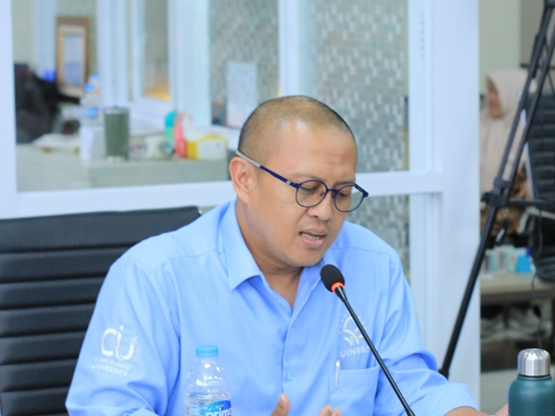
Reflecting on this achievement, Lala Bumela Sudimantara, Ph.D., stated that “This appointment is a validation of Indonesia’s capacity to generate world-class knowledge from our own soil. Multisensory CALL is grown here, in Cirebon.” His words capture UINSSC’s strategic vision to transform Cirebon into a global hub where Indonesian wisdom sets the standards for ethical, regenerative learning in the digital age. This milestone cements Lala Bumela Sudimantara, Ph.D.’s legacy as both a national pioneer and a global thought leader, ushering Indonesian scholarship into the forefront of UNESCO’s envisioned educational renaissance.
Author: Resa Diah Gayatri