
Lala Bumela Sudimantara, Ph.D. Brings International Office of UIN Siber Syekh Nurjati Cirebon into Decolonial Praxis in ELT Through Sundanese Cosmology at Deconstructing Indonesia’s Series
Cirebon, June 29, 2026 –The International Office of UIN Siber Syekh Nurjati Cirebon actively participated in the latest installment of the exclusive info session series organized by Deconstructing Indonesia, which took place on Monday, June 29, 2026. This particular session featured Lala Bumela Sudimantara, Ph.D., who serves as the Director of the International Office at UIN Siber Syekh Nurjati Cirebon, as the keynote speaker. Entitled "Decentering the Canon: Lutung Kasarung as a Site of Decolonial Praxis in English Language Teaching," the session offered a groundbreaking framework that challenges the deeply entrenched Eurocentric structures within global English Language Teaching (ELT).
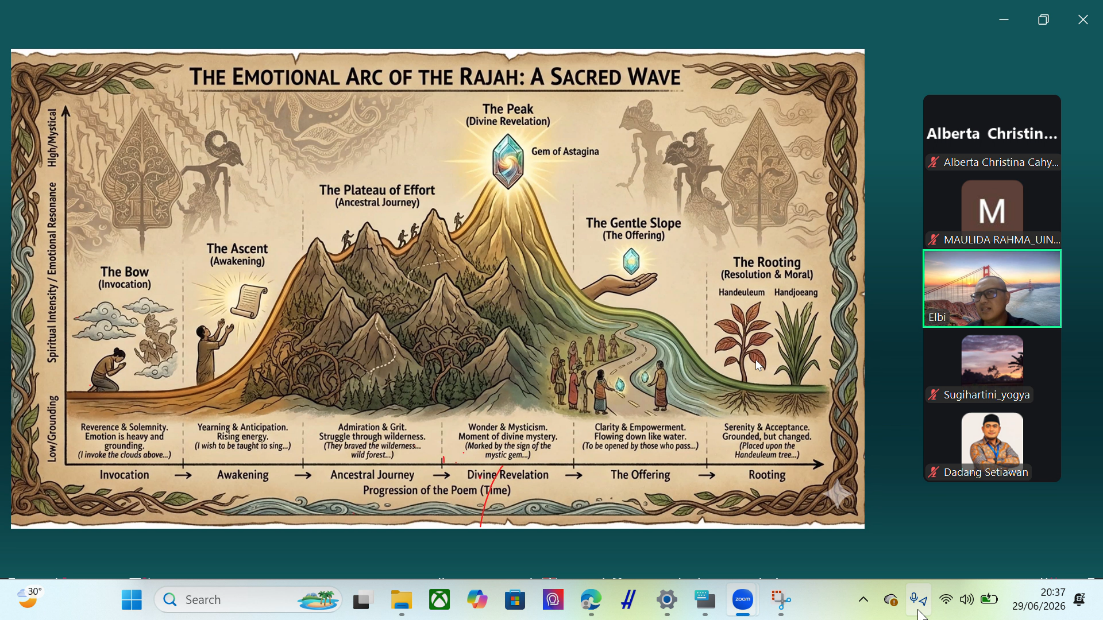
In his riveting presentation, Lala Bumela Sudimantara, Ph.D. introduced a profound paradigm shift, moving from a restrictive universal literacy concept toward a pluri-versal framework that validates non-Western systems of knowledge. Drawing from an extensive interdisciplinary research project launched in 2025 alongside domestic and international scientists, Lala Bumela Sudimantara, Ph.D. has been dissecting sacred Sundanese cosmological texts through the lenses of geoscience, system thinking, and effective neuroscience. He argues that Westernized educational frameworks systematically disconnect students from their ancestors and natural ecology.
A central highlight of the info session was Lala Bumela Sudimantara, Ph.D.’s innovative implementation of the BIMA (Bridging Intelligence, Mindfulness, and Awareness) framework, which utilizes ancestral Sundanese pillars to design modern pedagogical tools. This framework infuses the technological bloodstream of language learning with the philosophies of Silih Asih (mutual compassion), Silih Asah (mutual sharpening), and Silih Asuh (mutual nurturing). Lala Bumela Sudimantara, Ph.D. demonstrated how these ancestral philosophies serve as a literal "homecoming," allowing language classrooms to become collective ecosystems for ecological stewardship and critical reflection. Through this localized lens, the traditional epic of Lutung Kasarung is transformed from a basic romance folklore into a highly sophisticated agricultural liturgy and a precise cosmological map for disaster mitigation risk.
The presentation also laid bare a radical shift in language processing methodology by pioneering the fusion of verbotonal approaches, emotions, and aesthetics in a framework called regenerative multi-sensory computer-assisted language learning (CALL). Utilizing advanced AI tools like Gemini to visualize the intricate emotional architecture and arcs within ancient texts, Lala Bumela Sudimantara, Ph.D. completely eliminates rote grammar and vocabulary memorization from his curriculum. He emphasizes that neuroscientifically, cognitive processing cannot happen effectively without emotional sensitization. Lala Bumela Sudimantara, Ph.D. explicitly stated, "If you ask them to relate emotionally with the text, we were actually helping them to build a very dense emotional neural network." This pedagogical insight reframes language acquisition as an embodied, visceral experience where text is lived rather than just mechanically studied.
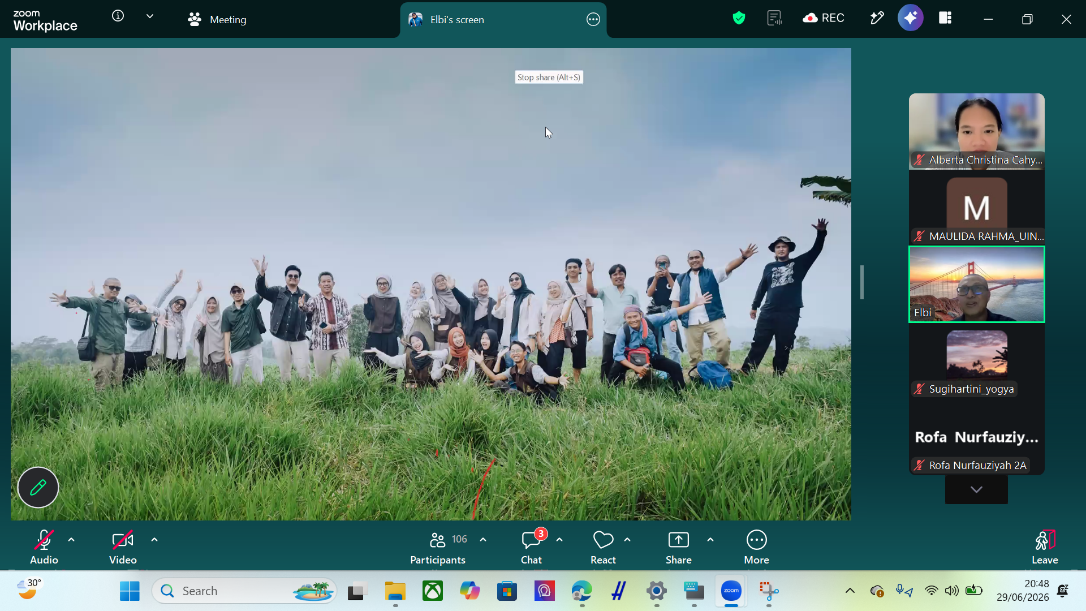
To put this decolonial theory into rigorous practice, he restructured the traditional classroom dynamic, shifting 80% of the teaching and learning processes outside into the sacred landscapes of Mount Ciremai, such as Pasir Batang Hill and Sagarahiang. Students learn to cross-examine ancestral cues with modern principles of geomythology and geoscience. Lala Bumela Sudimantara, Ph.D. explained that this immersive approach trains students to become true custodians of the land who can comfortably welcome international scholars and express Nusantara pride directly in fluent, critical academic English. Students are pushed to develop complete spatial awareness, proving that ancestral traditions hold a deep scientific precision that predates Western experimentation.
The session concluded with an engaging and highly scholarly Q&A segment that drew enthusiastic inquiries from academics across global networks. In response to inquiries regarding the boundaries of translating sacred ancestral knowledge into mainstream learning outcomes, Lala Bumela Sudimantara, Ph.D. reiterated that the inherent sacredness of these texts serves as an active moral imperative to perform dharma (concrete action for ecological regeneration) rather than producing static papers for Scopus-indexed journals.