
Lala Bumela Sudimantara, Ph.D. Delivers Keynote Speech on “Regenerative Multisensory CALL: A Framework for Deep Learning that Honors Brain, Culture, and Ecology” at International ELT Seminar Organized by the English Education Department in Collaboration with Charles Darwin University and the International Office UINSSC
Cirebon, May 20, 2026 – As part of his ongoing efforts to strengthen UIN Siber Syekh Nurjati Cirebon’s presence within the global academic community, Lala Bumela Sudimantara, Ph.D., Director of the International Office UINSSC, successfully facilitated an international collaboration with Charles Darwin University for a major seminar organized by the English Education Department. The event, held on May 20, 2026, under the theme “Hidden Curriculum for Sustainable Learning in ELT: Deep Learning & Love-Based Curriculum,” represented more than an academic gathering; it symbolized a shared commitment to reimagining the future of education through international partnership, interdisciplinary research, and cross-cultural dialogue. Bringing together nearly 200 English Education students, lecturers, researchers, and educational practitioners, the seminar featured a distinguished lineup of speakers led by Lala Bumela Sudimantara, Ph.D. as keynote speaker. Through his presentation, “Regenerative Multisensory CALL: A Framework for Deep Learning that Honors Brain, Culture, and Ecology,” he introduced a transformative educational vision that integrates neuroscience, culture, ecology, and technology into a single regenerative learning framework. The seminar was further enriched by presentations from Jian Wu of Charles Darwin University and Ginawati Samari, S.Pd.I., while Dra. Hj. Amroh Umaemah, M.Pd. officially opened the event. “International collaboration is not merely about connecting institutions across borders; it is about creating intellectual bridges that allow local wisdom, global scholarship, and future-oriented innovation to meet in one transformative learning ecosystem,” said Lala Bumela Sudimantara, Ph.D.
During his keynote address, Lala Bumela Sudimantara, Ph.D. highlighted a growing challenge facing contemporary education worldwide. He explained that the twenty-first century is increasingly marked by interconnected crises, including climate instability, ecological degradation, technological acceleration, social fragmentation, cultural dislocation, and rapidly changing economic systems. According to his analysis, educational institutions often continue to operate within fragmented disciplinary structures that separate language learning from ecology, psychology, culture, and community life. As a result, learners may acquire knowledge and technical skills yet remain disconnected from the deeper cultural, emotional, and ecological dimensions necessary for sustainable human development. He emphasized that traditional educational paradigms frequently reduce learning to cognitive achievement and measurable outcomes, overlooking the hidden curriculum that shapes values, relationships, emotions, and ways of understanding the world. This disconnect, he argued, has created an urgent need for educational frameworks capable of nurturing not only intellectual competence but also cultural consciousness, ecological awareness, and regenerative thinking.
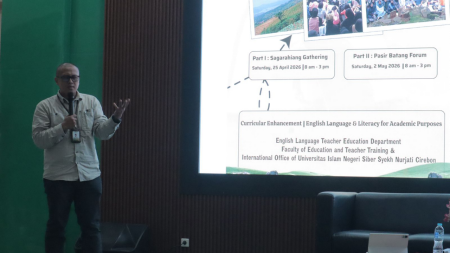
Addressing participants from diverse academic backgrounds, Lala Bumela Sudimantara, Ph.D. invited the audience to reconsider some of the fundamental assumptions underlying modern education. He posed a series of reflective questions that encouraged participants to engage in deeper dialogue about the future of language learning and sustainability. He asked, “What if learning is not merely cognitive but profoundly cultural? What if culture itself is not simply social but inherently ecological? And what if the brain, culture, and ecology are not separate domains at all, but parts of one living and interconnected system?” These questions became the intellectual centerpiece of the seminar and sparked lively discussion among students and lecturers. Drawing upon contemporary educational theory as well as indigenous perspectives from Indonesia, he argued that genuine learning occurs not only through formal instruction but also through the hidden curriculum embedded within relationships, emotions, stories, rituals, local wisdom, and collective experiences. The dialogue emphasized that sustainable education requires moving beyond isolated disciplines toward a more integrated and holistic understanding of human development.
Expanding on the foundations of his keynote presentation, Lala Bumela Sudimantara, Ph.D. explained that the concept of Regenerative Multisensory CALL has evolved through years of international academic engagement, interdisciplinary collaboration, and scholarly exploration. A major milestone in this journey was his leadership in bringing the 22nd AsiaCALL International Conference 2025 to UIN Siber Syekh Nurjati Cirebon, positioning the university as the host of one of Asia’s prominent international conferences in computer-assisted language learning. Through the conference theme, “Decolonising Language Education through Emotion, Myth, and Regenerative Design in the AI Era,” Lala Bumela encouraged scholars to move beyond conventional discussions of syntax, technology, and even the Sustainable Development Goals by exploring how emotion, culture, indigenous narratives, and regenerative thinking can reshape the future of language education. The intellectual momentum generated through AsiaCALL was subsequently enriched by a series of international engagements associated with the 4th International Water Week 2026 in Ecuador, discussions on Spiral Sovereignty: BIMA Framework and Citampian Spring as Regenerative Water, collaborative dialogues with Utrecht University on youth-led disaster resilience through ancestral wisdom and geoscience, as well as exchanges with BIMA Nexus Global Australia concerning critical intelligence and epistemic co-creation. These ideas continue to develop through ongoing international conversations, including initiatives related to Decolonising English Education and Restoring Nusantara Epistemologies. Together, these scholarly endeavors reflect a broader commitment to positioning Indonesian knowledge, local wisdom, and regenerative educational practices within contemporary global academic discourse. As Lala Bumela Sudimantara, Ph.D. remarked, “Indonesia should not only participate in global conversations; it should help shape them by contributing its own intellectual traditions, cultural heritage, and regenerative visions for the future of education.”
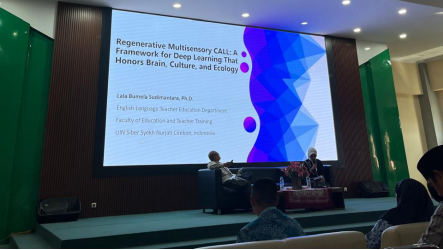
As the seminar progressed, participants gained a clearer understanding of the transformative educational paradigm proposed through Regenerative Multisensory CALL. Rather than treating education as a process dominated by instruction, the framework encourages inquiry, discovery, cultural engagement, and ecological responsibility. Lala Bumela Sudimantara, Ph.D. contrasted the traditional educational model—often characterized by approximately eighty percent instruction and twenty percent verification—with a regenerative model that prioritizes research, exploration, and collaborative knowledge creation. Drawing inspiration from Sundanese cosmology, indigenous narratives such as Lutung Kasarung, Nyai Sumur Bandung, and Ciung Wanara, as well as contemporary educational research, he demonstrated how local cultural heritage can enrich language learning while fostering sustainability and critical thinking. By integrating neuroscience, culture, ecology, and technology, the framework offers a holistic pathway for preparing future educators capable of addressing complex global challenges without losing connection to their cultural roots and ethical responsibilities.
The international seminar concluded with a powerful message about the future direction of education in Indonesia and beyond. Participants left with renewed awareness that meaningful learning extends far beyond textbooks, examinations, and classroom instruction. Instead, it emerges through the interaction of knowledge, emotion, culture, community, and ecological consciousness. The event also demonstrated UINSSC’s growing contribution to international academic discourse through strategic global partnerships and innovative research initiatives led by the International Office. In his closing remarks, Lala Bumela Sudimantara, Ph.D. emphasized, “The future of education is not about producing learners who merely consume information. It is about nurturing individuals who can regenerate knowledge, honor culture, care for the environment, and contribute meaningfully to humanity. When brain, culture, and ecology learn together, education becomes a force for healing, sustainability, and collective flourishing.” Through this international collaboration, UINSSC reaffirmed its commitment to advancing globally connected, culturally grounded, and socially transformative education for future generations.
Author: Muhammad Azkiya Bahtsulkhoir