
Lala Bumela Sudimantara, Ph.D. Explores Cosmological Literacy, Eco-Theology, and Education Rooted in Sundanese Wisdom during the Regenerative Human Capital Coordination Meeting
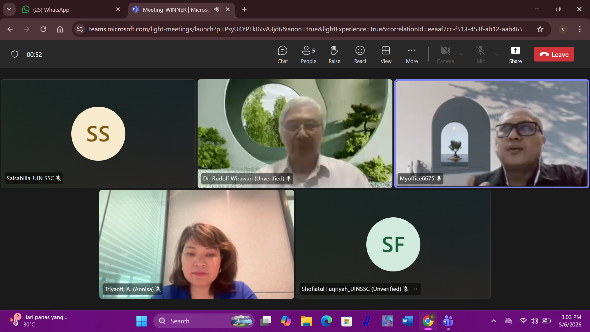
Cirebon, May 6, 2026 — A reflective and intellectually engaging presentation was delivered by Lala Bumela Sudimantara, Ph.D. during the online coordination meeting titled Regenerative Human Capital: Co-Creating Ancestral Wisdom and Geo-Science for Youth-Led Disaster Resilience in West Java. The discussion brought together Prof. Rudolf Wirawan, Ph.D. (University of Adelaide, Australia), Assoc. Prof. Annisa Triyanti, Ph.D. (Utrecht University, Netherlands), Luqman Baehaqi, Ph.D. (UIN Palangka Raya), Wakhid Nashruddin, Ph.D. (UIN Siber Syekh Nurjati Cirebon), and several students from the English Language Teaching Department of UIN Siber Syekh Nurjati Cirebon to discuss eco-theology, ancestral wisdom, and sustainable education. From the beginning, the presentation emphasized that education should not only develop intellectual competence, but also cultivate ecological awareness and spiritual consciousness. The atmosphere of the meeting became deeply reflective as participants explored the relationship between culture, nature, and learning. Through his presentation, Lala Bumela Sudimantara, Ph.D. invited the audience to reconsider how knowledge is formed and transmitted across generations. The session ultimately positioned local wisdom as an essential foundation for future educational transformation.
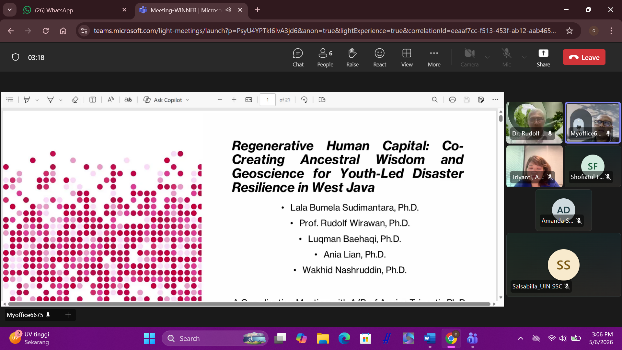
Opening his presentation, Lala Bumela Sudimantara, Ph.D. explained that resilience must be nurtured from an early age through cultural values and ancestral understanding. He reflected on his encounters with Sundanese knowledge holders such as Mr. Sukad and archaeologist Didin Mishbahuddin, S.Hum., whose perspectives deepened his appreciation of Sundanese cosmology. According to him, ancient Sundanese manuscripts and oral traditions contain sophisticated ecological knowledge that remains highly relevant today. He highlighted how stories such as Lutung Kasarung reveal early forms of eco-theological thinking, including efforts to preserve springs and maintain harmony with nature. These traditions, he argued, demonstrate that environmental consciousness has long existed within local communities. This reflection encouraged participants to see ancestral knowledge not as folklore, but as a meaningful intellectual resource.
As the discussion developed, the presentation introduced a new paradigm for English language education based on cosmological literacy. Lala Bumela Sudimantara, Ph.D. argued that language learning should evolve beyond grammatical competence toward a deeper engagement with ethics, spirituality, and cultural meaning. He proposed a framework that decolonizes interpretation by centering local epistemologies and honoring oral traditions such as Pantun Sunda as ancient technologies of knowledge. He also introduced multisensory-CALL learning tools that integrate verbal communication, aesthetic intonation, emotion, and technology-enhanced learning. According to him, meaningful learning requires space for students to connect emotionally and spiritually with the material they study. As he explained, “Language education must evolve from linguistic competence to cosmological literacy.” This statement became one of the central ideas shaping the overall direction of the presentation.
A particularly memorable moment emerged when Lala Bumela Sudimantara presented an AI-generated visualization titled The Emotional Arc of the Rajah: A Sacred Wave. The visualization mapped the emotional progression of the opening section of Lutung Kasarung through stages such as invocation, awakening, ancestral journey, divine revelation, offering, and moral resolution. This presentation illustrated how technology can be used not to replace ancestral wisdom, but to amplify and reinterpret it in contemporary contexts. Participants appeared deeply engaged as they observed how oral ecological narratives could be translated into visual and emotional forms. The session demonstrated that digital technology and indigenous knowledge do not have to exist in opposition. Instead, both can complement one another in creating transformative learning experiences. This integration reflected a broader effort to bridge tradition and innovation.
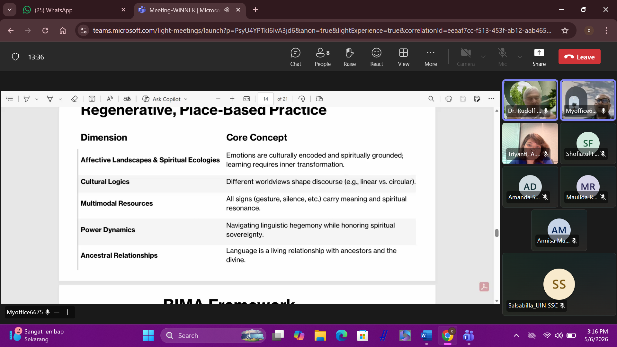
The presentation also explored the concept of regenerative, place-based practice through five interconnected dimensions. These dimensions included affective landscapes and spiritual ecologies, cultural logics, multimodal resources, power dynamics, and ancestral relationships. Through these ideas, Lala Bumela Sudimantara, Ph.D. emphasized that emotions, silence, gestures, and relationships with ancestors all carry meaning within the learning process. He argued that current deep learning models still lack these essential dimensions because they often separate education from cultural and spiritual contexts. The discussion highlighted the need to honor linguistic diversity and spiritual sovereignty while navigating modern academic systems. This perspective resonated strongly with participants who were interested in eco-theology and ethnoscience. The framework ultimately encouraged a more holistic understanding of education and human development.
In his closing reflection, Lala Bumela Sudimantara, Ph.D. connected these ideas with his recent international and community-based engagements related to water wisdom, ecological storytelling, and sustainability education. He explained that these initiatives align closely with the BIMA Framework developed by Prof. Rudolf Wirawan, particularly in integrating intelligence, mindfulness, and awareness through local wisdom. He also emphasized the importance of collaborative action involving students, researchers, and local communities. As he reflected, “Education should reconnect humans with the living intelligence of the earth.” This statement captured the emotional and philosophical essence of the presentation. More than an academic lecture, the session became a call to reimagine education as a process of remembering, reconnecting, and restoring balance between humanity and nature.
Author: Salsabilla