
Lutung Kasarung and the Ancient Syllabus of Life: Lala Bumela’s Creative Writing Class Reawakens Myth and Consciousness on the Slopes of Mount Ciremai
Cirebon, October, 5th 2025 — In the transformative journey of education, Lala Bumela, Ph.D., Director of the International Office and Partnership at UIN Siber Syekh Nurjati Cirebon, led a learning expedition to the sacred Sangiang Site in Sagarahiang, Kuningan—nestled on the slopes of Mount Ciremai. Together with 81 students from the English Language Teaching Department, the Global Engagement Team (Indra Maulana Arfan Ajiz and Tsamara Bahira Alzena), and the site’s guardian, Mang Ukad, Lala delved into the ancient pedagogical roots embedded within local myths such as Lutung Kasarung. The region is believed to be a central point in the diffusion of this story, which, according to Sundanese oral tradition, once served as a kamandalaan—an open-air classroom where kings, scholars, and villagers discussed ethics, ecology, and cosmology. For Lala, Lutung Kasarung is not merely folklore; it is an ancient syllabus of life, a poetic codex where myth becomes a method of transmitting consciousness. His approach—anchored in progressive pedagogy and global lifelong learning—aligns with the BIMA Framework (Bridging Intelligence, Mindfulness, and Awareness) first introduced by Professor Rudolf Wirawan from the University of Adelaide, Australia. “Education,” Lala said, “is not about escaping our past, but remembering how the ancients once made learning a living dialogue between the soul and the universe.”
Yet, in every process of transformation lies both the educative and the miseducative. As modern education races toward digital acceleration and utilitarian goals, many learners find themselves detached from the sacred sense of awareness that once grounded knowledge in lived experience. The myth of Lutung Kasarung becomes a mirror to this disconnection: the curse of Sanghyang Guruminda turning into a monkey can be read as the human mind losing its divine consciousness, falling into material form, and forgetting its spiritual origin. In this light, the “miseducative” condition is not about ignorance, but about forgetfulness—when learning becomes mechanical rather than mindful, when wisdom is replaced by mere information. The struggle of Lutung to regain his true form reflects humanity’s own struggle to reclaim awareness amid the noise of modernity. Through this realization, Lala’s students confronted an uncomfortable truth: that education today often forgets its essence—to awaken consciousness, not just competence.
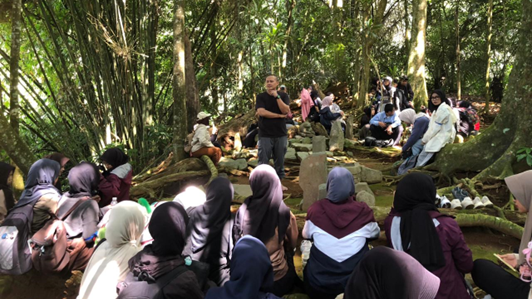
Standing beneath the old canopy of trees, with Mount Ciremai watching silently in the distance, Lala Bumela invited his students to sit upon the earth and listen—not just with intellect, but with intuition. The air shimmered with the murmur of the forest as he began to speak about the myth’s hidden syllabus. “Every legend,” he said, “was once a classroom, and every story a mirror of the human mind. When we study Lutung Kasarung, we are not merely analyzing a tale—we are remembering a forgotten curriculum of being.” His words fell like echoes of ancient teachers, bridging literature with cosmology, and myth with mindfulness. Mang Ukad then explained that the surrounding area, long before colonial mapping, had been a place of reflection and stargazing, where people learned to read the sky as both a calendar and a scripture. The students wrote in silence afterward, their creative pieces flowing not from imagination alone, but from a renewed sense of belonging to something timeless—a dialogue between myth, mind, and mountain.
Although Lutung Kasarung and archaeological sites such as Cipari are separated by centuries and contexts, both embody a distinct Sundanese worldview that emphasizes belonging—a sacred sense of connectedness with nature, ancestors, and the rhythm of life. The slopes of Mount Ciremai, with their mist and quiet streams, become a living metaphor for this unity. Through eco-poetic pedagogy, Lala Bumela encouraged students to see that myth and ecology are not separate disciplines but complementary paths to consciousness. In Lutung Kasarung, transformation begins with humility and devotion to the natural order—values that align deeply with the eco-humanistic principles of modern sustainability education. The course became a living experiment in bridging ancient wisdom with contemporary learning, where writing was not an academic task but a spiritual exercise. The students began to compose reflections inspired by the forest’s breathing—realizing that the truest form of poetry lies in awareness itself.
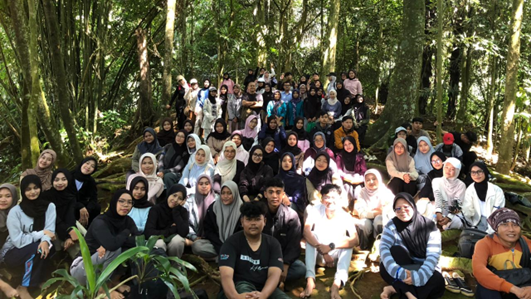
As dusk descended upon the slopes of Mount Ciremai, the forest seemed to breathe with them. The wind carried the scent of damp soil and fallen leaves, while the distant hum of cicadas became a language older than words. Lala Bumela gathered his students in a quiet circle, their faces glowing faintly in the amber light. “To learn,” he said softly, “is to remember that wisdom once flowed through song, through silence, through the pulse of living things. When you tell your stories, do not seek to conquer life—seek to move in rhythm with it.” His voice lingered like smoke over the valley, blurring the border between sound and thought. In that stillness, the myth of Lutung Kasarung rose again—not as a tale of the past, but as breath returning to the body of the earth.
In that moment, the textbook and the forest became one continuum of knowledge. Lala Bumela’s pedagogy illuminated that learning does not end at the printed page—it expands through experience, reflection, and poetry as the codification of knowledge itself. The written text found its echo in rustling leaves, while theory turned alive in the students’ mindful observations. The forest became an open textbook, and the myth a living syllabus; both guided the learners toward the same essence of understanding. Through this harmony, they realized that education is not only about mastering information, but about entering the rhythm of awareness—where knowledge, nature, and narrative move as one enduring symphony of wisdom.

Author: Muhammad Azkiya Bahtsulkhoir