
Neural Echoes of Emotion: Farah Syifa’s AI-Assisted Aesthetic Analysis in Academic Writing at the AsiaCALL 2025 Pre-Conference Workshop
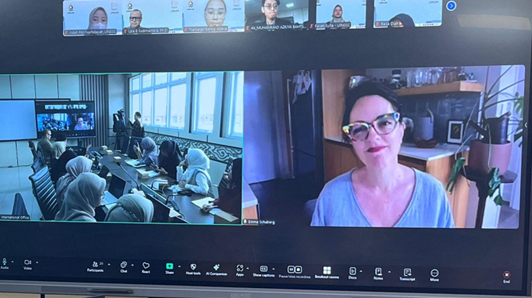
Cirebon, October, 11th 2025 — In a series of pre-conference capacity-building workshops organized by the International Office and Partnership of UIN Siber Syekh Nurjati Cirebon, Indonesia, the spotlight shone brightly on the young researchers preparing to present their full papers at the AsiaCALL 2025 International Conference. Under the guidance of Lala Bumela, Ph.D., Director of the International Office and Chairperson of AsiaCALL 2025 (Indonesia), this hybrid workshop brought together seven student presenters from the Global Engagement Team (GET), each delivering their research in front of an international researcher, Emma L. Schuberg, Ph.D. from Charles Darwin University, Australia. Among them, Farah Syifa Mutiara Riyadi, a student from the English Language Education Department, delivered an exceptional presentation of her research titled “Neural Analysis of Emotional and Aesthetic Patterns in AI-Assisted Academic Writing.” The atmosphere reflected not only academic rigor but also an emotional resonance, as these students represented the intellectual identity of UIN SSC on a global stage. “This is more than preparation,” said Lala Bumela. “It’s the cultivation of global thinkers who learn to merge knowledge, ethics, and creativity—an echo of our vision to build lifelong global impact.”
Farah’s research originated from her deep concern about the educational imbalance between policy ideals and actual classroom practice. Although Indonesia’s education framework aligns with Sustainable Development Goal 4 (Quality Education), its implementation often remains teacher-centered and exam-oriented, limiting the emotional and creative growth of students. In many academic settings, writing is reduced to a mechanical act—accurate yet lifeless. Farah observed that even AI-assisted writing often mimics this pattern: structured, efficient, but lacking emotional intelligence. “The challenge today,” she said during her presentation, “is not about replacing human intellect with AI, but about ensuring that AI can help us rediscover the emotional and aesthetic depth of learning.” This reflection became the foundation of her research, as she sought to redefine academic writing not as mere performance of knowledge but as a dialogue between emotion, cognition, and machine intelligence.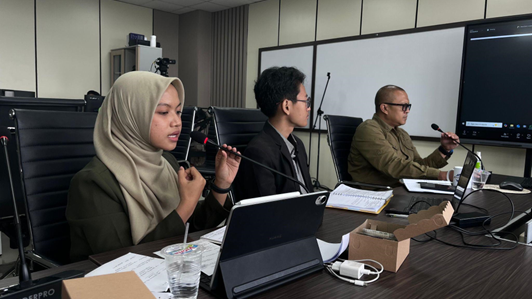
In her theoretical framework, Farah entered into a meaningful dialogue with the fields of neuroscience, aesthetics, and learning theory. She referred to Iain McGilchrist’s hemispheric theory, which emphasizes the need for balance between the brain’s analytical left hemisphere and its intuitive, creative right hemisphere. She further incorporated Antonio Damasio’s and Mary Helen Immordino-Yang’s insights on emotion as the core of reasoning, as well as James Zull’s idea of the learning brain. These were combined with two major frameworks: A.-B. Lian’s “Reading for Emotion (RfE)”, which emphasizes emotional literacy in reading and writing, and Ramachandran & Hirstein’s “Neurological Principles of Aesthetics,” which describes how beauty is processed in the human brain. As Lala Bumela emphasized in his remarks, “This kind of interdisciplinary synthesis is what defines our educational future—where neuroscience, AI, and humanistic values no longer compete but collaborate in harmony.”
To bring theory into practice, Farah employed a qualitative content analysis design with a neuro-aesthetic orientation. She analyzed 15 undergraduate mini-thesis abstracts from the English Language Education Department using a three-phase analytical process: AI prompt engineering, AI-based emotion and aesthetic mapping, and human interpretation. Through this combination, her study visualized the emotional rhythm and narrative flow of each text, identifying how metaphor, contrast, and syntactic rhythm reveal the emotional engagement of the writer. Her use of AI-enhanced visualization transformed abstract concepts into measurable emotional curves—each representing how the mind oscillates between logic and feeling during academic expression. This innovative approach exemplified how AI can function as a reflective mirror, amplifying rather than replacing human insight, and revealing hidden layers of beauty in academic prose.
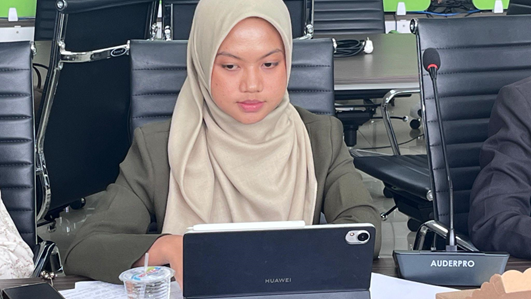
The results of Farah’s analysis carry profound implications for education and AI research. Her study demonstrates that AI-assisted writing can serve as a pedagogical bridge—helping students connect analytical thought with emotional awareness. This approach echoes the philosophy of regenerative education proposed by Prof. Rudolf Wirawan in “Beyond the SDGs,” which envisions education as a living system that integrates meaning, ethics, and creativity. Farah’s findings encourage educators to move beyond the false dichotomy between objectivity and emotion, advocating instead for a curriculum that values aesthetic sensitivity and affective reasoning as cognitive strengths. “When we write with both precision and passion,” Farah concluded in her reflection, “our ideas don’t just inform—they transform.” Her research thus bridges the rational and emotional aspects of scholarship, offering a model for the future of language education in the AI era.
Farah’s achievement represents not only her intellectual maturity but also the vision of UIN SSC in nurturing global learners who understand the symphony between mind, machine, and meaning. Her work exemplifies how AI can humanize, not dehumanize, education when guided by empathy and theory. As the AsiaCALL 2025 conference approaches, her study stands as a testament to the role of young scholars in shaping the next paradigm of knowledge creation. Lala Bumela, Ph.D., reflected proudly, “What we are witnessing is the rise of a new intellectual generation—one that does not fear AI, but teaches it to serve humanity through emotion, ethics, and enlightenment.” The neural echoes of emotion within Farah’s research remind us that the future of learning lies not in choosing between human and machine, but in teaching both to think, feel, and create together.
Author: Muhammad Azkiya Bahtsulkhoir