
Opening a Focus Group Discussion on Eco-Theology, Assoc. Prof. Lala Bumela Sudimantara, Ph.D. Advocates Sundanese Cosmology for Regenerative English Language Education
Kuningan, May 23, 2026 — Assoc. Prof. Lala Bumela Sudimantara, Ph.D., director of the International Office of UIN Siber Syekh Nurjati Cirebon delivered the welcoming remarks at a Focus Group Discussion (FGD) titled From Erasure to Emplacement: Reclaiming Sundanese Ecotheology in Digital English Language Teaching, held in Pasir Batang, Kuningan. The event brought together Sukad (cultural elder from Pasir Batang and Sagarahiang), Didin Misbahuddin, S.Hum. (archaeologist and researcher at Niskala Institute), and Intan Pusvitasari, M.Si. (academic influencer and author of Fisikologi). Also in attendance were Dra. Hj. Amroh Umaemah, M.Pd. (Head of the English Education Department), along with cultural practitioners, English teachers and lecturers from Cirebon and Kuningan, UIN SSC alumnus, and International Office interns. In his opening address, Assoc. Prof. Lala Bumela Sudimantara, Ph.D. introduced a broader vision for English language education that seeks to reconnect learning with local wisdom, ecological awareness, and cultural identity. He explained that the discussion emerged from his ongoing exploration of Sundanese cosmology over the last two years. Through this experience, he became increasingly aware of the richness of ancestral knowledge that has often been overlooked within contemporary educational systems. The opening immediately invited participants to reconsider what counts as legitimate knowledge in education.
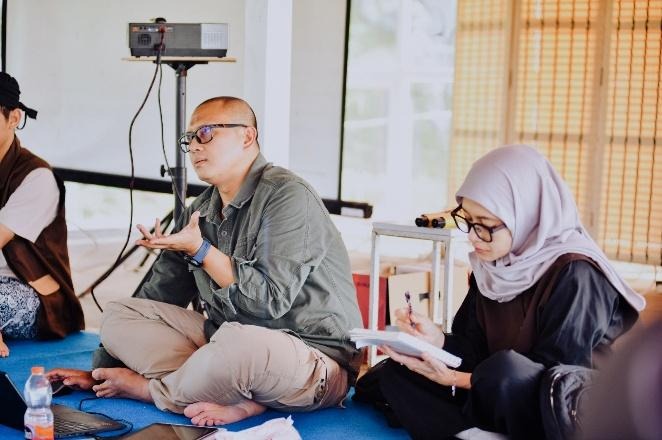
Building on this reflection, Assoc. Prof. Lala Bumela Sudimantara, Ph.D. explained that one of the long-term goals of the initiative is to develop an English language learning blueprint grounded in Sundanese cosmology. Rather than treating local knowledge as supplementary content, the proposed framework positions it as a meaningful source of learning capable of strengthening both language proficiency and environmental awareness. He argued that many forms of inherited wisdom contain remarkable precision and insight that can complement dominant educational paradigms. At the same time, the initiative seeks to support students in improving their language competence while nurturing a deeper connection with nature. According to him, education should not only prepare learners for academic achievement but also cultivate ecological responsibility. The proposed model therefore combines language development, cultural understanding, and environmental consciousness within a single educational framework.
A central concern raised during the welcoming speech was the tendency of current educational practices to focus heavily on technical aspects of language learning while paying less attention to emotion, meaning-making, and cultural logic. Assoc. Prof. Lala Bumela Sudimantara, Ph.D. observed that many learning models remain strongly influenced by fragmented and individualistic perspectives that often separate knowledge from lived experience. He suggested that meaningful learning requires a more holistic approach capable of integrating intellectual, emotional, and cultural dimensions. As he stated, “Deep Learning should not stop at grammar mastery; it must also engage emotion, semiotic experience, and cultural logic so that learning becomes transformative rather than merely technical.” He further explained that the curriculum he envisions would embrace regenerative, spiral, and non-linear ways of understanding knowledge, reflecting principles already embedded within Sundanese cosmology. This perspective encouraged participants to view education as a dynamic process of continuous growth rather than a linear path toward predetermined outcomes.
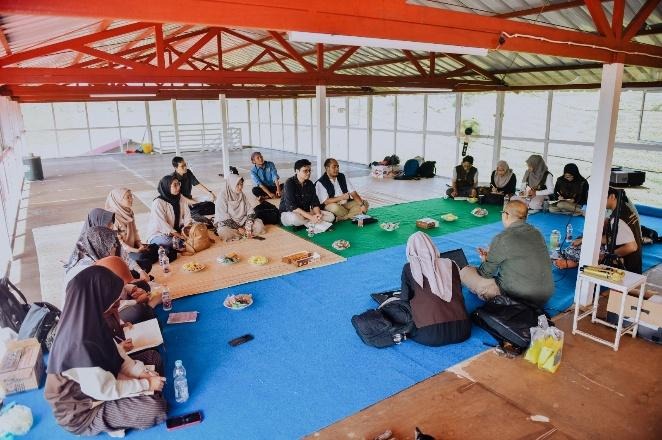
The discussion then shifted toward the role of nature as a source of learning. Drawing from his experiences in mountainous environments, Assoc. Prof. Lala Bumela Sudimantara, Ph.D. described how encounters with nature can generate moments of reflection that are difficult to achieve in conventional classroom settings. He explained that being surrounded by natural landscapes often creates what he referred to as a sense of sacred silence, encouraging deeper contemplation and awareness. Such experiences challenge the assumption that knowledge can only be obtained through formal institutions. He also emphasized that ancient texts and oral traditions frequently contain interdisciplinary insights that connect ecological understanding with spirituality and psychology. Through this perspective, nature becomes not merely an object of study but an active participant in the learning process.
Further enriching his remarks, Assoc. Prof. Lala Bumela Sudimantara, Ph.D. shared his experience attending a Carita Pantun performance delivered by Ki Rastani in Cigobang Village, Cirebon. He explained that many people tend to view these narratives primarily as stories of romance or entertainment, while overlooking the ecological and educational knowledge embedded within them. According to his observations, Carita Pantun contains valuable lessons related to environmental stewardship, disaster mitigation, ethics, and community values. He also highlighted a significant gap within contemporary educational materials, particularly in English language learning, where local narratives are rarely utilized as sources of wisdom. As a result, opportunities to introduce students to culturally grounded understandings of resilience and environmental responsibility are often missed. This reflection invited participants to reconsider the educational potential of traditional narratives.
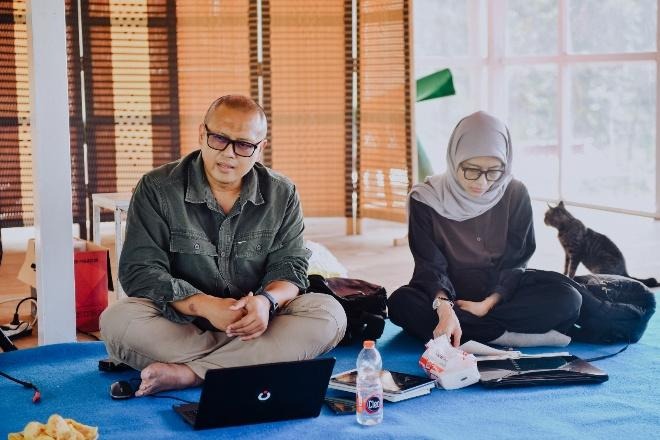
Concluding his welcoming speech, Assoc. Prof. Lala Bumela Sudimantara, Ph.D. expressed hope that the FGD would inspire educators to strengthen the relationship between learning, local wisdom, and ecological awareness. He emphasized that his ongoing research into Sundanese cosmology continues to demonstrate the validity and relevance of ancestral knowledge within contemporary educational contexts. Furthermore, he argued that preserving local wisdom is not merely a cultural obligation but also an educational necessity for future generations. Referring to the opening sections of Lutung Kasarung, he noted that many important ecological insights remain hidden within traditional narratives that deserve further exploration. As he remarked, “Our ancestral knowledge is not obsolete; it is legitimate, relevant, and urgently needed to help future generations develop ecological consciousness and epistemological justice.” His closing statement left participants with a sense of responsibility to ensure that local wisdom remains a living part of educational practice rather than a forgotten inheritance.
Author: Salsabilla