
Poem as Codification of Knowledge: Reviving Ancient Wisdom Through Eco-Poetry and the Spirit of Academic Revolution
Cirebon, October, 5th 2025 — From age to age, knowledge has continuously undergone codification—a transformation of wisdom into structured forms of learning that transcend generations. Around 4000 BCE, kings and scholars of ancient civilizations turned nature itself into a kamandalaan, a sacred space of education where intellectual and spiritual discussions took place. Learning was never separated from the environment; it was born from observing the stars, feeling the wind, and understanding the rhythm of the earth. Over time, this evolved into a cycle of continuous progress—an evolution that led to revolutionary and sustainable forms of education. One of the most remarkable remnants of this ancient intellectual civilization lies in Situs Sangiang, Sagarahiang, located in Kuningan, West Java. The site reveals evidence of an advanced past: lingga stones used as instruments of astronomical interpretation, royal architectural systems, and early technological innovations that once supported the daily lives of its people. However, much of this grandeur vanished after the eruption of Mount Krakatoa, leaving behind only ruins. Yet these ruins are not symbols of loss—they are treasures of hidden wisdom.
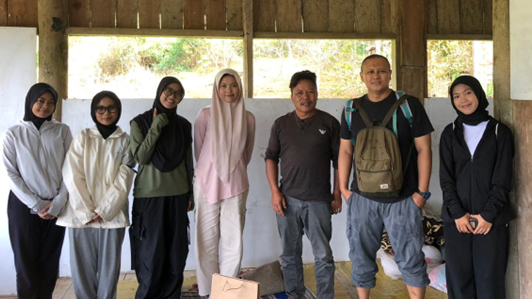
It was within this context that Lala Bumela, Ph.D., Director of the International Office at UIN Siber Syekh Nurjati Cirebon, found a new pedagogical concept after being inspired by the BIMA Framework (Bridging Intelligence, Mindfulness, and Awareness) developed by Professor Rudolf Wirawan from the University of Adelaide, Australia. From this inspiration emerged Eco-Poetry—a curriculum model that revives the spirit of ancient education, where knowledge is not only studied but lived. The poem referred to here is not a modern form of verse or rhyme; rather, it is the ancient oral narrative—a spoken codification of knowledge passed from one generation to the next, integrating social, cultural, and ideological dimensions of local life. These oral poems served as vessels of learning, ensuring that wisdom flowed continuously within the community. In this modern revival, Lala Bumela led 81 students to rediscover that ancient curriculum alongside Mang Ukad, the spiritual guardian of Situs Sangiang, and the Global Engagement Team of the International Office—Indra Maulana Arfan Ajiz and Tsamara Bahira Alzena.
“Knowledge,” said Lala Bumela, “is not something to be stored—it must be lived, narrated, and passed on. When learning breathes through story, it becomes eternal.”
In the modern era, the codification of knowledge has become rigid—limited to textbooks, data, and digital archives that often strip wisdom of its living essence. Students learn facts but seldom experience their meanings. The younger generations, shaped by the rhythm of globalization and algorithmic thinking, have gradually lost their intimacy with nature, culture, and reflection. Knowledge today is often pursued as an object to possess rather than a consciousness to awaken. This detachment creates a spiritual void in education, where the intellect (intelligence) is active but the heart (mindfulness and awareness) remains dormant. The fast-paced culture of productivity and assessment has caused learners to overlook the dialogical nature of knowledge—the way it once connected humanity to the cosmos. In this context, Eco-Poetry reemerges as an act of resistance—a poetic revolution that challenges mechanistic learning by reuniting science with story, intellect with soul, and humanity with its environment.
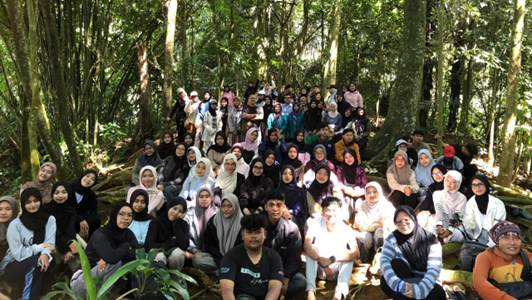
During their journey to Situs Sangiang, the students stood amidst the sacred stones of the Lingga Punden Berundak, surrounded by whispering winds and timeless silence. It was here that Mang Ukad shared a piece of ancestral memory: that the lingga once served as an astronomical tool, allowing ancient kings and scholars to observe celestial movements and measure the rhythm of time. The site, he explained, was not merely a remnant of the past—it was once a cosmic classroom, where the dialogue between earth and sky became the essence of learning. As the students listened, Lala Bumela began to speak about Eco-Poetry as a modern bridge between the intellectual and the spiritual, between the written word and the living world. “The ancients did not separate poetry from science,” Lala said. “For them, a poem was a map of consciousness—a record of human encounters with the divine order of nature.” Inspired by this dialogue, the students began to write their reflections, not as academic tasks but as living experiences. Their writings flowed with the pulse of the forest, capturing fragments of wind, memory, and silence as part of their creative awakening.
The implementation of Eco-Poetry in the Creative Writing course became a dynamic field laboratory for educational transformation. Students were encouraged to explore how ancient forms of oral storytelling encoded ecological, ethical, and spiritual knowledge within language. Through guided observation, they discovered that every natural element—a tree, a rock, a stream—embodies symbolic intelligence. This pedagogy merged the ancient with the contemporary, positioning poetry as both a cognitive and contemplative practice. Under Lala’s guidance, the class translated these experiences into modern literary works that honor the continuity of learning—from oral traditions to written creativity. The activity not only enhanced students’ writing skills but also nurtured their emotional and ecological literacy, making Eco-Poetry a pedagogical model that integrates science, philosophy, and art into one living curriculum.
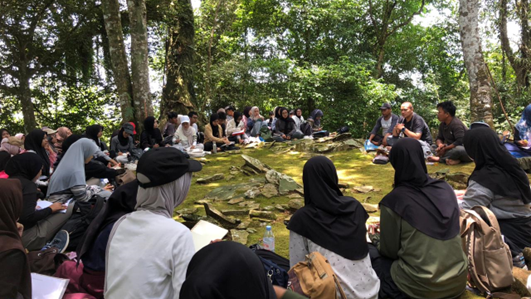
The visit to Situs Sangiang and the practice of Eco-Poetry rekindled a long-forgotten form of wisdom: the unity of knowledge, nature, and humanity. Students came to realize that education is not confined to the classroom or the screen—it is a lifelong dialogue between self and creation. The ruins of Lingga were no longer silent stones; they became metaphors for the forgotten chapters of civilization waiting to be reinterpreted through creative expression. This project, initiated by the International Office of UIN SSC, thus became a cultural and academic milestone—an embodiment of the university’s vision for life-long global learning. Through this transformative experience, students reconnected not only with their intellectual capacities but with their ancestral roots and spiritual consciousness.
Ultimately, Poem as Codification of Knowledge offers more than a poetic movement—it represents the revival of a timeless educational philosophy. By translating the ancient oral traditions of the past into a modern learning framework, Lala Bumela redefined what it means to be educated in the 21st century. His initiative teaches that poetry is not a luxury of the arts but a vessel of wisdom that binds humanity to its cosmic origins. “When knowledge returns to its poetic form,” said Lala Bumela, “it remembers where it came from—nature, spirit, and the collective memory of humanity. And that remembrance is where true education begins.” Through Eco-Poetry, learning becomes not just an act of knowing but an act of being—a sacred journey to revive ancient wisdom in the heart of modern academic revolution.
Author: Muhammad Azkiya Bahtsulkhoir