
Pop-Culture Hegemony and Sociolinguistic Dynamics in the Malay World: Repositioning Indonesian Language Diplomacy in Malaysia from Traditional Claims toward the Contemporary Creative Economy
Cirebon, August 06, 2026 – When tickets for Pestapora Malaysia sold out within days and the band Dewa 19 filled three consecutive concert nights in Kuala Lumpur, the commercial appetite of Malaysian youth for Indonesian pop culture became an empirically observable fact. It was against this backdrop that Ir. R. Ahmad Romadoni Suryaputra, Ph.D., the Education and Cultural Attaché of the Indonesian Embassy in Kuala Lumpur, addressed the Thursday session of the Seminar of the Education and Cultural Attachés and the Deputy Permanent Delegate of the Republic of Indonesia to UNESCO.
His intervention argued that diplomatic strategy must migrate from ceremonial exhibitions toward the creative industries that already dominate the Malaysian cultural marketplace. The seminar, devoted to information on cultural and Indonesian language activities in various countries, thus acquired a distinctly contemporary register in its Malaysian segment.
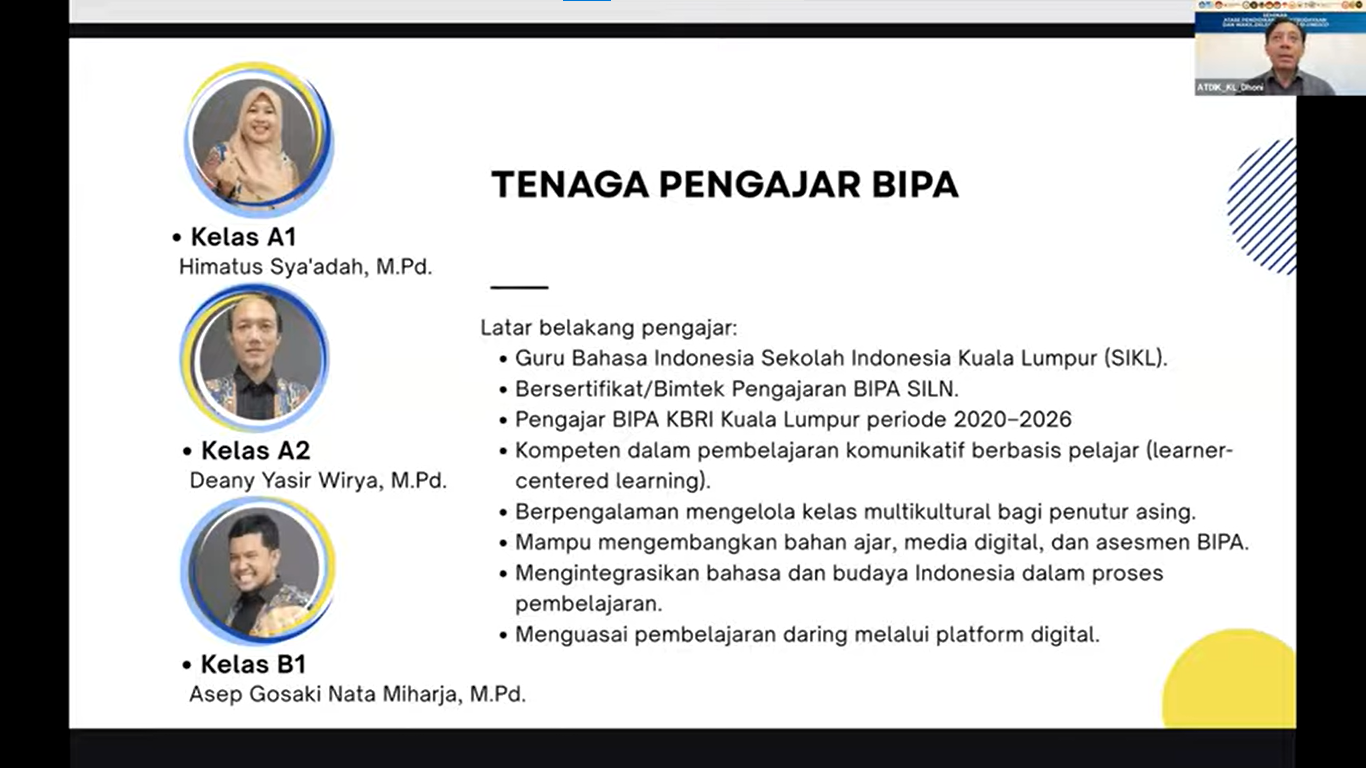
The linguistic dimension of this diplomacy, launched on 5 June 2026 with the support of the National Language Agency, revealed a learner profile far more cosmopolitan than the host nationality alone. Enrolled participants originated from eight countries, including Canada, Yemen, Sudan, Egypt, Pakistan, the Philippines, and South Korea, indicating that Bahasa Indonesia functions in Malaysia as a regional lingua franca of opportunity.
Instruction is delivered by certified teachers drawn from the three Indonesian overseas schools in Johor Bahru, Kuala Lumpur, and Kota Kinabalu, whose pedagogical competence compensates for the attaché office's limited personnel. Post-pandemic delivery through virtual platforms has dissolved geographical concentration, allowing learners from peripheral states to join cohorts that were previously confined to the capital. An appreciation competition culminating in the August diplomatic reception now institutionalizes learner motivation within the ceremonial calendar of the embassy.
Beneath this operational success lies a more delicate sociolinguistic negotiation, because the promotion of Bahasa Indonesia inevitably intersects with Malaysia's own institutional commitment to Bahasa Melayu. During the plenary discussion, a senior representative of the Indonesian Language Agency reported that certain bureaucratic and academic circles in Malaysia still regard the internationalization of Indonesian with suspicion, even while acknowledging their common Malay ancestry. Such defensiveness surfaces periodically in social media disputes over cultural ownership, although field realities among ordinary citizens remain overwhelmingly reciprocal and warm.
Border Community Learning Centers have responded pragmatically by teaching both language varieties side by side, thereby reframing rivalry as complementary literacy. The International Office interprets these tensions as an invitation for universities to supply philological and maritime-historical research that can depoliticize public debate and anchor cooperation in documented shared heritage.
Administrative friction constitutes the second structural challenge, particularly in the processing of invitation-based visas whose approval timelines extend well beyond standard expectations. Student mobility benefits from the centralized Education Malaysia Global Services pathway, yet short-term institutional visits for cultural or academic events remain vulnerable to procedural delay. Compounding this difficulty, every cooperation proposal must navigate a dual advocacy environment in which Malaysian counterparts are simultaneously tasked with promoting their own national language abroad. Strategic patience is therefore not optional but constitutive of any sustainable partnership across the Strait of Malacca. Campuses that internalize this constraint can sequence their engagements, beginning with virtual collaboration before committing resources to physical mobility.

Confronted with questions about recurring cultural claims in the digital sphere, the attaché offered a philosophical resolution that the International Office considers foundational for future programming. He stated directly, "We can all understand that culture is universal, especially since we share the same ancestors, the same region, and the same geography within this Nusantara." This acknowledgment of unavoidable kinship redirects institutional energy from defensive monitoring toward generative co-production. Joint film projects such as the recently circulated co-produced horror titles, together with co-developed music festivals, exemplify the kind of shared authorship that renders ownership disputes obsolete. Universities equipped with film, literature, and ethnomusicology programs are consequently positioned to become the technical workshops of this co-productive diplomacy.
The Malaysian segment closed with an implicit thesis, hegemony in the Malay world will be decided in cinemas, streaming platforms, and festival stages rather than in ceremonial halls. By coupling creative-industry engagement with rigorous sociolinguistic scholarship, the university can help stabilize a partnership in which both languages advance together. In such a configuration, the siblinghood of the Nusantara ceases to be a sentimental metaphor and becomes an operational framework for measurable academic cooperation.