
Post-Colonial Cultural Diplomacy and the Management of Colonial Historical Sensitivity: Contemporary Strategies for Promoting the Indonesian Language and Culture through Education, Repatriation, and Creative Industries in the Netherlands
Cirebon, August 04, 2026 – The final segment of the Tuesday session of the Seminar of the Education and Cultural Attachés and the Deputy Permanent Delegate of the Republic of Indonesia to UNESCO turned to the Netherlands, a country with a long and complex history with Indonesia. This virtual event, focused on information on cultural and Indonesian language activities in various countries, presented the Netherlands as a strategic partner in education and culture.
Professor Aulia Iskandarsyah, M.Psi., MSc., Ph.D., the Education and Cultural Attaché of the Indonesian Embassy in The Hague, explained how Nusantara connects with the land of windmills through modern cultural diplomacy. He noted that out of seventeen million Dutch residents, around 1.7 million are Indonesian diaspora or have ties with Indonesia. Even President Soekarno once remarked that the most delicious Indonesian food could be found in The Hague, reflecting the strong presence of the community. From the International Office's perspective, this demographic reality makes the Netherlands a natural bridge for cultural and educational engagement in Europe.
In the education sector, Sekolah Indonesia Den Haag in Wassenaar stands as one of the prides of Indonesian overseas schooling. Located in an elite residential area, the school follows the national curriculum while instilling Indonesian cultural values in its students. Its students regularly appear at events such as Pasar Nusantara on 27–28 June 2026 and the anniversary celebrations of partner institutions such as The British School.
Workshops on wayang orang and traditional children's dances from Semarang have also enriched the students' cultural experience. The school offers BIPA classes and Dutch as local content, and adopts unique practices such as a uniform-free daily routine and multiclass multisubject teaching. These features make the school an interesting partner for virtual mobility and sister school programs with Indonesian schools.
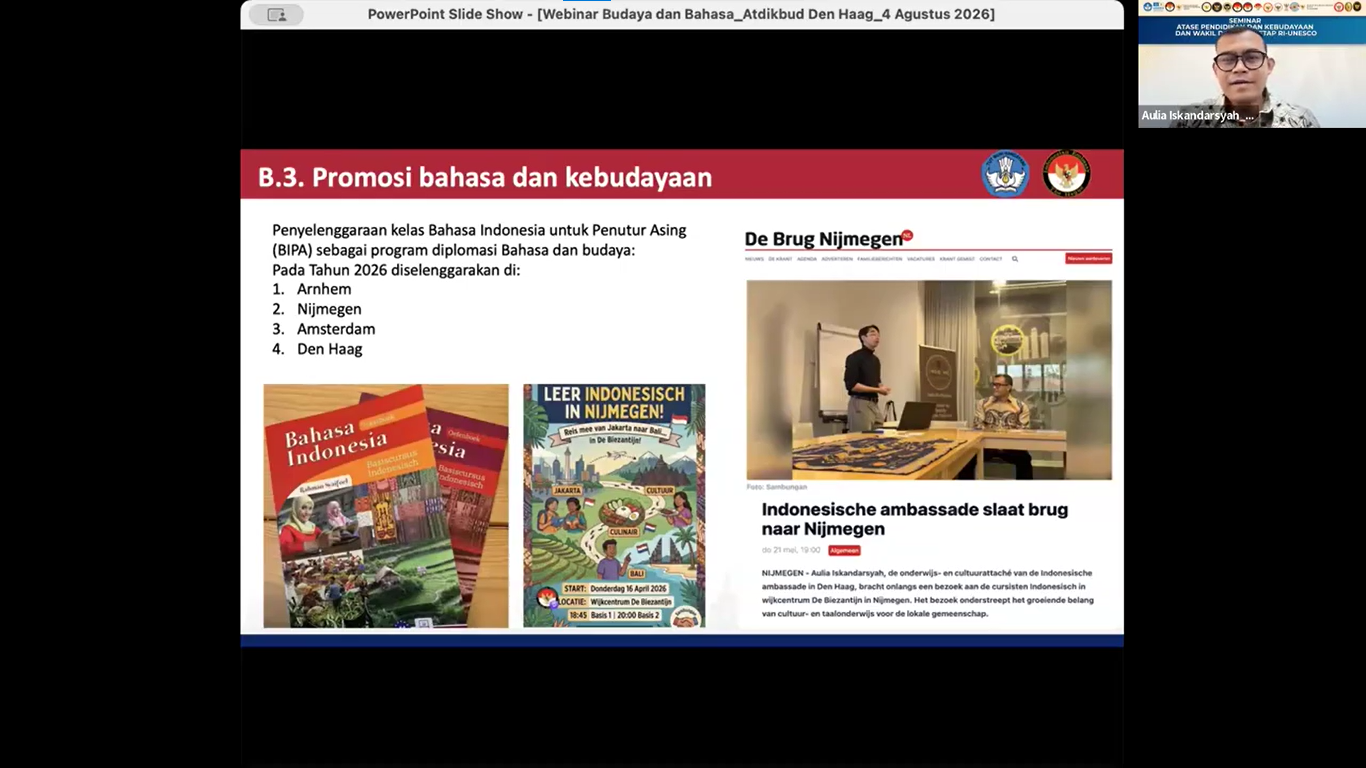
On language promotion, the attaché office this year held BIPA classes in four cities, namely Arnhem, Nijmegen, Amsterdam, and The Hague. Contemporary formats have also been embraced, such as the Indomie Podcast and the Nusantara Beat band that mixes traditional music with psychedelic flows. A DJ of Moluccan descent based in the Netherlands has brought eastern Indonesian nuances into house music through the Kembali ke Timur movement, reaching younger audiences. Recognition of this cultural bridge was affirmed on 11 April 2026, when an Indonesian cultural activist was awarded the Order of Oranye-Nassau by the Dutch royal family for fifteen years of contribution.
Despite the warm people-to-people relations, Professor Aulia acknowledged that cultural diplomacy in the Netherlands must manage the sensitivity of colonial history carefully. When visiting the Bronbeek Museum in Arnhem, he found different historical perspectives, and when challenged, the museum proposed comparing research data. This experience shows that Indonesia must equip itself with strong research perspectives to produce balanced narratives of the colonial past.
He also recalled that at the Maritime Museum in Rotterdam, a sultan from Bengkulu was labeled as a great pirate of the Sunda Strait, while Indonesians regard him as a hero. Funding remains another classic challenge, because promotion requires resources, and programs must therefore be selective and produce concrete outputs. Advising Indonesian institutions on how to attract international attention, he stated, "If the flower is good, the beetles will surely come." In other words, campuses must offer unique added value, such as summer courses on coastal or agrarian culture, rather than generic promotions that can already be found online.
At the state level, the Ministry of Culture has intensified cooperation with Dutch institutions such as the Wereldmuseum on the repatriation of cultural objects and documents. The ambassador's podcast Ruang Tamu, which first invited student representatives, shows how the embassy accompanies the Indonesian student community. Student organizations also contribute through events such as Indonesian Day in Groningen and the Historan program in Leiden, which traces the anti-colonial movement of Indonesian students before the German occupation of the Netherlands.
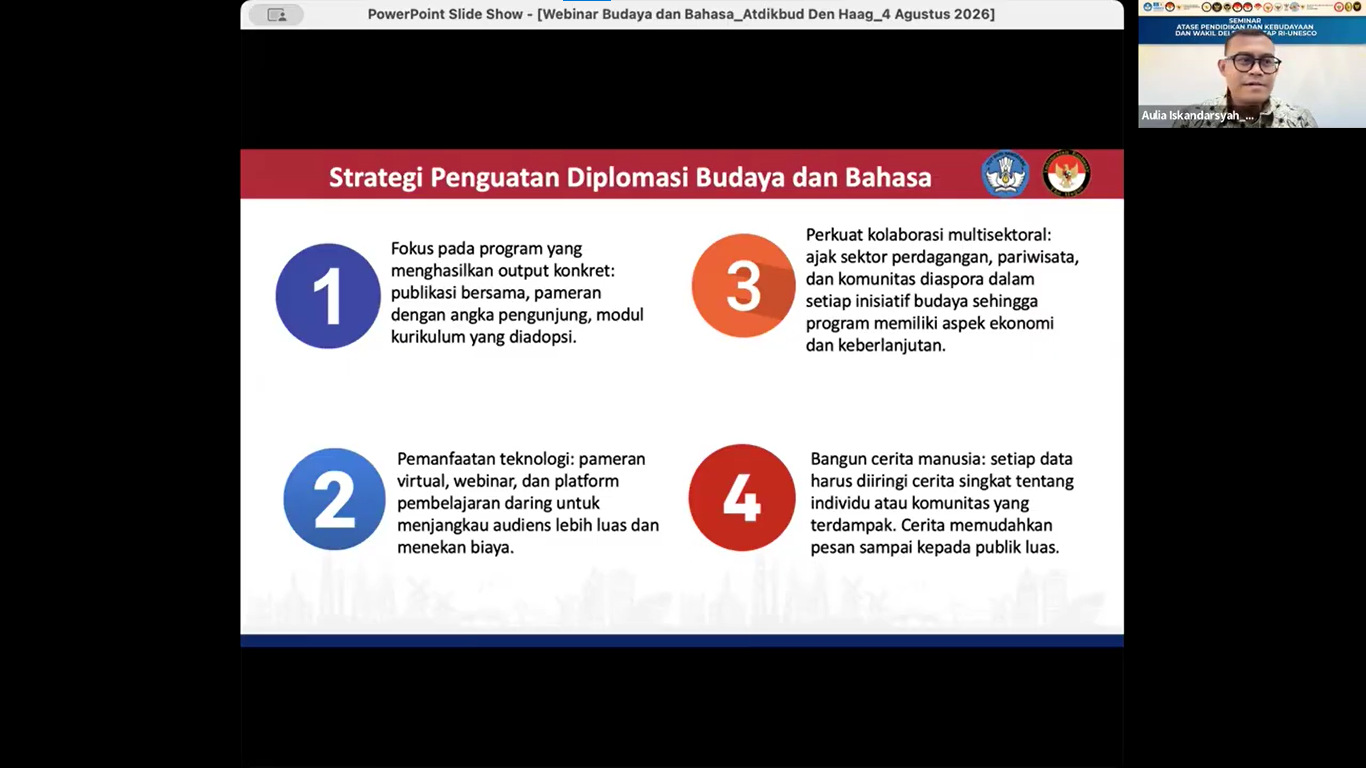
Looking ahead, the attaché office prioritizes programs with concrete outputs, the use of technology and contemporary cultural content, and multisector collaboration across education, economy, tourism, and culture. Professor Aulia emphasized that every promotion must carry a human narrative so that it is remembered and emotionally touching. Books and films about the lives of Indonesian students in the Netherlands prove that romance and scholarship can walk hand in hand in diplomacy.
The session concluded with an open invitation for Indonesian campuses to propose research collaboration, community service, and BIPA partnerships in the Netherlands. The attaché office welcomes concrete proposals through its official email channel and is ready to coordinate them with relevant Dutch partners. For the International Office, the Dutch experience teaches that historical ties, when managed with strong research and creative formats, can be transformed into productive partnerships. The unique practices of Sekolah Indonesia Den Haag also open opportunities for teacher and student exchanges through virtual mobility. By combining respect for history with contemporary creativity, our campus can build a meaningful presence in the European cultural landscape