
Questioning Education Systems: Lala Bumela Sudimantara, Ph.D. and UIN SSC Students Engage in an Indonesia–Australia International Mini Symposium on Early Career Secondary Teachers, Educational Sustainability, and Global Academic Dialogue
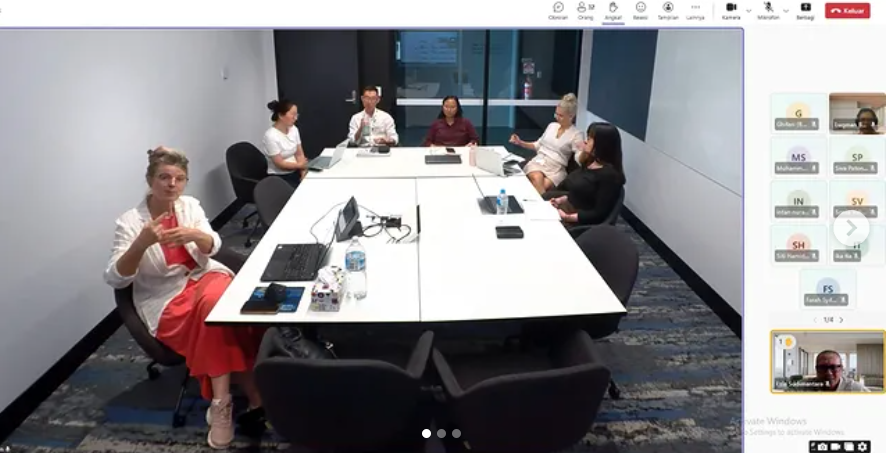
Cirebon, February 23, 2026 — An intellectually vibrant and cross-continental academic exchange unfolded during the International Mini Symposium organized by Lala Bumela Sudimantara, Ph.D., Director of the International Office of UIN Siber Syekh Nurjati Cirebon and alumnus of Charles Darwin University, Australia. The symposium brought together scholars and students from Indonesia and Australia in a reflective forum dedicated to questioning the foundations of contemporary education systems. Distinguished participants included Ania Lian, Ph.D. and Kate Edger from Charles Darwin University, alongside Luqman Baehaqi, Ph.D. from UIN Palangkaraya, as well as students from UIN Siber Syekh Nurjati Cirebon and UIN Palangkaraya. Rather than functioning as a conventional academic conference characterized by rigid presentations and formal hierarchies, the symposium was designed as an open intellectual space where research could be examined through dialogue, interruption, reflection, and collective inquiry. Participants were encouraged not merely to present completed work but to articulate emerging ideas, questions, and conceptual tensions, transforming the symposium into a dynamic environment of scholarly experimentation where research was treated as a living conversation rather than a finished product.
Central to the discussion was the growing concern surrounding early career teacher attrition, a phenomenon increasingly recognized as a critical issue within global education systems. Participants examined how many education systems interpret teacher attrition primarily as an individual failure—an inability of teachers to adapt, endure pressure, or sustain professional commitment. However, the symposium challenged this perspective by reframing attrition as a symptom of structural misalignment within the education system itself. Conversations highlighted how educational institutions frequently prioritize measurable administrative performance, compliance procedures, and visible indicators of productivity over meaningful pedagogical engagement. As a consequence, teachers often experience a profound gap between the emotional, intellectual, and relational labor they invest in their classrooms and the limited forms of professional recognition provided by institutional structures. This imbalance raises fundamental questions about the sustainability of educational systems that rely heavily on compliance mechanisms while overlooking the complex human dimensions of teaching practice.
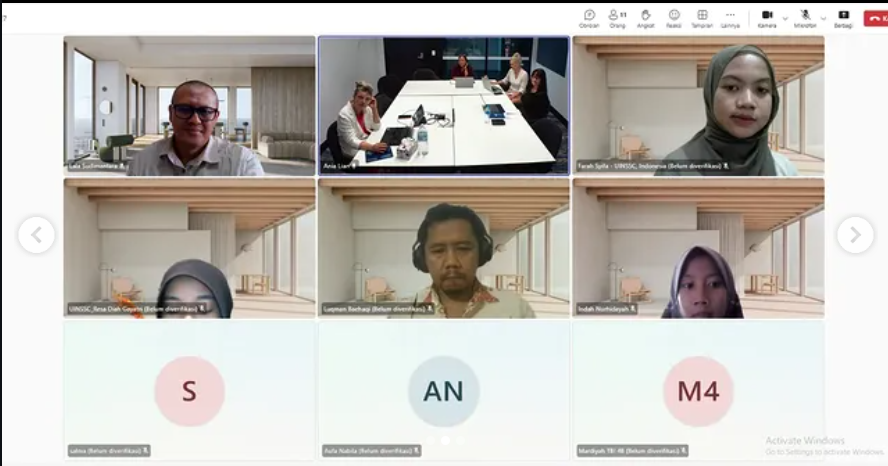
Reflecting on the purpose of the symposium, Lala Bumela Sudimantara, Ph.D. emphasized the importance of cultivating an academic culture grounded in dialogue rather than performance. He noted, “This mini symposium is not designed to showcase perfect presentations. It is a space where scholars and students learn to articulate their ideas clearly, question assumptions, and develop their thinking through conversation. Research becomes meaningful when it is tested through dialogue.” In this context, the symposium encouraged participants to practice articulating their research questions, defending conceptual frameworks, and responding to critique in real time. By creating a collaborative intellectual environment, the event allowed participants to explore the epistemic foundations of their research while simultaneously strengthening their academic communication skills—an ability increasingly recognized as essential for emerging scholars in global academic communities.
As the symposium progressed, discussions expanded beyond policy debates to address deeper pedagogical questions concerning the role of language, literacy, and texts in the lives of students. Participants explored the concept of “reading for emotions,” which proposes that reading should not be reduced to a technical activity focused solely on decoding words or mastering grammatical structures. Instead, reading was discussed as a complex cognitive and emotional process through which students develop empathy, interpret social realities, and construct meaningful responses to the world around them. Within this perspective, texts function not merely as instructional materials but as cultural and emotional environments that enable learners to build nuanced psychological maps of human experience. The symposium therefore critiqued educational practices that reduce literacy instruction to mechanical drills—such as repetitive vocabulary exercises or narrow curriculum targets—arguing that such practices risk stripping reading of its civilizational function as a medium of human understanding and communication.

To illustrate alternative possibilities for educational practice, the symposium highlighted examples of community-based learning initiatives in which students engage directly with social environments outside the classroom. In these models, students participate in the production of authentic texts, collaborate with community members, and contribute to shared knowledge within their social contexts. Through such experiences, learning shifts from passive knowledge acquisition toward active participation in cultural dialogue. Students begin to perceive themselves not simply as recipients of information but as contributors to broader social narratives. This transformation demonstrates that when education connects classroom learning with real social interaction, the process of learning becomes intertwined with the development of identity, responsibility, and civic engagement. The symposium thus underscored the potential of educational practices that integrate intellectual inquiry with meaningful social participation.
Concluding the event, Lala Bumela Sudimantara, Ph.D. reiterated the broader vision behind organizing the symposium. He stated, “Education systems must move beyond control and compliance. Sustainable education grows from dialogue—between teachers, students, institutions, and communities. When we allow ideas to be questioned and meanings to be negotiated together, education becomes a process of human development rather than administrative procedure.” The symposium ultimately highlighted that the future sustainability of education depends on a fundamental paradigm shift: from rigid institutional control toward open dialogue, from procedural compliance toward meaningful engagement, and from purely technical instruction toward a holistic understanding of education that integrates intellectual, social, and emotional dimensions of human learning. Through this international academic collaboration, the participants demonstrated how global dialogue can inspire new perspectives for building more reflective, humane, and sustainable education systems.
Author: Muhammad Azkiya Bahtsulkhoir