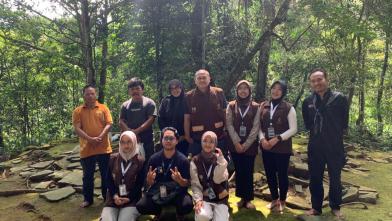
Reading the Mountain, Tracing Civilization: Mr. Sukad on Lingga Heritage, Kabuyutan Systems, and the Ecological-Spiritual Foundations of Sundanese Ancestral Knowledge in Sagarahiang, Mount Ciremai
Kuningan, April 25, 2026 – In the Public Lecture Academic Voices for Sustainable Earth: Seminar Series on Sustainability and Eco-Theology, organized by the International Office of UIN Siber Syekh Nurjati Cirebon in Sagarahiang, Mount Ciremai, Lala Bumela Sudimantara, Ph.D., Director of the International Office and Professor of Multisensory Learning advancing Regenerative Material ELT, positioned the academic encounter as a radical rethinking of how knowledge is produced, experienced, and embodied in the 21st century. He stated in his opening address, “This space in Sagarahiang is not an outdoor classroom in the conventional sense, but a multisensory epistemic field where learning emerges through sight, sound, bodily perception, emotional resonance, and affective awareness, allowing students to encounter knowledge as lived experience rather than textual abstraction.” The program featured Mr. Sukad, a key custodian of Sundanese cultural heritage in Kuningan, alongside the International Office team and 84 second-semester Literacy students, situating the Sagarahiang landscape as a living educational ecosystem where ecological awareness, cultural memory, and ancestral epistemologies converge into a unified holistic learning environment.
Mr. Sukad emphasized that one of the fundamental problems in contemporary knowledge systems is the reduction of ancestral landscapes into mere archaeological objects, detached from their original cosmological, ecological, and spiritual functions. He stated, “Lingga and kabuyutan are not relics of the past, but living systems of knowledge where human life, nature, and cosmic order are inseparably interconnected.” According to him, modern interpretations often fail to grasp that these sites once functioned as integrated frameworks of governance and environmental regulation, not as isolated artifacts. This epistemic reduction, he argued, represents a rupture between modern analytical thinking and the holistic worldview of Sundanese ancestors, in which knowledge was always relational, embodied, and grounded in lived ecological experience.
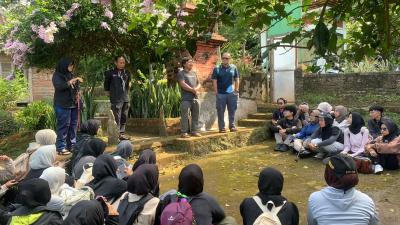
Mr. Sukad continued by asserting, “Mount Ciremai is a civilizational structure where the kabuyutan system regulates the relationship between life, nature, and spiritual order.” He explained that symbolic systems such as lingga–yoni represent cosmic balance and social harmony, reflecting an integrated worldview where humans are part of nature rather than separate from it. He described how spatial governance systems—larangan, tutupan, and baladahan—functioned as ecological regulations that ensured sustainability and ethical interaction with the environment. Springs such as Seke Sadel and Seke Menger, he added, served as foundational nodes of early civilization, marking the emergence of structured social life rooted in ecological awareness and sacred geography.
Building on these foundations, Mr. Sukad elaborated that the Sundanese ancestral system represents a fully integrated civilizational ecology in which knowledge, environment, and spirituality are inseparable. He explained that what is often perceived today as mythology or folklore is in fact a structured system of ecological governance encoded through symbolic language, spatial arrangement, and ritual practice. He emphasized that this system allowed communities to manage water resources, agricultural cycles, and social organization in alignment with natural rhythms, long before the emergence of modern environmental science. Through practices embedded in kabuyutan landscapes, ancestral society developed a form of environmental intelligence that ensured sustainability not through extraction or control, but through balance, restraint, and reverence toward nature as a living entity.
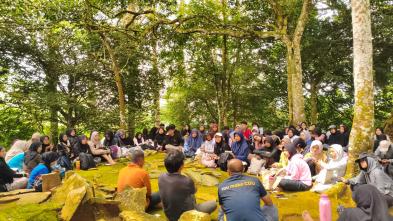
Mr. Sukad stated, “Ilmu gunung is an ecological science that teaches humans to read nature as a living system of signs, not as an object to be exploited.” He explained that this knowledge system is based on careful observation of rainfall cycles, seasonal transitions, and hydrological flows, which collectively maintain ecological stability. Systems such as Gentong Bumi and Gerhalang demonstrate advanced environmental planning that ensures water retention and distribution across landscapes. He further emphasized that the continuity of this knowledge is preserved through community custodianship, ritual traditions like Babari, and the lived dedication of local guardians who maintain the integrity of the site despite modern pressures. For him, safeguarding Sagarahiang means protecting an active epistemology that continues to function as a guide for ecological and cultural sustainability.
In his concluding reflection, Lala Bumela Sudimantara, Ph.D. stated, “True sustainability emerges only when knowledge is understood as a holistic integration of cognition, emotion, sensory experience, and ecological consciousness.” He emphasized that environmental ethics must be recognized as a lived framework rather than an abstract discourse, rooted in direct engagement with landscapes such as Sagarahiang. He further highlighted that decolonizing knowledge requires re-centering ancestral epistemologies that operate through multisensory and relational understanding, challenging the dominance of purely textual and rational paradigms. He concluded that the future of education lies in regenerative and holistic approaches where humans, nature, and knowledge are experienced as an interconnected continuum, forming the foundation of meaningful learning in the 21st century.