
Reawakening Ancestral Wisdom through Story: A Transformative Lecture by Mr. Sukad Unveils Carita Pantun as a Living Cosmological Knowledge System Rooted in Nature and Human Consciousness
Kuningan, May 2, 2026 — A meaningful public lecture themed Academic Voices for a Sustainable Earth: Seminar Series on Sustainability and Eco-Theology was held in Pasir Batang, Kuningan, West Java, at the foothills of Mount Ciremai. This event brought together 84 second-semester students in a reflective learning environment deeply connected to nature. The session centered on the exploration of Carita Pantun as an ancestral knowledge system, delivered by Mr. Sukad—a key custodian of Sundanese cultural heritage in Kuningan—as the main speaker. The lecture was further enriched by the presence of Lala Bumela Sudimantara, Ph.D., and Didin Mishbahuddin, S.Hum., whose perspectives complemented and expanded the discussion. Their contributions created a more holistic understanding by connecting cultural insight, academic reflection, and scientific interpretation. The natural setting itself fostered an atmosphere that encouraged deeper emotional and intellectual engagement. From the beginning, the session felt immersive, as if learning was not only heard, but also sensed and experienced. The lecture became more than an academic activity—it evolved into a moment of reconnection with cultural roots.
As the session developed, Mr. Sukad explained that Carita Pantun, particularly the story of Lutung Kasarung, should not be understood merely as folklore, but as a structured system of knowledge designed by Sundanese ancestors. He emphasized that each element within the narrative reflects patterns of causality, where every action leads to a consequence. This structure, according to him, functions as a form of life mitigation, allowing individuals to anticipate and understand outcomes. Rather than relying on formal formulas, knowledge is transmitted through narrative patterns and symbolic meaning. This approach challenges modern assumptions about how knowledge is constructed and delivered. It invites learners to see stories as carriers of deep wisdom. In this sense, storytelling becomes a method of learning, not just entertainment.
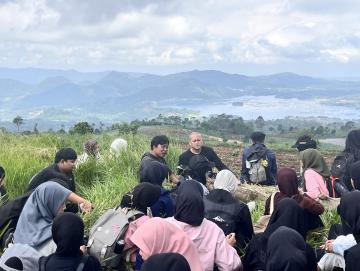
The lecture further explored the diminishing roles of traditional knowledge holders such as juru pantun and paraji, whose presence is increasingly rare in modern society. Mr. Sukad highlighted that while these figures still exist in certain communities, their epistemological roles are gradually being replaced by formal systems. This shift reflects a broader transformation in how knowledge is valued and transmitted. As he expressed, “What we are losing is not only the storytellers, but the way knowledge itself is lived and passed through generations.” This statement resonated deeply with participants, emphasizing the urgency of preserving oral traditions. It also raised awareness of the gap between modern education and ancestral knowledge. The discussion encouraged reflection on what is gained and lost in this transition. It positioned tradition as something that still holds relevance in contemporary life.
Another central theme of the lecture was the relationship between humans and nature, as reflected in Sundanese cosmology. Mr. Sukad explained the symbolism of Nyi Pohaci, who represents rice, not merely as a cultural figure but as an embodiment of ecological balance and equality among living beings. This perspective challenges the dominant view of humans as superior to nature. Instead, it positions nature as a subject that deserves respect and understanding. The lecture also redefined the concept of the forest, often perceived as a place of exile, into a space of learning, healing, and transformation. Through the story of Lutung Kasarung, the forest becomes a kamandalaan—a sacred space where individuals grow and reconnect with themselves. This interpretation revealed the restorative power of nature. It invited participants to reconsider their relationship with the environment.
Building on this understanding, Mr. Sukad introduced the concept of jagat alit (microcosmos) and jagat gede (macrocosmos), emphasizing the interconnectedness between humans and the universe. He explained that humans are not separate from nature, but reflections of a larger cosmic system. This idea was further illustrated through the interpretation of natural signs, where humans learn survival and adaptation through observation, intuition, and sensory awareness. Nature, in this sense, becomes both teacher and guide. The lecture also highlighted how knowledge in Carita Pantun is multisensory, involving seeing, hearing, and feeling. This approach contrasts sharply with modern education, which often prioritizes cognitive understanding alone. It suggested that true learning occurs when knowledge is experienced holistically. The discussion deepened participants’ awareness of how knowledge can be embodied.
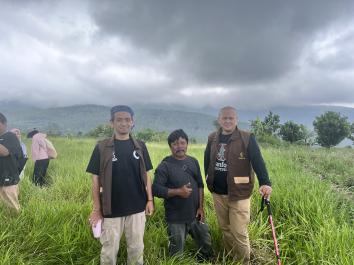
In its closing reflection, the lecture emphasized that Carita Pantun is not merely a story, but a living curriculum that integrates ecological awareness, philosophy, and human experience. Mr. Sukad reaffirmed that ancestral knowledge systems offer valuable insights for addressing contemporary challenges, particularly in understanding the relationship between humans and nature. As he concluded, “Lutung Kasarung is not just a story—it is a way of learning how to live, to feel, and to exist in harmony with the world around us.” This statement captured the emotional and philosophical depth of the session. It left participants with a renewed sense of awareness and responsibility. The experience extended beyond intellectual understanding, touching a more personal and reflective dimension. Ultimately, the lecture became a reminder that knowledge is not only something to be learned, but something to be lived.
Author: Salsabilla