
Reclaiming Ancestral Wisdom: UINSSC Initiates Grounded English Curriculum Innovation Through Non-Linear International Collaboration at the Sacred Landscape of Pasir Batang
Kuningan, May 23rd 2026 – Assoc. Prof. Lala Bumela Sudimantara, Ph.D., who serves as the lead researcher and lecturer in the English Language Teaching Department (Tadris Bahasa Inggris), as well as the Director of the International Office at UIN Siber Syekh Nurjati Cirebon, successfully organized an academic Focus Group Discussion (FGD) titled “From Erasure to Emplacement: Reclaiming Sundanese Ecotheology in Digital English Language Teaching”. Held in the Pasir Batang area, Kuningan Regency, the focus group discussion was attended by academics, education practitioners, alumni, students, and traditional leaders. They are Assoc. Prof. Lala Bumela Sudimantara, Ph.D. (Director of the International Office), Dra. Hj. Amroh Umaemah, M.Pd. (the Head of the English Language Teaching Department of UINSSC), Mr. Sukad (Conservationist and Elder of Pasir Batang), Didin Mishbahuddin, S.Hum. (Niskala Institute Archaeologist), and Intan Pusvitasari, M.Si (Physicology expert). Also, present were education practitioners such as Wulan Rahmatunisa, M.Pd, Dadang Setiawan, S.Pd, Nurfitri Habibi, M.Pd., Niyati Wulandari, S.Pd., Galang Adhitia Mahardhika, M.Pd., community representative Mela Nurhikmah, S.Pd., Farah Mutiara Riyadi, S.Pd., along with the staff and students of UINSSC’s English Language Teaching Department and Geeta Junior High School Cirebon.
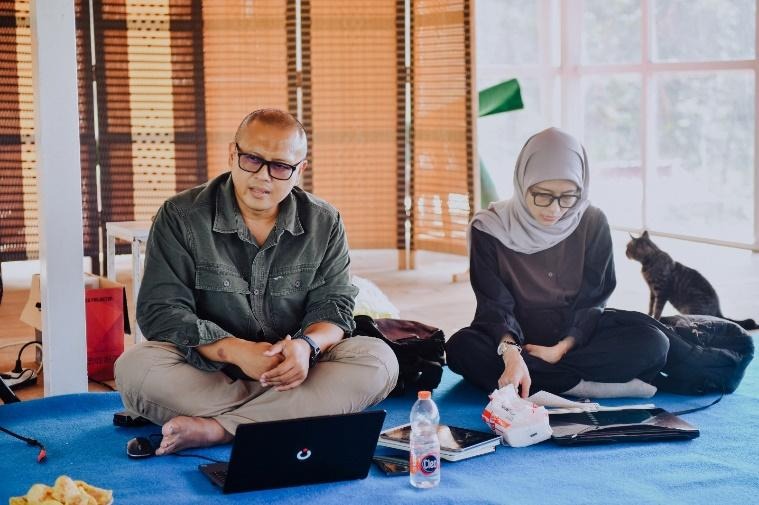
In the opening session, Lead Researcher Assoc. Prof. Lala Bumela Sudimantara, Ph.D. explained that this FGD represents a specific mission for curriculum innovation, specifically in the development of Digital Learning for English language teaching featuring ecotheological content from Sundanese Cosmology. He expressed deep concern regarding the current reality, where learning resources addressing such topics remain highly limited, while the educational sphere is instead dominated by pragmatic Western mindsets that lead to environmental destruction and moral degradation, such as the rampant issue of bullying.
To trigger an epistemological shift, he emphasized the urgency of building Knowledge Sovereignty so that ancestral knowledge is recognized as legitimate and valid through the integration of circular-spiral local wisdom within the BIMA Framework. Regarding this international web-based project, Lala Bumela Sudimantara, Ph.D. affirmed, “This project is about emplacing digital English language teaching within the ancestral intelligence and local wisdom of our community.” He also criticized the implementation of conventional Deep Learning, which often stagnates at mere literal grammar and vocabulary aspects.
The speaker presentation session began with Mr. Sukad, who thoroughly dissected the ecological structure of Mount Ciremai through the analogy of human inner harmony, where the mountain’s spatial layout is divided into Larangan (restricted), Tutupan (protected), and Baladahan (utilization) zones. As an elder who understands the Ciremai landscape, he explained how slope gradient calculations are used precisely to measure the protective radius around sacred springs such as Ibu Pertiwi, Seke Sadel, and Seke Menger to maintain the earth’s reservoir capacity.
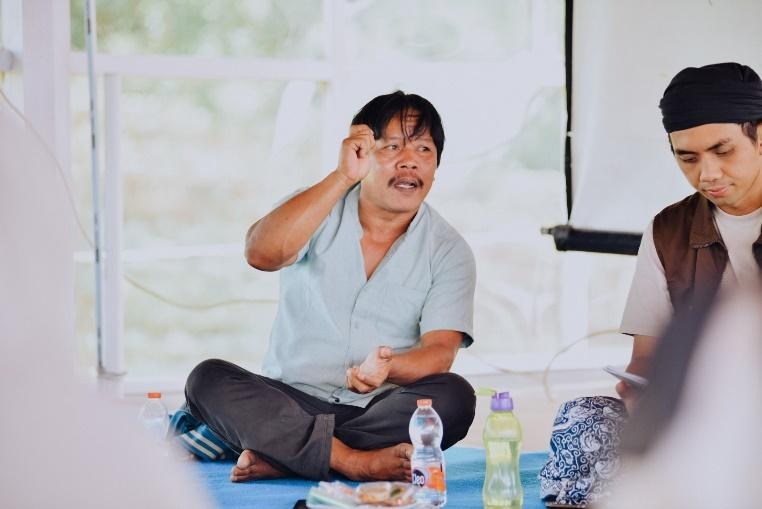
Mr. Sukad also elaborated on local wisdom regarding signs of geological faults on river cliffs and the philosophy of Sanghyang Sangga Winata, which teaches humans to care for themselves and preserve the four main elements of nature: wind, water, earth, and fire. Responding to natural phenomena, Mr. Sukad corrected the public’s misconceptions by asserting, “Volcanic eruptions are a form of the mountain’s devotion to its Creator. The eruption results in volcanic ash that can serve as natural fertilizer to enrich the soil for 32 years, while the sand and rocks become building foundation materials used by humans, there is no waste in this process. Nature is never wrathful, it is humans who are wrathful.”
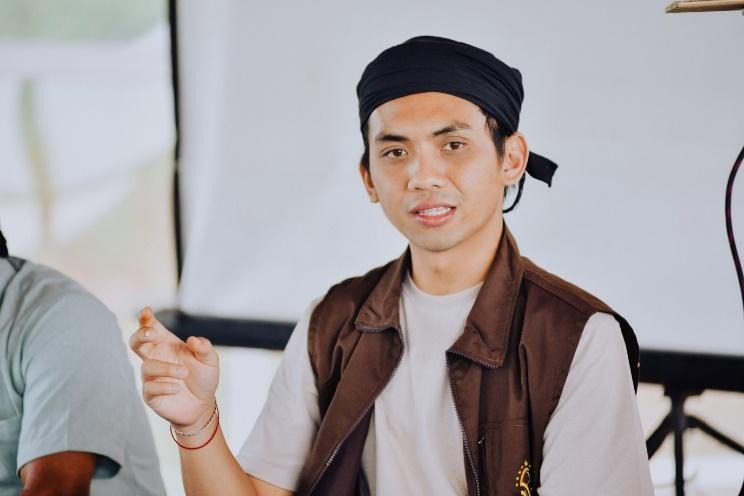
The next speaker, Didin Mishbahuddin, S.Hum., analyzed Carita Pantun such as Lutung Kasarung, Ciung Wanara, and Nyi Mas Sumur Bandung from an archaeological perspective as a layered knowledge repository that records life guides, disaster mitigation, and soil characteristic mapping through real geographical landscapes, and noting that the Lutung Kasarung manuscript holds the highest stratum because it serves as the primary guide for ngahuma (swidden agriculture). Didin Mishbahuddin, S.Hum. elaborated that the plot and characters in this oral tradition are not superstitions, but highly rational symbols of science, stating, “Carita Pantun has many layers of knowledge, more than just romance stories; there is ethical learning on how to behave and correlate with the original spatial layout, and of course, there are specific purposes there, such as disaster mitigation.” He also explained the sacred position of the Juru Pantun (traditional storyteller) as a bearer of ancestral messages and a connector of the past, present, and future, alongside the Paraji (traditional midwife/healer) as a connector between the spiritual realm of the womb and the physical world, were two sacred professions positioned just below the gods.

Next, Intan Pusvitasari, M.Si. introduced the Physicology framework, which marries the principles of physics with psychology to build regenerative humans and heal the inner self from the impacts of the Western linear mindset, which often triggers anxiety and emotional fragility in adolescents. Through the analysis of the Lutung Kasarung story, the character of Purbasari is viewed as an ideal psychological support system, where her exile in the forest represents a phase of mechanical incubation and noise reduction to recalibrate the inner system through the power of silence with Guru Minda. Intan explained how local wisdom values such as Silih Asah, Silih Asih, and Silih Asuh blend with Stoic principles and the laws of emotional mechanics to create stable emotional regulation, emphasizing, “Building regenerative humans cannot rely solely on Western linear approaches but must also incorporate local wisdom approaches that are circular-spiral.”
The discussion atmosphere grew increasingly dynamic during the Q&A session as education practitioners raised crucial questions regarding traditional learning methods, the correlation between educational philosophy and the ngahuma tradition, and strategies for teaching international English while remaining rooted in cultural locality for Generation Alpha. In response to these questions, the speakers provided practical solutions ranging from creating an emotional inner safety valve through daily journal writing to implementing the MCALL (Multisensory Computer Assisted Language Learning) method to expand students’ semiotic horizons outside the classroom. Regarding the vital role of an educator in contextualizing the curriculum beyond conventional standards, Lala Bumela Sudimantara, Ph.D. delivered an affirmation that motivated the teachers in the room by stating a principle: “Curriculum doesn’t matter, the teacher does. The teacher is the main component of learning.”
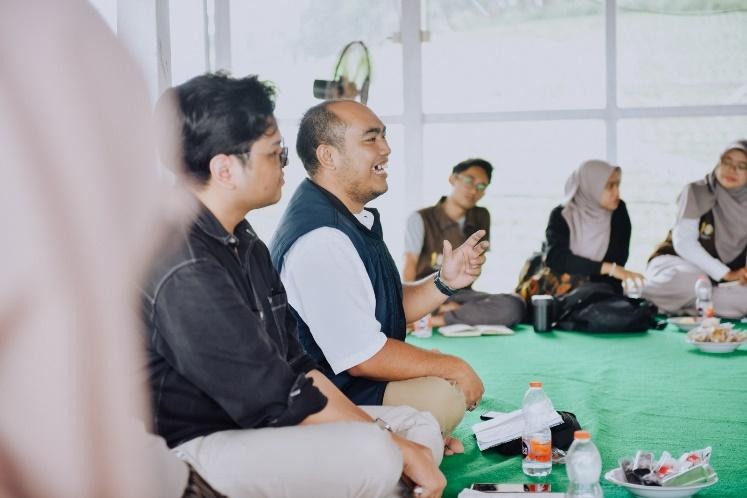
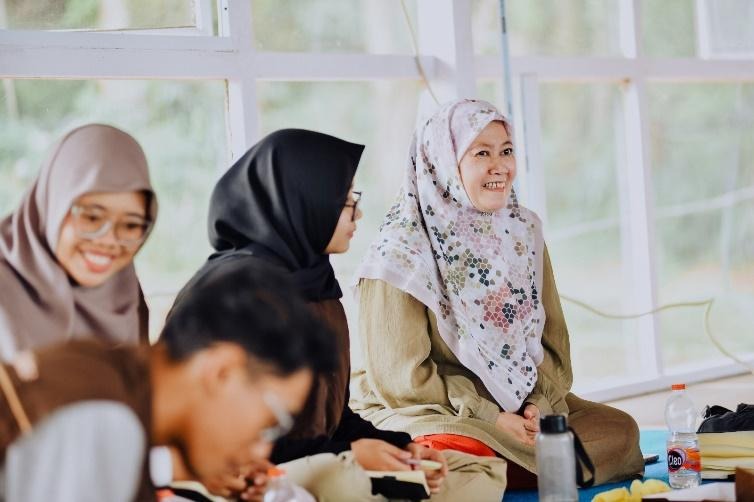
The Head of the English Language Teaching Department of UINSSC, Dra. Hj. Amroh Umaemah, M.Pd., expressed an outpouring of happiness, gratitude, and deep appreciation for the organization of this highly enlightening and horizon-broadening scientific discussion. She emphasized that the opportunity to sit together with keepers of knowledge and cross-disciplinary experts provides an incredibly valuable learning space, as well as a transformative momentum for the academic future of the department she leads. With utmost sincerity before the forum, Dra. Hj. Amroh Umaemah, M.Pd. expressed her gratitude, “I express my joy in being able to participate in this activity and learn so much from those who are experienced.” She also expressed her gratitude for the opportunity given to ELTD students to attend this event.
Following the formal sessions, the FGD transitioned from conceptual dialogue into a tangible, shared physical experience. Recognizing Pasir Batang not merely as a venue but as a sacred starting ground for this educational shift, all participants journeyed together into the surrounding landscape. This specific terrain is deeply revered and believed by local tradition to be the actual, physical landscape where the legendary Carita Pantun Lutung Kasarung took place. This pilgrimage beautifully embodies the deep-rooted philosophy of the Sundanese community, which asserts that one should not discuss or unpack a certain matter before physically coming to the very place where that knowledge originated. By stepping out into this living repository, the participants engaged in a literal "emplacement" of knowledge, directly experiencing the environment that shaped the very ancestral ecotheology they had spent the morning discussing.
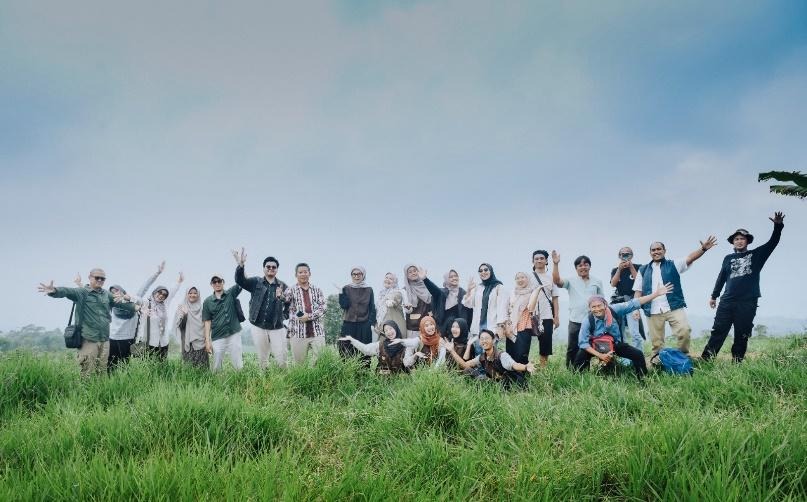
Ultimately, the true essence of this gathering underscores Assoc. Prof. Lala Bumela Sudimantara’s firm belief that reshaping international education cannot be achieved through isolated efforts or grand, short-lived projects. Instead, it requires a commitment to small-scale yet consistent and highly impactful collaboration. By working hand-in-hand with academics and experts across non-linear disciplines, this initiative proves that genuine academic transformation thrives at the intersection of diverse fields. It is these steady, interdisciplinary collective actions that bridge ancestral wisdom with modern pedagogy, demonstrating that even the smallest consistent steps can create a lasting ripple effect for future generations.
Author: Resa Diah Gayatri