
Reframing International Internship as Epistemic Practice: UINSSC Students in the Global Tapestry of Alternatives Engagement on Sundanese Ecotheology
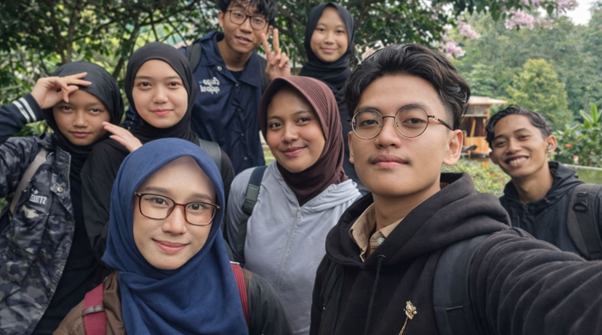
Cirebon, April 12, 2026 — The International Office of UIN Siber Syekh Nurjati Cirebon, under the intellectual direction of Lala Bumela Sudimantara, Ph.D., in collaboration with the elders of Sagarahiang, Kuningan, West Java, co-hosted a global delegation of the Global Tapestry of Alternatives (GTA) centered on Sundanese mountain ecotheology. The gathering convened approximately 70 participants representing 23 countries, including Indonesia, the United States, the United Kingdom, Colombia, India, Mexico, New Zealand, Argentina, South Africa, Denmark, France, Spain, the Philippines, Nepal, and Kenya, alongside other global participants within the network. At the heart of this engagement were UINSSC international internship students, Muhammad Azkiya Bahtsulkhoir, Indra Maulana Arfan Ajiz, Bilqis Syifa Shoraya, Muhammad Haikal, Khesya Nazwa Nur Sy'bani, Sri Arkati, Shilfa Sholitun Nisa, and Shena Valentina Qisti, whose responsibilities spanned documentation, notulensi, on-site guiding, as well as the production of Instagram Reels and institutional press releases. Their presence transformed the event into a dynamic site of knowledge mediation. As Lala Bumela Sudimantara, Ph.D., emphasized, “What we encounter here is not merely heritage, but a living epistemology, one that must be experienced, interpreted, and communicated across worlds.”
Yet, this immersive engagement revealed a critical tension within conventional understandings of internship. Tasks such as documenting, note-taking, guiding, and producing digital media are often perceived as technical or auxiliary functions. However, within the Sagarahiang encounter rooted in an ancient Sundanese eco-theological cosmology, these roles proved insufficient when reduced to mere procedures. The epistemic depth of Sagarahiang, historically known as a Kabuyutan or sacred center of learning at the foothills of Mount Ciremai, structured through the ecological zones of Larangan, Tutupan, and Baladahan, resisted simplification into linear documentation or surface-level narration. Moreover, the conception of mountains as kanagaraan, the civilizational axis from which life and meaning emerge, challenged dominant educational paradigms that detach knowledge from its ecological and spiritual foundations. This revealed a deeper disjunction: that modern systems often fail to recognize the intellectual and interpretive labor embedded within so-called “support roles."
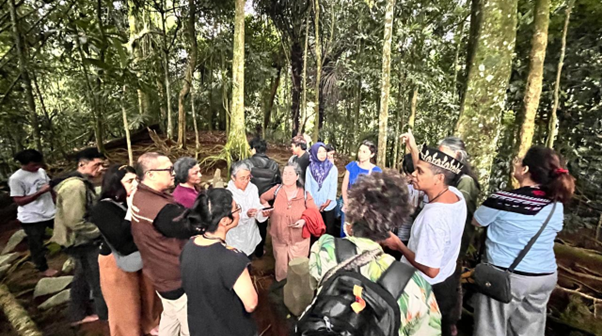
In response, a critical and transformative dialogue unfolded. Lala Bumela Sudimantara, Ph.D. articulated a reframing that resonated across cultures, stating, “To document is to decide what becomes history; to write is to shape how knowledge survives; and to guide is to translate worlds, not just directions.” This perspective reoriented the internship students’ understanding of their roles. Documentation became narrative construction, notulensi evolved into epistemic selection, and guiding transformed into intercultural mediation. Even the production of Instagram Reels emerged as a form of condensed storytelling where fragments of Sundanese ecotheological wisdom were translated into visually compelling narratives accessible to global audiences. Through continuous interaction with delegates from diverse national and epistemic backgrounds, the students found themselves situated at the intersection of local cosmology and global discourse, actively negotiating meaning across boundaries.
As the program unfolded, these practices converged into a multisensory and regenerative learning experience in situ, dissolving the boundaries between observation, participation, and interpretation. Through engagement with sacred landscapes, oral narratives, and symbolic sites such as the Lingga-Yoni, an ancient marker of fertility and cosmological balance participants encountered knowledge as lived and embodied reality. Crucially, this encounter revealed that what contemporary discourse identifies as eco-theology is not a modern theoretical construct, but an ancient epistemological foundation deeply embedded within Sundanese civilization. Long before its articulation in global academic frameworks, Sundanese cosmology had already integrated ecology and theology into a unified worldview, wherein nature is understood as a living manifestation of divine order. This realization repositions eco-theology not as innovation, but as rediscovery, an epistemic memory resurfacing through lived engagement. Within this process, the internship students became active participants in this rediscovery, translating its meanings through their practices of writing, guiding, documenting, and digital storytelling.
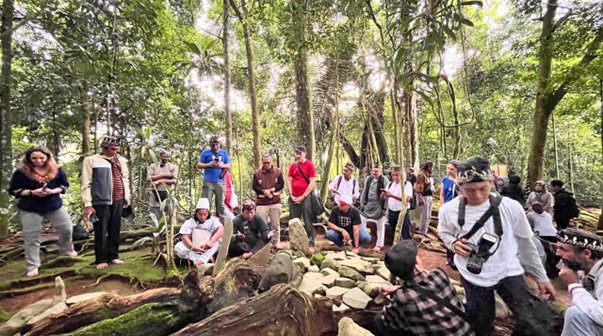
By the conclusion of the engagement, the cumulative contributions of the internship students had generated a multilayered and globally accessible narrative of Sagarahiang and its ecotheological significance. Their documentation, structured notulensi, guided interactions, Instagram Reels, and press releases collectively functioned as epistemic bridges, linking local knowledge systems with international audiences. Through their work, the Global Tapestry of Alternatives delegation encountered Sagarahiang not merely as a geographical site, but as a coherent and communicable epistemic landscape. In this sense, the internship evolved into a critical infrastructure for global knowledge circulation, demonstrating that intellectual contribution is not confined to formal discourse alone, but is equally enacted through media production, narrative framing, and lived intercultural engagement.
At its deepest level of meaning, this experience redefines the ontology of internship as an epistemic and transformative practice within higher education. As Lala Bumela Sudimantara, Ph.D. reflected, “When students are entrusted not only with tasks but with meaning, internship becomes a space where knowledge is not consumed, but created.” This insight extends beyond the instrumental frameworks of the Sustainable Development Goals, pointing instead toward a deeper civilizational reorientation grounded in awareness, relationality, and ecological consciousness. The presence of Prof. Rudolf Wirawan from the University of Adelaide further amplifies this trajectory through the envisioned development of a StoryPathway, grounded in the BIMA Framework, Bridging Intelligence, Mindfulness, and Awareness aimed at expanding the global recognition of Sagarahiang and its cosmological heritage. Ultimately, what emerges is a powerful rearticulation: that through acts of documenting, writing, guiding, and creating, students do not merely assist knowledge, they participate in its unfolding, becoming mediators between worlds, histories, and futures
Author: Muhammad Azkiya Bahtsulkhoir